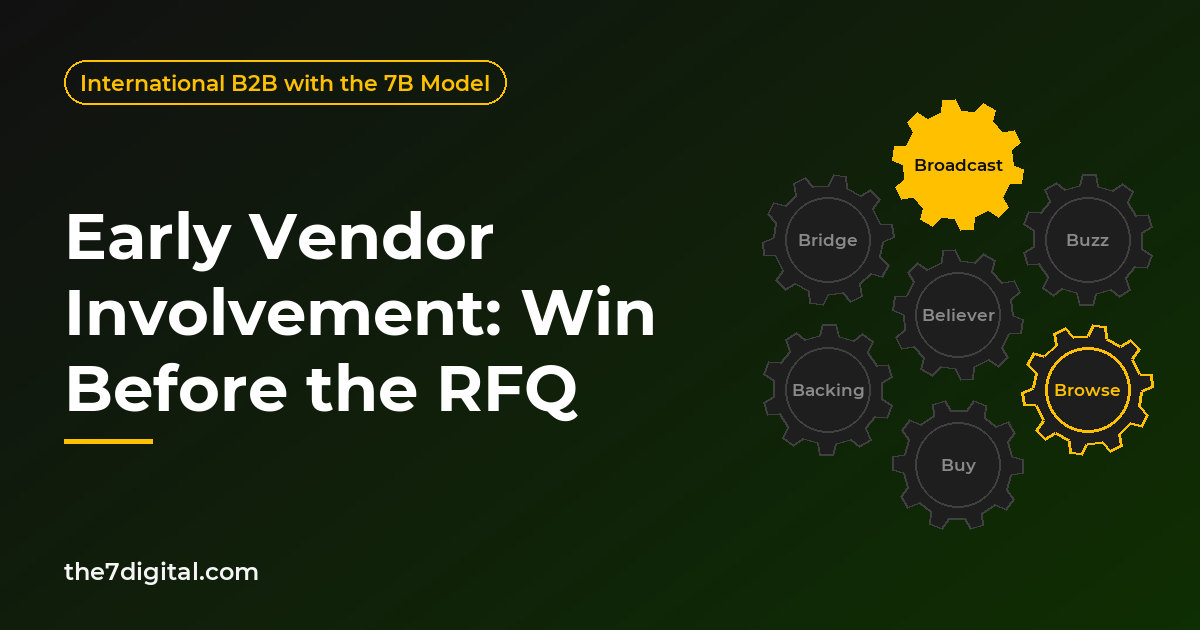
Summary: Early vendor involvement (EVI) means working with a customer’s engineers while the product or project is still being designed, before the specification is frozen and the RFQ goes out. Whoever helps write the spec is halfway to the contract. In the 7B Model, EVI is Broadcast aimed at engineers, verified through Browse.
Picture a sales director at a European valve maker opening an RFQ from a contractor building a factory outside Hanoi. The datasheet asks for a body material, a pressure class and a test standard that read like a page from a rival’s catalog. She will submit a careful price and lose, because the decision she is bidding on was made eighteen months earlier, when the plant’s engineers sat down with someone else.
Most companies treat the RFQ as the start of a sale. In technical B2B it is closer to the end. By the time procurement sends it, engineers have chosen the materials, tolerances and standards, and every one of those choices quietly decides who can win.
This article explains what early vendor involvement is and how to get into a specification before it sets, with a Chinese case, a playbook for markets where you have no office, and a closing section on Vietnam and ASEAN.
Why is the specification the real battlefield?
Read a specification the way its author wrote it. A design engineer picks a material, a tolerance band, a test method and a standard, and each pick opens the door to a few suppliers and closes it on the rest. Under deadline pressure, engineers copy what they trust: a familiar datasheet, a past project that worked, a conversation with a supplier’s engineer. Procurement arrives afterward, looking for whoever can meet what is already written.
Academics call this early supplier involvement in new product development. Handfield, Ragatz, Petersen and Monczka (1999), writing in California Management Review, list what buyers can get from it: lower cost, shorter concept-to-customer time, better quality and access to new technology. Sellers, especially in steel and automotive, call the same thing early vendor involvement.
In 6sense’s 2025 survey of nearly 4,000 B2B buyers, first contact with a seller came 61% of the way through the buying process; 94% had already ranked their shortlist, and 77% bought from the vendor at the top. Engineers behave the same way. GlobalSpec and TREW Marketing (2026) found that 62% of the buying process happens online before technical buyers engage with sales.
The same study found that 70% of technical buyers pick the better-known brand when two solutions are technically similar (GlobalSpec and TREW Marketing, 2026). When the spec cannot separate suppliers, the name already in the engineer’s head does the separating. That is mental availability, and it is built long before any project exists.
Do not write procurement out of the story. Forrester (2026) reports that procurement professionals are decision-makers in 53% of business buying cycles and engage from the start. They too need early proof that you can deliver, hold a price and keep their supply chain from getting fragile.
I think of a specification as freshly poured concrete. While it is wet, whoever stands close can leave a handprint. Once it sets, latecomers can only measure whether they fit the mold. Early vendor involvement is the discipline of standing close while the concrete is wet.
How does a steelmaker get into a carmaker’s drawings?
Automotive sheet steel is the clearest place to watch EVI at work, because the grade of every stamped part is chosen while the car is being designed. The best documented case I know comes from China.
Baosteel: Selling steel while the car is still a drawing
Baosteel (Baoshan Iron & Steel) in Shanghai told its EVI story in a 2018 paper in the journal Iron and Steel, written by engineers from its own research institute (Lu Jiangxin et al., 2018). It is a self-portrait, but a specific one: exploratory technical service for auto sheet from 1996, the early involvement concept in 1998, a first systematic EVI system by 2000.
The formative project came in 1999. Nanjing Yuejin, developing its first passenger car, could not stamp some complex parts and asked Baosteel for a steel that formed better than super-deep-drawing grade. Baosteel looked past the request. Using forming simulation for the first time, it worked with the carmaker on material selection, blank size, die tryout and stamping, and the parts were trial-produced from ordinary super-deep-drawing steel. Die tryout took far less time and material costs fell sharply.
The customer asked for a better steel. What it needed was a part it could stamp. That gap is where early involvement lives, and a supplier who closes it, even by selling a cheaper grade, gets called in earlier on the next project.
Between 2001 and 2003, as FAW Haima became Hainan Mazda and developed the Fumeilai, Baosteel joined a three-way team with the carmaker and its die maker from the start, analyzing formability and die manufacturability and supplying grades and performance data. Baosteel sheet became the design material for the new car, and material certification ran alongside part and die development instead of after it.
For anyone selling across borders, the key detail comes from 2002. When the Changan Ford joint venture prepared the Fiesta for production, Ford, long used to EVI with major North American steelmakers, readily accepted Baosteel’s approach and asked it to join die acceptance, Baosteel’s first EVI assignment abroad. A customer that runs EVI at home will open the door to a supplier that speaks the same process language.
Over twenty years, from 1996 to 2016, the practice was codified as a “532” pattern: five support phases from advanced engineering to cost optimization, three levels from body in white to VA/VE, and two solution types, cost-driven or lightweighting. EVI also went into strategic agreements with Dongfeng Renault in 2014 (SteelOrbis, 2014) and NIO in 2022 (Gasgoo, 2022).
The authors observe that the earlier and deeper a supplier engages with customer needs, the more value it can create, enough to step beyond a steel transaction. Baosteel did not win on cheaper steel. It won by being in the drawing.
How do you get in before the RFQ in a market you do not live in?
Baosteel’s story played out mostly with carmakers in its own country, a short trip away. If your engineers sit in Lyon or Osaka and the plant is being designed for a site in Binh Duong, you cannot stand next to the drawing board. You need the customer’s engineers to know your name before the project starts, and to be able to verify you within minutes once it does.
Start where engineers already read. GlobalSpec and TREW Marketing (2026) found that 76% of technical buyers routinely research on online technical publications, for the first time ahead of supplier websites (74%). An application note in a trade publication your targets read, under your engineer’s name, does more Broadcast work than ten unread blog posts. Keep the rhythm steady even with no project in sight, for the reasons covered in the 95/5 rule.
Paid media shortens the seeding time. LinkedIn’s Marketing API documentation on Microsoft Learn (2026) lists targeting facets such as job function, seniority, title, skills, field of study and location, enough to put an application note in front of design engineers at OEMs in a single country. The7 runs this kind of program as part of its full-service digital marketing in Vietnam, with one rule: promote engineering content, not sales pitches.
On YouTube, Google Ads custom segments can reach people who searched for terms you choose on Google properties such as Google.com and YouTube (Google Ads Help), so a video of a real test can reach the engineer who just typed the name of a material grade. To have one team run both channels as one machine, see The7’s comprehensive digital marketing services.
No platform replaces people already in the room. A distributor with application engineers, an EPC contractor or a local design house can carry your name to the drawing board faster than any campaign. That is the Bridge gear at work.
What technical content makes a foreign engineer call you first?
Content that gets you invited early has one thing in common: engineers can use it in their own work. In 2013 Texas Instruments opened its TI Designs library with about 150 reference designs, each with test data, a schematic or block diagram, a bill of materials and design files, alongside PowerLab’s more than 1,000 tested power management reference designs (eeNews Europe, 2013). An engineer who starts from a reference design starts with the vendor’s parts already in the bill of materials. That is early involvement delivered by content.
A mid-sized manufacturer does not need a library that big; what it needs is B2B content marketing written for engineers. I usually start with six assets:
- A selection guide for materials or processes that says plainly when not to choose you.
- Real test data, with the standard and test conditions stated.
- CAD files, sample drawings and calculators that download without a form.
- Ready-to-paste requirement text written around performance and international standards.
- Failure analyses of common problems, with photos and measurements.
- Videos of real tests, explained by your own engineers.
Who speaks matters as much as what is said. GlobalSpec and TREW Marketing (2026) found that 66% of technical buyers rate engineering experts at vendor companies as very or extremely trustworthy. Let your engineers sign the articles, appear on camera and answer questions; keep sales in the background until the other side is ready to talk terms.
And do not lock these assets behind forms; the 7B Model book (chapter 6) calls this giving value on the spot. A drawing downloaded today can sit in a project folder for two years. Baosteel’s 1999 lesson applies to content too: the most persuasive asset is a solution to the customer’s problem, even when it means you sell less.
Is EVI lock-in an advantage or a risk?
Both, for both sides. For the seller the reward is obvious: once a part is designed around your material or process, switching means retesting, recertifying and delays. The cost is just as real. Engineering hours go into projects that may be cancelled, the drawing you improved can end up with a cheaper rival, and know-how you share may never come back.
Buyers know the risks of dependence too. Handfield and colleagues (1999) noted that not all supplier involvement efforts succeed, and that leading companies run a formal, in-depth supplier evaluation and risk assessment before a supplier joins the project team. An EVI invitation is earned after verification.
In public procurement the limit is written into law. Article 42 of the EU public procurement directive 2014/24/EU requires technical specifications to give suppliers equal access and bars references to a specific make, source or process that would favor or eliminate certain companies, unless justified, in which case the words “or equivalent” must follow. Vietnam has a similar rule, covered below. With public buyers, real EVI means helping write performance requirements and test methods, not getting your brand written in.
So I separate two kinds of lock-in. Lock-in by paperwork, a specification only you can meet, invites procurement to break it next time. Lock-in by performance, where the customer stays because leaving means losing a partner who solves problems, lasts and moves the customer into the Believer gear. To get there, go deep with a few target accounts, the logic of account-based marketing, instead of spreading engineering hours thin.
Where does early vendor involvement fit in the 7B Model?
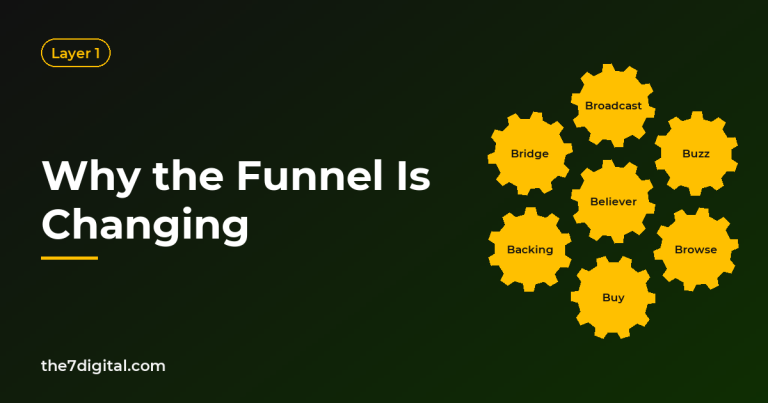
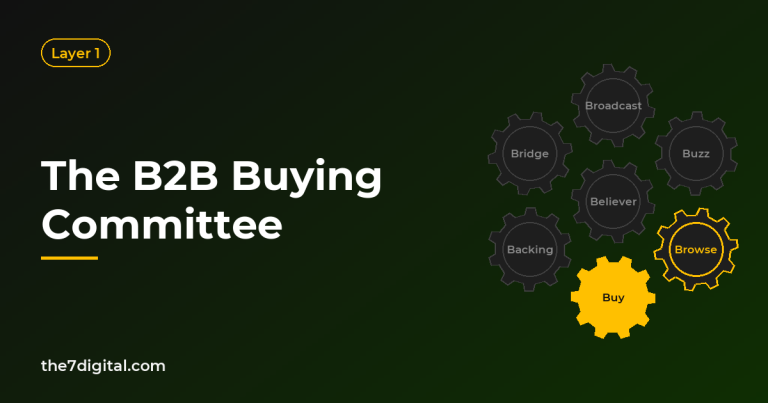
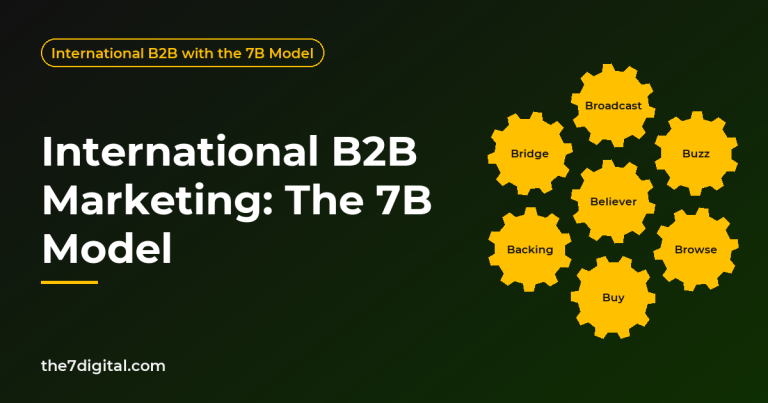
Early vendor involvement turns two gears. The Broadcast gear: Seeding valuable presence into the market, clear, steady and sharp enough that the right people know you exist. In EVI, the right people are design engineers, application engineers and spec writers, a group most marketing target lists leave out.
The Browse gear: Where emotion meets reason: buyers verify and compare you through six gateways. An engineer who reads your name in a trade publication goes on to check you through search, conversational AI, LinkedIn or YouTube (7B Model book, chapter 8). If those doors are empty, the signal dies there: one stuck gear slows the whole flywheel.
Across the three operating layers, EVI starts in demand creation and ends in demand capture: the RFQ belongs to Buy, but its content was settled in Broadcast and Browse. Across the three energy flows, paid is advertising aimed at engineers, owned is your technical library, and earned-and-shared is an engineer forwarding your drawing to a colleague, mostly through dark social.
This article does not launch a new tool. If you filled in the 7B Buying Table Map from the cross-cultural buying council, add one column: when each person touches the specification. The 7B Model was developed by Nguyen Dinh Bao (Bao7) at The7 Digital and is set out in full in the book Mô hình 7B cho B2B (Stop Begging, Start 7B). Every term is in the 7B Glossary; newcomers can start with what the 7B Model is.
Selling B2B into Vietnam and ASEAN
Vietnam is a market where specifications are being written right now. Registered foreign investment reached US$50.36 billion as of September 30, 2026, up 76.4% year on year, and disbursed FDI in the first nine months reached an estimated US$21.07 billion, up 12.1% (NSO, 2026). Every new plant behind those numbers needs equipment, materials and components, and each of them is specified before it is bought.
The import data points the same way. Production inputs made up 93.6% of Vietnam’s merchandise imports in 2025, worth US$426.11 billion (NSO, 2026), and imports in the first nine months of 2026 rose 36.7% to US$453.72 billion (NSO, 2026). Most of what foreign suppliers sell into Vietnam goes into factories, exactly where engineers write specs.
Ask where the specification is written before you ask who signs the purchase order. Foreign-invested companies produced 77.3% of Vietnam’s exports in 2025 (NSO, 2026). For each target plant, find out whether the spec is set by the parent company’s engineering team, an EPC contractor or a local design institute. EVI for a plant in Vietnam may need to start in Seoul, Osaka or Shenzhen.
Public projects follow tighter rules. As the procurement newspaper Báo Đấu thầu (2025) explains, Vietnamese bidding documents may not require a specific brand or origin of goods except in cases the Law on Bidding allows, and where goods cannot be described in detail, a brand or catalog may be cited only with the words “or equivalent”. Shape the performance requirements and test methods, and make sure your local partner can prove equivalence fast.
Language and channels differ across the region. EF’s 2025 English Proficiency Index ranks Vietnam 64th with a score of 500, and technicians and maintenance staff score 467 (EF EPI, 2025), so the documents a plant’s maintenance team will use should come in Vietnamese. LinkedIn’s ads reached 13.5% of adults in Vietnam in late 2025, against 37.4% in Malaysia and 11.1% in Thailand (DataReportal, 2025, reports for Vietnam, Malaysia and Thailand). Where reach is lower, distributors with application engineers and local technical events carry more of the Broadcast load.
Conclusion: the contract is signed in procurement but written in engineering
Back to the valve maker’s RFQ from outside Hanoi. The price was not the problem; the timing was. The useful question next time is not how to quote faster but how to make the plant’s engineers know your name before the next line is drawn.
Early vendor involvement is not selling earlier. It is helping customers think earlier, so that when they write things down, there is room for you.
The previous article in the series, on Chaos Logic Theory, explains why no one can predict which touchpoint triggers a project. The next, on building a B2B marketing team, asks who captains each gear, including when the captain is an engineer. The pillar article on international B2B marketing with the 7B Model has the whole map, and YouTube for B2B shows how to turn a test into a video engineers watch.
Frequently asked questions
Is early vendor involvement the same as early supplier involvement?
Yes, in substance. Academics and procurement teams tend to say early supplier involvement, as in Handfield and colleagues (1999); sellers in steel and automotive tend to say early vendor involvement, which is how Baosteel names its system. Both mean a supplier working with the customer from the design stage, before the specification is frozen.
Can a small supplier do EVI?
Yes, if it chooses narrowly. You need a few target accounts with real projects, a technical library that downloads without a form, and one or two engineers willing to write and speak. Small-company EVI usually starts with one good answer to one specific problem, which then gets forwarded around the customer’s engineering team.
When should a supplier get involved in a customer’s project?
As close to the concept stage as possible, and no later than design freeze. Watch for new product programs, new plants, cost-down redesigns and changes of standard. Ask the customer’s engineers for the design freeze date; after it, you are only invited to quote.
How do you measure early vendor involvement?
Use the four signals from the 7B Model book (chapter 14): branded search volume, answers to an open “How did you hear about us?” question, engagement quality, and the content customers touched before closed deals. Add two counts of your own: projects where you were asked for input before the RFQ, and specifications that carry a grade or standard you proposed.
International B2B with the 7B Model · Part 4 of 24 · Previous: The Cross-Cultural Buying Council · Next: Building a B2B Marketing Team: Who Captains Each Gear? · Pillar article: International B2B Marketing: The 7B Model
References
- Handfield, Ragatz, Petersen and Monczka (1999). Involving Suppliers in New Product Development. California Management Review, 42(1). https://cmr.berkeley.edu/1999/11/42-1-involving-suppliers-in-new-product-development/
- 6sense, summarized by CustomerThink (2025). Research Round-Up: 6sense Study Provides Critical Insights on B2B Buyer Behavior. https://customerthink.com/research-round-up-6sense-study-provides-critical-insights-on-b2b-buyer-behavior/
- GlobalSpec and TREW Marketing (2026). State of Marketing to Engineers 2026. https://advertising.globalspec.com/state-of-marketing-to-engineers-research-report
- Forrester (2026). Forrester’s 2026 Buyer Insights: GenAI Is Upending B2B Buying. https://www.forrester.com/press-newsroom/forrester-2026-the-state-of-business-buying/
- Lu Jiangxin, Chen Xinping, Bao Ping, Jiang Haomin, Shi Lei (2018). Technical service and EVI of automotive panel in Baosteel. Iron and Steel, 53(3). https://www.sciengine.com/doi/pdf/C722B81FDB07444BA4E82645F79F6BD6
- SteelOrbis (2014). Baosteel inks strategic cooperation agreement with Dongfeng Renault. https://www.steelorbis.com/steel-news/latest-news/baosteel-inks-strategic-cooperation-agreement-with-dongfeng-renault-828683.htm
- Gasgoo (2022). NIO teams up with steel producer Baosteel for supply chain, low-carbon tech. https://autonews.gasgoo.com/articles/ev/nio-teams-up-with-steel-producer-baosteel-for-supply-chain-low-carbon-tech-70019530
- eeNews Europe (2013). Texas Instruments releases the industry’s most extensive reference design library. https://www.eenewseurope.com/en/texas-instruments-releases-the-industrys-most-extensive-reference-design-library/
- Microsoft Learn (2026). Ad Targeting, LinkedIn Marketing API. https://learn.microsoft.com/en-us/linkedin/marketing/integrations/ads/advertising-targeting/ads-targeting
- Google (n.d.). About custom segments. Google Ads Help. https://support.google.com/google-ads/answer/9805516?hl=en
- European Parliament and Council of the European Union (2014). Directive 2014/24/EU on public procurement, Article 42. https://eur-lex.europa.eu/legal-content/EN/TXT/HTML/?uri=CELEX:32014L0024
- National Statistics Office of Vietnam (2026). Press release on the socio-economic situation in the third quarter and nine months of 2026. https://www.nso.gov.vn/du-lieu-va-so-lieu-thong-ke/2026/10/thong-cao-bao-chi-tinh-hinh-kinh-te-xa-hoi-quy-iii-va-9-thang-nam-2026/
- National Statistics Office of Vietnam (2026). Report on the socio-economic situation in the fourth quarter and full year 2025. https://www.nso.gov.vn/du-lieu-va-so-lieu-thong-ke/2026/01/bao-cao-tinh-hinh-kinh-te-xa-hoi-quy-iv-va-nam-2025/
- Báo Đấu thầu (2025). Trao đổi nghiệp vụ ngày 10/02/2025: Tiêu chí giấy phép bán hàng, quy chuẩn, tiêu chuẩn. https://baodauthau.vn/trao-doi-nghiep-vu-ngay-10022025-tieu-chi-giay-phep-ban-hang-quy-chuan-tieu-chuan-post173618.html
- EF Education First (2025). EF English Proficiency Index: Vietnam. https://www.ef.com/wwen/epi/regions/asia/vietnam/
- DataReportal (2025). Digital 2026: Vietnam. https://datareportal.com/reports/digital-2026-vietnam
- DataReportal (2025). Digital 2026: Malaysia. https://datareportal.com/reports/digital-2026-malaysia
- DataReportal (2025). Digital 2026: Thailand. https://datareportal.com/reports/digital-2026-thailand