Summary: Cross-industry innovation means borrowing a solution that already works in another industry and retranslating it for your own buyers, the way TK Elevator took a linear motor from a maglev train. In the 7B Model, the borrowed lesson feeds the Broadcast gear, and a partner from that other industry opens the Bridge gear.
By late January 2015, ten order pickers in a warehouse in Bergen op Zoom, in the Netherlands, had spent three weeks picking with smart glasses instead of hand-held terminals. They picked more than 20,000 items for 9,000 orders, and efficiency rose 25% over conventional picking with hand-held terminals (Logistics Manager, 2015).
Who brought what? The warehouse was Ricoh’s, a DHL customer. The headsets were Google Glass and Vuzix M100 (DHL, 2015), and Ubimax, a supplier of wearable computers, provided the glasses and software (Logistics Manager, 2015). DHL itself had published a trend report on augmented reality in June 2014, seven months before announcing the pilot (DHL, 2015). The technology did not come from logistics: DHL borrowed it from wearable-computer makers.
If you sell into Vietnam or ASEAN, your buyers probably hear the same pitch from every supplier who reads the same trade press, and the way out is often sideways. Last time, Rolls-Royce sells flying hours showed a supplier that changed how it gets paid. This article asks where ideas like that come from: an elevator that borrowed a train’s motor, maintenance that borrowed the cloud, what research says about outsiders, and how partners from other industries open the Bridge gear in Vietnam and ASEAN.
What did elevators learn from a maglev train?
The higher the building, the more shafts and floor space conventional elevators need (TK Elevator, 2024). Elevators and escalators can take up to 40% of a high-rise’s floor space (Thyssenkrupp, 2017). MULTI’s answer is several self-driving cabins in one shaft, circling in a loop like a metro, which, the company says, could raise the shaft’s transport capacity by up to 50%. The borrowed part is the motor: when thyssenkrupp broke ground on its Rottweil test tower in December 2014, it wrote that this became possible by applying the linear motor technology of the Transrapid maglev train (TK Elevator, 2014). Many vehicles, one track, no ropes: the elevator engineers’ job was to recognize that solution and retranslate it for a shaft.
TK Elevator: Cutting the rope with a train’s motor
The tower is Broadcast in concrete. The company invested more than 40 million euros in it (TK Elevator, 2014). On June 22, 2017, MULTI was inaugurated in the 246-meter tower, and almost 200 representatives of the building industry were due to attend (thyssenkrupp, 2017). By 2024 the company’s flyer still invited visitors up the viewing platform at 232 meters, Germany’s highest public one, from Friday to Sunday for 9 euros, and rented the tower out for events (TK Elevator, 2024). If you want the playbook behind a venue like this, read B2B events and trade shows.
The launch also named a first customer, OVG Real Estate, whose new Berlin building would get the very first MULTI (thyssenkrupp, 2017). Naming a customer is a promise; a building that runs the system is proof. In 2026, TK Elevator’s product page still calls MULTI the world’s first rope-free elevator but names no building that uses it (TK Elevator, accessed 2026).
In 7B terms, borrowing a train’s motor gave the company a memorable story and a tower to tell it from every weekend. But a story does not turn itself into a contract: Franke, Poetz and Schreier (2014) found that solutions from analogous markets are less ready for immediate use but substantially more novel. A test tower can be a 246-meter piece of Broadcast. Broadcast can spin fast. The Buy gear waits for proof.
What did predictive maintenance learn from cloud computing?
ThyssenKrupp Elevator sized the problem in 2015: 12 million elevators worldwide moving one billion people a day, and more than 190 million hours a year out of service because of maintenance interventions (ThyssenKrupp Elevator, 2015). A stopped elevator quietly takes time from everyone in the building.
On October 27, 2015, the company launched MAX. Real-time data from connected elevators flows to Microsoft’s Azure cloud, where an algorithm calculates the remaining lifetime of key systems and components. The stated goal was to halve out-of-service time, and in the first 18 months the company aimed to connect some 180,000 units in North America and Europe, with pilots in the US, Germany and Spain (ThyssenKrupp Elevator, 2015). Remote data, a cloud platform and predictive algorithms belong to the software industry. The elevator industry borrowed the kit.
Less than a year later it borrowed hardware too: on September 15, 2016, it announced that Microsoft HoloLens was set to support more than 24,000 of its service technicians, and initial field trials suggested a maintenance intervention could be up to four times faster, according to the company (thyssenkrupp, 2016). By 2018 it counted more than 120,000 MAX units worldwide and called MAX the elevator industry’s first real-time, cloud-based predictive maintenance solution (TK Elevator, 2018).
KONE took a parallel route. On February 8, 2017, it launched 24/7 Connected Services on the IBM Watson IoT platform, a year after KONE and IBM announced a multiyear agreement, and it aimed to connect more than 1 million additional elevators and escalators to the cloud (KONE, 2017).
Under a year and a half separates the two launches: two elevator makers borrowing the same idea from two different technology companies. A borrowed idea does not stay exclusive for long, but the story you tell first, with numbers behind it, does. That is the lesson of category design. You cannot own a borrowed idea. You can own being the one who explained it first.
Is cross-industry benchmarking a process or just inspiration?
Conventional wisdom says expertise in the target market is indispensable. The experiment by Franke, Poetz and Schreier (2014) points the other way: solutions from people in analogous markets were less ready for immediate use but substantially more novel, and the effect grew when the two markets sat further apart.
Outsiders see what insiders miss. In 166 science challenges with more than 12,000 scientists, the chance of a winning solution rose with the distance between the solver’s field of expertise and the field of the problem (Jeppesen and Lakhani, 2010).
Distance alone does not make a breakthrough, though. Enkel and Gassmann (2010) define cross-industry innovation as creative imitation: a solution that already exists in one industry is retranslated for the market or product of another, whether it is a technology, a process or a whole business model. Across 25 cases, they found no direct correlation between a greater or smaller cognitive distance and a more explorative or exploitative outcome. Inspiration is free. Translation is the work.
So I use a four-step process. It is my own, not a finding of those three studies: restate the customer’s problem in words outside your industry; find an industry that has lived with that problem longer; retranslate the solution and test it with one real customer; then tell it, with proof. The table applies it to the two cases above.
| Step | Question | MULTI | MAX |
|---|---|---|---|
| 1. Restate the problem | Strip the jargon: what is left? | Many vehicles on one track | Know before it breaks |
| 2. Find who solved it | Who has lived with it longer? | The Transrapid maglev train | Microsoft’s Azure cloud |
| 3. Retranslate and test | Where and with whom do you test? | A 246 m test tower; first customer named in 2017 | Pilots in the US, Germany, Spain |
| 4. Tell it | Who needs to know, with what proof? | The 2017 launch, a public deck | “Industry first”, 120,000 units |
I built the table myself from the sources above. Step 3 is the one people skip, because it needs a real customer willing to test.
How do you turn a borrowed lesson into thought leadership?
The Mô hình 7B cho B2B book (chapter 6) says pillar content never runs out of topics if you listen to three sources: the questions customers keep asking your sales team, the common mistakes in your industry, and successful cases. In my reading, a cross-industry lesson is the sharpest form of the second source: our industry does it this way, the industry next door already does it that way. A borrowed lesson arrives with a contrarian angle and a story built in. What it usually lacks is the sourced number (Mô hình 7B cho B2B book, chapter 7).
DHL shows how to add the number. Its June 2014 trend report came before it owned anything. The 2015 pilot put a customer’s name and words on the idea, with Ricoh speaking as Backing. By August 2017 the trials showed an average 15% productivity gain and onboarding time cut in half (Logistics Manager, 2017), and DHL was rolling the approach out to more warehouses.
That gives four moves: name the idea you borrowed, tell it with a real customer, publish the number with its conditions (how many weeks, how many people, compared with what), and keep telling it, because one launch is not a rhythm. B2B content marketing covers how to package and pace all this. A cross-industry lesson with no number is just a good anecdote.
How do partners from other industries open the Bridge gear?
The Mô hình 7B cho B2B book (chapter 12) calls strategic partners the fastest Bridge: you use an audience that already exists, and they use yours. A good partner serves the same customers without competing with you directly, through three forms: creating content together, selling together through referrals, and building an ecosystem together through product integration. A distributor sells your product, as choosing international B2B channels explains. A partner from another industry sells something else to the same buyer.
Look at Microsoft and thyssenkrupp. Microsoft’s COO was quoted in the 2015 MAX launch release (ThyssenKrupp Elevator, 2015). In September 2016, Microsoft’s own news site told the story of thyssenkrupp bringing HoloLens to its 24,000 service engineers (Microsoft, 2016). By 2018, 69 of the 337 elevators thyssenkrupp maintained on Microsoft’s Redmond campus, the busiest ones, ran MAX (TK Elevator, 2018).
I read two of the book’s three forms in that: ecosystem (MAX runs on Azure, HoloLens supports technicians) and something close to joint content (Microsoft told thyssenkrupp’s story to Microsoft’s audience). There is a bonus outside the three forms: a partner who is also a customer, whose campus can serve as a reference site. A story a partner tells on its own channel is earned credibility, not your advertising; B2B PR goes further into that.
Siemens and Sony: One headset, two audiences
On January 8, 2024, at CES in Las Vegas, Siemens and Sony announced a partnership: Siemens Xcelerator industrial software combined with Sony’s new spatial content creation system, built around an XR head-mounted display. Siemens said NX Immersive Designer, an integrated solution that combines its NX software with Sony technology, was expected to be available later in 2024 (Siemens, 2024). Sony’s page says NX Immersive Designer and the SRH-S1 headset would begin taking orders from Siemens starting January 23, 2025, that customers buy the headset through Siemens, and that a launch event was held in Japan on January 31, 2025 (Sony, 2025).
Sony reaches industrial engineers through Siemens’ sales channel. Siemens hands its customers a device from the electronics industry, and borrows that industry’s stage to announce it. How such a stage fits into the machine is covered in trade shows in the 7B machine.
Three tests for a partner from another industry, in my view: the same buyer but a different budget line; both sides gain a story to tell; and you can start with one piece of joint content, then count partner-sourced deals each quarter.
Where does cross-industry innovation fit in the 7B Model?
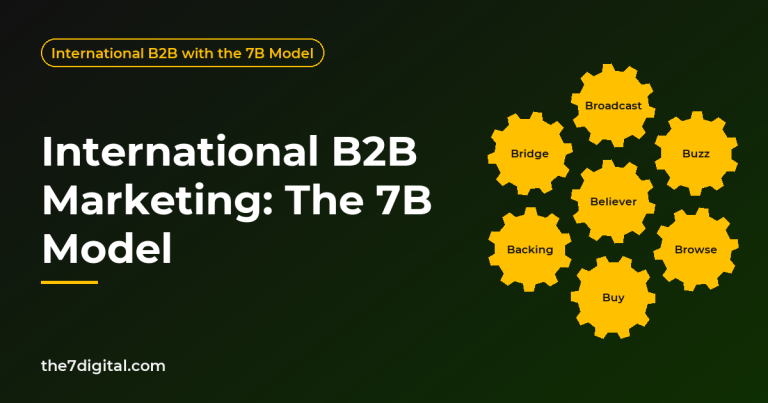
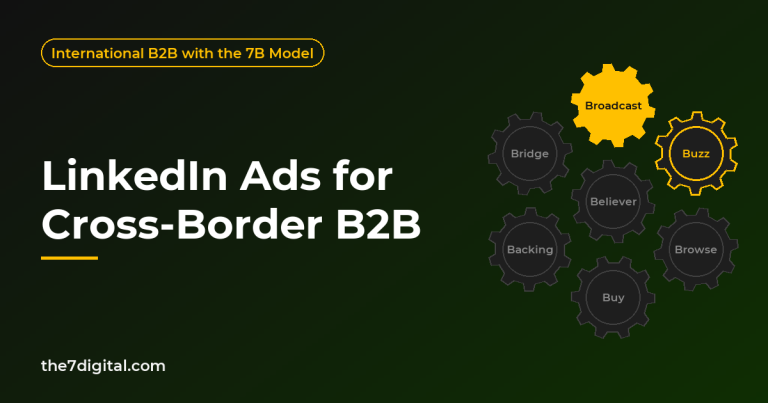
Two gears carry this article. The Bridge gear: Customers bring in others through referrals, communities and partners, and the flywheel amplifies itself. The Broadcast gear: Seeding valuable presence into the market, clear, steady and sharp enough that the right people know you exist.
The three operating layers read: Demand creation (Broadcast, Buzz), amplification (Backing, Bridge), demand capture (Browse, Buy); Believer is the connecting loop. A borrowed lesson is fuel for demand creation, because it gives you something to say that your competitors have not said. A partner from another industry is the circuit of amplification, because it lends you an audience. According to the Mô hình 7B cho B2B book (chapter 12), all three Bridge mechanisms run strongest in dark social. When an engineer forwards a partner’s article to colleagues in a private group, that is Bridge no measurement tool will ever see.
The three energy flows: Paid, owned, earned-and-shared. The test tower and the trend report are owned. A story on a partner’s news site and a customer’s quote are earned-and-shared. Paid has a specific job here: putting the content you built with a partner in front of both audiences once the pilot has produced a number.
Both definitions come word for word from the 7B Glossary; for all seven gears on one page, start with the 7B Model. The 7B Model was developed by Nguyen Dinh Bao (Bao7) at The7 Digital and is set out in full in the book Mô hình 7B cho B2B (Stop Begging, Start 7B).
Selling B2B into Vietnam and ASEAN
The same story lands differently across ASEAN. In WIPO’s Global Innovation Index 2025, Singapore ranks 5th, Malaysia 34th, Vietnam 44th, Thailand 45th, the Philippines 50th and Indonesia 55th (WIPO, 2025). An analogy that is old news to an engineer in Singapore may still be fresh in Hanoi or Jakarta, so test where your borrowed story is new before you roll it out region-wide.
Vietnamese plants already run on borrowed technology. WIPO notes rapid gains in Vietnam’s high-tech exports, high-tech manufacturing and publications (WIPO, 2025), and its country profile ranks Vietnam first in the world for high-tech imports as a share of total trade (WIPO, 2025). In my reading, buyers in a market that imports this much high technology are used to borrowed technology, so an analogy from electronics, logistics or software should land faster than abstract talk about Industry 4.0.
Innovation is becoming a budget line. Resolution 57, issued on December 22, 2024, targets R&D spending rising from 0.4% to 2% of GDP by 2030, with over 60% of the funding to come from societal contributions (Viet Nam News, 2025). Your champion inside a Vietnamese buyer is likely to need innovation stories to win budget, and a cross-industry case with a small pilot plan hands them one.
Do not wait for a cluster to make the introduction. Vietnam has no clusters in the GII’s list of the world’s top innovation clusters (WIPO, 2025). Cross-industry introductions will not happen by proximity, so build the Bridge on purpose: find a non-competing partner from another industry that serves the same buyers, such as an industrial park operator, an automation integrator, a logistics provider or a bank, and co-host one session or one pilot report before you co-sell anything.
Translate the lesson, not just the language. Publish the borrowed lesson in Vietnamese, with local pilot numbers and the local customer’s own words, the way Ricoh’s manager spoke for DHL’s pilot. Then keep telling it on a steady rhythm. Broadcast that stops after one launch is a press release, not a signal.
Conclusion: The next idea is in the industry next door
Four scenes, one idea. Ten pickers in smart glasses in a Ricoh warehouse. A train’s motor in an elevator shaft in Rottweil. MAX watching the busiest elevators on Microsoft’s Redmond campus. A Sony headset sold through Siemens, introduced at CES.
Your competitors read the same trade press and walk the same trade fairs, so they reach the same ideas. The next idea is usually in the industry next door, and the supplier who brings it back first, translates it for buyers and keeps telling it is the one the market remembers.
Next, cross-industry growth goes a step further, moving into another industry instead of borrowing from it. To see where this article sits in the series, open the pillar article, international B2B marketing with the 7B Model.
Frequently asked questions
What is cross-industry innovation?
It is borrowing a solution that already works in another industry, whether a technology, a process or a whole business model, and retranslating it for your own market. Enkel and Gassmann (2010) call it creative imitation. TK Elevator’s MULTI, for example, applies the linear motor technology of the Transrapid maglev train to elevators (TK Elevator, 2014).
How is borrowing from another industry different from copying a competitor?
Copying a competitor gives you what buyers have already seen elsewhere. Borrowing from another industry gives you something your own industry has not seen: in the experiment by Franke, Poetz and Schreier (2014), solutions from analogous markets were substantially more novel, though less ready for immediate use. So the hard part is retranslating the idea and testing it with a real customer.
How do I find the right industry to learn from?
Restate your customer’s problem in words that do not belong to your industry, then ask which industry has already solved it. Distance helps: in 166 science challenges, the chance of a winning solution rose with the distance between the solver’s field and the problem’s field (Jeppesen and Lakhani, 2010).
Does cross-industry thought leadership work when selling into Vietnam?
It does when it comes with local proof. Resolution 57 targets R&D spending of 2% of GDP by 2030, up from 0.4% (Viet Nam News, 2025), so buyers need credible innovation stories. Bring a borrowed idea with a small pilot, publish the result in Vietnamese, and co-host it with a partner that serves the same buyers.
International B2B with the 7B Model · Part 18 of 24 · Previous: Rolls-Royce Sells Flying Hours · Next: Cross-Industry Growth · Pillar article: International B2B Marketing: The 7B Model
References
- Logistics Manager (2015). Wearable tech ups picking productivity 25pc. https://www.logisticsmanager.com/wearable-tech-ups-picking-productivity-25pc
- Deutsche Post DHL (2015). DHL successfully tests Augmented Reality application in warehouse (reposted on MarketScreener). https://ca.marketscreener.com/quote/stock/DHL-GROUP-435996/news/Deutsche-Post-Jan-26-2015-DHL-successfully-tests-Augmented-Reality-application-in-warehouse-19777765
- TK Elevator (2024). Rottweil Test Tower: New Horizons (English flyer, printed 03/2024). https://testturm.tkelevator.com/media/test_tower/testturm_rottweil_website/downloads_test_tower_rottweil/test_tower_rottweil_flyer_en_tke_2024.pdf
- thyssenkrupp (2017). thyssenkrupp makes the future a reality: inauguration of the world’s first rope-less horizontal-vertical elevator system MULTI. https://testturm.tkelevator.com/global-en/news/thyssenkrupp-makes-the-future-a-reality-inauguration-of-the-worlds-first-rope-less-horizontal-vertical-elevator-system-multi-119755.html
- ThyssenKrupp Elevator (2014). Construction of test tower in Rottweil begins with ceremonial groundbreaking. https://www.tkelevator.com/global-en/newsroom/press-releases/construction-of-test-tower-in-rottweil-begins-with-ceremonial-groundbreaking-1402.html
- TK Elevator (n.d., accessed 9 November 2026). MULTI. https://tkelevator.com/global-en/products-and-service/multi
- Franke, N., Poetz, M. K., Schreier, M. (2014). Integrating Problem Solvers from Analogous Markets in New Product Ideation. Management Science, 60(4) (EconPapers). https://econpapers.repec.org/RePEc:inm:ormnsc:v:60:y:2014:i:4:p:1063-1081
- ThyssenKrupp Elevator (2015). ThyssenKrupp launches MAX: Maximizing urban efficiency with leading Microsoft Azure IoT-enabled technology. https://www.tkelevator.com/uk-en/press/press-releases/thyssenkrupp-launches-max-maximizing-urban-efficiency-with-leading-microsoft-azure-iot-enabled-technology-1346.html
- thyssenkrupp (2016). thyssenkrupp unveils latest technology to transform the global elevator service industry, Microsoft HoloLens for enhancing interventions. https://www.tkelevator.com/uk-en/press/press-releases/thyssenkrupp-unveils-latest-technology-to-transform-the-global-elevator-service-industry-microsoft-hololens-for-enhancing-interventions-20928.html
- thyssenkrupp Elevator Americas (2018). TKE MAX Moves Microsoft. https://www.tkelevator.com/us-en/company/news-archive/08-16-18-tke-max-moves-microsoft.html
- KONE (2017). KONE revolutionizes elevator maintenance with new customizable KONE Care service offering and 24/7 Connected Services. https://www.kone.co.za/news-insights/press-releases/kone-revolutionizes-elevator-maintenance-with-new-customizable-kone-care-tm–service-offering-and-24-7-connected-services-2017-02-08.aspx
- Jeppesen, L. B., Lakhani, K. R. (2010). Marginality and Problem-Solving Effectiveness in Broadcast Search. Organization Science, 21(5) (EconPapers). https://econpapers.repec.org/RePEc:inm:ororsc:v:21:y:2010:i:5:p:1016-1033
- Enkel, E., Gassmann, O. (2010). Creative Imitation: Exploring the Case of Cross-Industry Innovation. R&D Management, 40(3) (Alexandria repository, University of St. Gallen). https://www.alexandria.unisg.ch/62766/
- Logistics Manager (2017). DHL to roll out vision picking in its warehouses. https://www.logisticsmanager.com/dhl-to-roll-out-vision-picking-in-its-warehouses
- Microsoft (2016). Quicker fixes, hands-free, when thyssenkrupp Elevator’s service technicians use Microsoft HoloLens. https://news.microsoft.com/transform/quicker-fixes-hands-free-when-thyssenkrupp-elevators-service-technicians-use-microsoft-hololens/
- Siemens (2024). Siemens & Sony partner to enable immersive engineering. https://news.siemens.com/en-us/siemens-sony-ces-2024/
- Sony (2025). Experience an Immersive Design Workflow at Siemens! NX New Product Launch Event in Japan; Go Immersive 3D. https://xyn.sony.net/en/news/20250314
- WIPO (2025). Global Innovation Index 2025: GII 2025 results. https://www.wipo.int/web-publications/global-innovation-index-2025/en/gii-2025-results.html
- WIPO (2025). Viet Nam ranking in the Global Innovation Index 2025 (economy profile). https://www.wipo.int/edocs/gii-ranking/2025/vn.pdf
- Viet Nam News (2025). Politburo resolution driving transformative research and innovation. https://vietnamnews.vn/politics-laws/1690795/politburo-resolution-driving-transformative-research-and-innovation.html