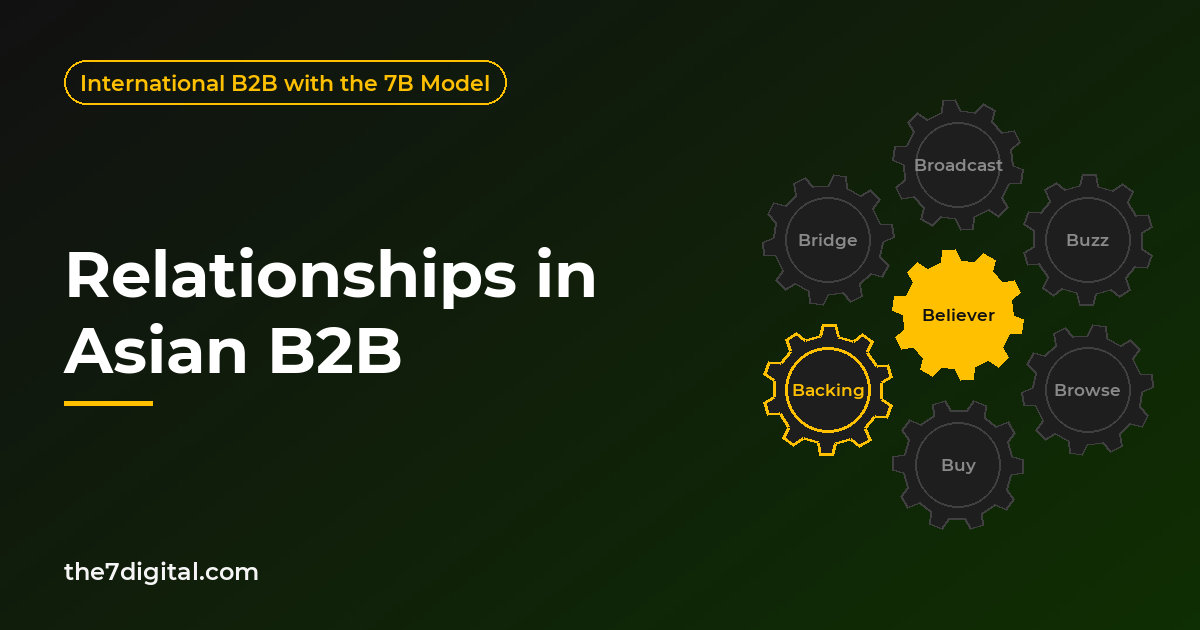
Summary: B2B relationships in Asia often start with people who share a school, a hometown or a trade. Those ties open doors fast, but they belong to one person. Turn them into trust in your company and proof that others voice for you. In the 7B Model, this sits in the Believer and Backing gears.
Malaysia ranked seventh in the world in the 2026 Edelman Trust Barometer, and its Trust Index rose to 71 from 66. Yet on average 65% of Malaysians hold an “insular trust mindset,” meaning they are reluctant to trust people who differ from them (The Star, 2026). Indonesia scores 73 on the same index, and 66% of Indonesians are hesitant or unwilling to trust someone different from them (Marketing-Interactive, 2026). High trust, small circles.
A foreign supplier stands outside those circles. The obvious fix is to hire a well-connected local manager. But a study of 362 industrial buyers by Palmatier, Scheer and Steenkamp found that loyalty to the salesperson, rather than to the company’s products and services, can lift sales and leave the company more vulnerable (University of Missouri, 2007). Choosing international B2B channels was about who sells for you abroad. This article asks what happens to trust when that person changes.
Here is the route: why insiders win, how incumbents keep the door closed, why one person’s network is not your asset, how to turn ties into Believer and three-tier Backing, and how a newcomer breaks in.
Why do insiders win so many deals in Asia?
The abstract of a review of social networks opens with three words: “Similarity breeds connection” (McPherson, Smith-Lovin and Cook, 2001). Ties form where people live near each other, belong to the same family or share an organization. School, hometown and trade are a social rule, not an Asian specialty.
The Edelman Trust Barometer says the same at global scale: about 7 in 10 respondents in 28 countries hesitate to trust people who do not share their values, beliefs or news sources (PR Daily, 2026). That is a survey of the public, not of B2B buyers. Insularity is human, not Asian; what Asia adds is names and institutions.
China: guanxi. A meta-analysis of 53 studies covering 20,212 organizations found that business ties help operational performance more, government ties help economic performance more but matter less as China’s institutions develop, and business ties remain a valuable strategic tool (Luo, Huang and Wang, 2012). Guanxi is somewhat accessible to outsiders (Horak and Taube, 2016).
South Korea: yongo. Yongo networks draw mainly on kinship, school and regional origin (Horak, 2014). They are predefined, partly by birth, and so homogeneous and highly exclusive (Horak and Taube, 2016). You cannot change your school or hometown, so you need someone inside to vouch for you.
Japan: keiretsu. The article on the Aisin fire calls firms such as Denso “Toyota keiretsu firms.” According to the article, Toyota’s supplier association, the Kyohokai, had 245 members, and about 60 core firms accounted for 80% of Toyota’s parts purchasing costs (Nishiguchi and Beaudet, 1998). The cross-cultural buying council covers hierarchy around the meeting table; this article covers the network outside it.
Buyers do not hate strangers. They just have no reason to gamble on one. Someone a trusted person vouches for is insurance against the risks no contract can spell out.
How do incumbent suppliers keep the door closed?
The BuyGrid model of Robinson, Faris and Wind (1967) splits buying into three situations: new task, modified rebuy and straight rebuy. A straight rebuy is where buyers give the least thought to new alternatives. Wind and Thomas (1996) summarize both sides: the incumbent tries to “keep the next purchase as close to a straight rebuy as possible,” while the challenger looks for levers to unseat it.
Why do buyers stay? Luthardt (2002) cites Johnson (1982): people stay in a relationship because they want to or because they have to. Switching costs and dependence are the “have to”; trust is the “want to.” In Luthardt’s working paper, 58% of 191 German manufacturers that had just bought production equipment chose the incumbent again (Luthardt, 2002). Trust did not stop buyers from considering new suppliers, but it made them less likely to invite those suppliers to bid. It is a German sample, not an Asian one.
Toyota: A network that moved before the paperwork
On February 1, 1997, a fire at an Aisin Seiki plant almost completely destroyed the lines that made P-valves, proportioning valves the size of a pack of cigarettes that sit in every Toyota vehicle. Aisin was the only source. Toyota announced it would stop 20 of its 30 assembly lines, and for two days practically all its plants closed (Nishiguchi and Beaudet, 1998).
Then more than 200 firms joined the recovery, about 62 of them taking direct responsibility for making P-valves. Brother Industries, a sewing-machine maker that had never made car parts, helped. Denso and Kayaba began before any explicit agreement on compensation, with no haggling over technical rights or money; Aisin later agreed to reimburse direct expenses in full. By Monday, February 10, the group’s assembly plants were back to normal (Nishiguchi and Beaudet, 1998).
Toyota still lost about 70,000 vehicles and ¥160 billion in revenue. Then it paid every first-tier supplier a sum equal to 1% of its sales to Toyota from January to March 1997. Many firms saw it as a reward for cooperation rather than compensation, and most first-tier suppliers announced they would pass most of it on to their own suppliers (Nishiguchi and Beaudet, 1998).
The authors note that firms that “voluntarily” offered help were in many respects forced to cooperate, since refusing could have damaged future business with the Toyota group. Both of Luthardt’s reasons are present. In my reading, this is Believer and Backing at network scale: firms that put in work first trusted they would be treated fairly later, and Toyota’s extra payment kept that trust.
A new supplier outside the network does not compete with a contract. It competes with years of kept promises. A contract says what each side must do. A relationship decides what they will do when the contract runs out of words.
Why is a salesperson’s network not your company’s asset?
Go back to those 362 industrial buyers. Three-fourths could have bought exactly the same product elsewhere, yet they stayed loyal to one company; even in B2B, the release adds, personal relationships matter (University of Missouri, 2007). Then comes the question every regional director should ask: what happens if a salesperson leaves to join a competitor? Ties between people who are not alike also dissolve faster (McPherson, Smith-Lovin and Cook, 2001), so a foreign firm’s own ties break easily. The ties an insider builds go wherever that insider goes.
GSK: The price of buying relationships
After an investigation that China’s Ministry of Public Security opened in June 2013, GSK announced on September 19, 2014 that the Changsha Intermediate People’s Court in Hunan Province had ruled, under Chinese law, that GSK China Investment offered money or property to non-government personnel to obtain improper commercial gains. As a result of the verdict, the company would pay a fine of 3 billion yuan, about £297 million (GSK, 2014).
GSK said it had fundamentally changed the incentive program for its salesforces, decoupling sales targets from compensation; changed its engagement with healthcare professionals; and expanded review of invoices and payments. CEO Andrew Witty said: “We have and will continue to learn from this.”
Note what GSK chose to fix: the pay system, not a search for better-connected salespeople. Note also who did what: a Western company, a Chinese court. This is not a story about “Asian culture.” It shows the worst version of a relationship: one bought with money or property to win business.
A relationship tied to one person and one quota carries a double risk: it can walk out with that person, and it can slide into what the law calls bribery. Personal brand or company brand is the marketing side of the same question. If the relationship lives in one person’s phone, it is that person’s asset, not yours.
How do you turn personal ties into Believer and three-tier Backing?
The Mô hình 7B cho B2B book (chapters 4 and 10) says a buyer needs one reason to sign, a believer needs many reasons to stay, and expansion follows trust. In Asia the order often flips: the personal relationship comes first and wins the deal. Do not drop it, but do not stop there: use the deal to earn the trust of the whole buying organization.
FANUC, the Japanese robot and CNC maker, does this at company level. In the spirit of “Service First,” it provides lifetime maintenance for its products as long as customers use them, even for discontinued models: more than 270 service locations supporting more than 100 countries, a stock of more than 3.5 million repair parts, and a repair factory in Japan that still handles products made more than 40 years ago (FANUC, accessed 2026). Those are FANUC’s own figures. The promise does not leave with any one engineer. The first 90 days after signing are covered in the total product in B2B.
Tier one: customers vouch for you inside their own circles. Praise travels in groups you cannot see: alumni networks, supplier associations, industry chats, or dark social. Give customers something worth forwarding: a story with name, numbers and dates, collected in a short interview rather than by asking the customer to write it (Mô hình 7B cho B2B book, chapter 11).
Tier two: an ecosystem that vouches for you. Trade press (B2B PR), partners and experts; I add industry associations and certification bodies. The ecosystem is where outsiders get introduced into the circle.
Tier three: AI cites you. Forty-five percent of B2B software buyers say citations from review sites are the most confidence-inspiring signal in an AI answer (G2, 2026). G2 runs review sites, so it has a stake. AI repeats what tiers one and two have written, so tier three is a result you cannot buy.
Side by side:
| What a personal tie does | The company version | Gear | Owner |
|---|---|---|---|
| A friend vouches for you | A customer story with name and numbers | Backing, tier one | Marketing, customers |
| Insiders speak well of you | Associations, trade press and certifiers name you | Backing, tier two | Leaders, marketing |
| “Everyone knows that company” | Content AI can cite | Backing, tier three | Marketing |
| A seller remembers everything and keeps promises | CRM, two owners per account, a written service promise | Believer | Sales, service |
Referrals and communities come next: see customer advocacy and referrals and B2B community marketing.
How does a newcomer break an incumbent’s hold?
The door is not locked. In Luthardt’s sample, 42% of buyers switched to a new supplier even though they had an incumbent (Luthardt, 2002).
According to Wind and Thomas (1996), a challenger can instigate the next purchase and turn it into a new task or a modified rebuy, bring new product opportunities straight to key influencers, or offer enough value, lower prices included, for the buyer to build a financial case for change. Early vendor involvement does this early: getting in before the specification is written.
Samsung Biologics: A latecomer that borrowed trust from regulators
Samsung Biologics was founded in 2011 as part of Samsung Group’s diversification, with 110 employees; it now has over 5,000 and rose on competitiveness in quality and large-scale capacity (Korea Times, 2025). By its own page, updated December 24, 2024, it serves 125 clients, including 17 of the top 20 global biopharma companies, and as of November 2024 held 339 cumulative regulatory approvals from over 50 countries, including the FDA and EMA (Samsung Biologics, 2024).
In my reading, each approval is tier-two Backing any new customer can check, and each big-name client is tier one. The company did not ask to join anyone’s straight rebuy; it brought a capability that turned the next purchase into a new decision. To be fair, belonging to Samsung Group is also a layer of endorsement.
That suggests four ways in. Wait for or create a change, such as a new line, a new model or a supplier re-audit, so the next purchase becomes a modified rebuy. Bring proof issued by a third party. Get introduced through the ecosystem: consultants, associations, B2B events and trade shows. Or take a small first order, deliver it so well that you become the incumbent, then turn the account into a straight rebuy as fast as you can (Wind and Thomas, 1996). Never buy your way in; GSK paid for that lesson.
Where do relationships in Asian B2B fit in the 7B Model?
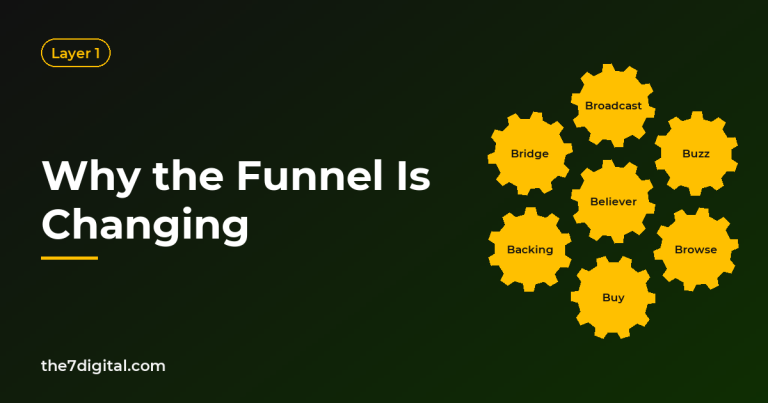
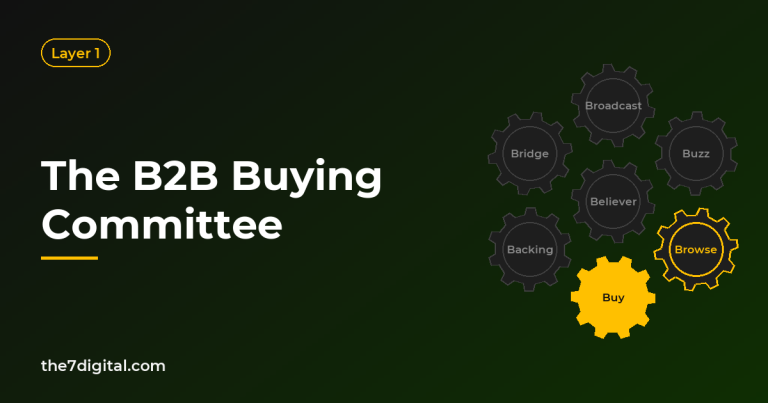
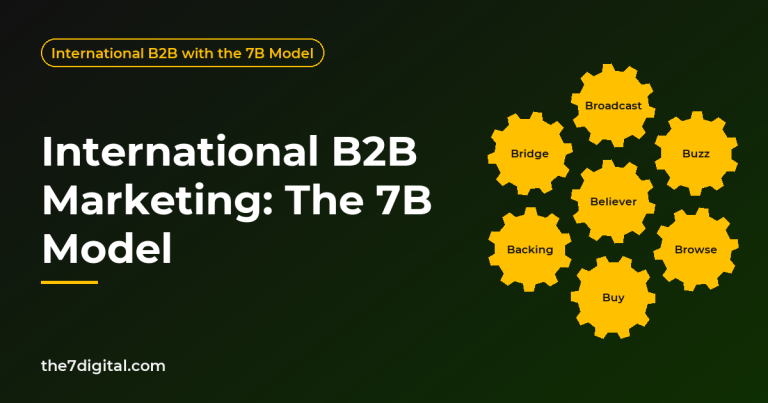
By the standard definitions, the Believer gear: Customers who do not just buy but believe, through real experience after the deal. The Backing gear: Customers, the ecosystem and AI speak up on your behalf.
A personal relationship is those two gears at the scale of one person: one who believes in you, one who vouches for you. The 7B machine moves that trust into the company, as FANUC does, and multiplies it across the market through three tiers of Backing, as Samsung Biologics does.
Backing sits in the amplification layer, and Believer is the connecting loop. The loyalty loop: Believers create Backing, Backing creates Bridges, and Bridges bring new people back into Broadcast, Browse and Buy.
Of the three energy flows, paid, owned and earned-and-shared, relationships travel mostly in earned-and-shared. Paid cannot buy other people’s vouching. Owned, meaning your site and library of customer stories, gives the relationship a home where AI and buyers can find it.
To check each definition word for word, open the 7B Glossary; to see how Believer and Backing mesh with the other five gears, read the 7B Model. The 7B Model was developed by Nguyen Dinh Bao (Bao7) at The7 Digital and is set out in full in the book Mô hình 7B cho B2B (Stop Begging, Start 7B).
Selling B2B into Vietnam and ASEAN
Many of your buyers arrived with their own circle. In the first ten months of 2026, Singapore accounted for 31% of newly registered foreign investment capital in Vietnam and South Korea for 18.9%, while Hong Kong, China took 11.6% and China 9% (NSO, via Thoi bao Tai chinh Viet Nam, 2026). In my reading, many large buyers are foreign-invested plants whose supplier lists began at home and are approved at headquarters. Win approval where the list is kept, and trust where the parts are used.
Supply already runs through those networks. China was Vietnam’s largest import source in the first ten months of 2026, at USD 212.46 billion (NSO, 2026). In many categories you are the out-supplier facing an incumbent with a home-country relationship. Plan for the moments when a purchase turns into a modified rebuy: a new line, a new model, a supplier re-audit.
Trust flows to institutions too. In Indonesia, trust is led by employers (92% among employees), followed by business (80%) (Edelman Trust Barometer 2026, via Marketing-Interactive, 2026). That is general-public trust, and I have no comparable figure for Vietnam. A circle is hard to join as a person, but company-level proof lands, such as certifications, named local references and association membership.
Make every relationship belong to the company. Give every key account two owners and a CRM record. Have headquarters engineers visit with the local team. Publish case stories in Vietnamese with named local customers, with their permission, and write your service promise down in Vietnamese.
Keep it clean and keep it public. GSK’s own fix was to decouple sales targets from pay. Pair that with Backing people can see: certifications, association memberships and trade press.
Conclusion: Let the market know your company, not just your country manager
I opened with a region where trust is high and circles are small. Toyota’s network moved before the paperwork. GSK paid the price for buying relationships. FANUC keeps a promise to repair machines more than 40 years old. Samsung Biologics borrowed trust from regulators.
In Asia, people tend to buy from people they know. Make sure they know your company, not just your country manager.
Last time, choosing international B2B channels decided who sells for you abroad. Next, Rolls-Royce sells flying hours goes to the other end of trust: a seller that earns money only when the customer succeeds. The whole seven-gear machine sits in the pillar article, international B2B marketing with the 7B Model.
Frequently asked questions
Why do relationships matter so much in Asian B2B?
Because for a buyer, someone known reduces risk. Hesitating to trust people unlike you is global: about 7 in 10 respondents in 28 countries, according to the Edelman Trust Barometer 2026 (PR Daily, 2026). Asia gives it names and institutions: guanxi, yongo, keiretsu.
How are guanxi, yongo and keiretsu different?
Guanxi (China) is utilitarian and somewhat accessible to outsiders. Yongo (South Korea) draws on kinship, school and regional origin, so it is highly exclusive (Horak, 2014; Horak and Taube, 2016). Keiretsu (Japan) are firms affiliated with one group: Nishiguchi and Beaudet (1998) count Denso among “Toyota keiretsu firms,” unlike independent suppliers such as Kayaba.
How do you keep accounts when a salesperson leaves?
Make customers trust the company, not only the person. Palmatier, Scheer and Steenkamp (2007) found that loyalty to the salesperson can leave a company vulnerable. Give each key account two owners, keep every exchange in a CRM, and turn your service promise into a process, as FANUC does.
How should a foreign supplier build relationships in Vietnam?
Start where trust already sits: the plant engineers and the headquarters that approve suppliers, often in Singapore, South Korea, Hong Kong or mainland China. Give every key account two owners, a CRM record and a written service promise. Publish stories with named local customers, join your buyers’ associations, and never let incentives reward buying access.
International B2B with the 7B Model · Part 16 of 24 · Previous: Choosing International B2B Channels · Next: Rolls-Royce Sells Flying Hours · Pillar article: International B2B Marketing: The 7B Model
References
- The Star (2026). Malaysia seventh most trusted nation in the world, says study. https://www.thestar.com.my/news/nation/2026/05/20/malaysia-seventh-most-trusted-nation-in-the-world-says-study
- Marketing-Interactive (2026). Two-thirds of Indonesians show insular trust mindset, Edelman finds. https://www.marketing-interactive.com/two-thirds-of-indonesians-show-insular-trust-mindset-edelman-finds
- University of Missouri-Columbia, via EurekAlert (2007). Marketing study: companies benefit most from examining where customer loyalty lies. https://www.eurekalert.org/news-releases/893501
- McPherson, M., Smith-Lovin, L., Cook, J. M. (2001). Birds of a Feather: Homophily in Social Networks. Annual Review of Sociology, 27 (Duke Scholars page). https://scholars.duke.edu/publication/652661
- PR Daily (2026). The Scoop: Edelman Trust Barometer shows a slip into ‘insular’ mode. https://www.prdaily.com/the-scoop-edelman-trust-barometer-shows-a-slip-into-insular-mode/
- Luo, Y., Huang, Y., Wang, S. L. (2012). Guanxi and Organizational Performance: A Meta-Analysis. Management and Organization Review, 8(1) (IDEAS/RePEc). https://ideas.repec.org/a/cup/maorev/v8y2012i01p139-172_00.html
- Horak, S., Taube, M. (2016). Same but different? Similarities and fundamental differences of informal social networks in China (guanxi) and Korea (yongo). Asia Pacific Journal of Management, 33(3) (IDEAS/RePEc). https://ideas.repec.org/a/kap/asiapa/v33y2016i3d10.1007_s10490-015-9452-x.html
- Horak, S. (2014). Antecedents and characteristics of informal relation-based networks in Korea: Yongo, Yonjul and Inmaek. Asia Pacific Business Review, 20(1) (author’s page). https://facpub.stjohns.edu/horaks/prep/Yongo-inmaek-yonjul.html
- Nishiguchi, T., Beaudet, A. (1998). The Toyota Group and the Aisin Fire. MIT Sloan Management Review, Fall 1998. https://sloanreview.mit.edu/article/the-toyota-group-and-the-aisin-fire/
- Wind, Y., Thomas, R. J. (1996). The BuyGrid Model: Twenty-Five Years Later (working paper, April 1996). https://www.dropbox.com/s/l6p4yz3iboizzdr/9802_The_BuyGrid_Model_30_Years.pdf?dl=0
- Luthardt, S. (2002). In-Suppliers versus Out-Suppliers: Determinants of Switching Behaviour in Industrial Purchasing Relationships (work-in-progress paper, IMP Group conference, Dijon). https://impgroup.org/wp-content/uploads/wpallimport/files/papers/525.pdf
- GSK (2014). GSK China Investigation Outcome. https://www.gsk.com/en-gb/media/press-releases/gsk-china-investigation-outcome/
- FANUC (n.d., accessed November 9, 2026). Service (Sustainability: With Our Customers). https://fanuc.co.jp/en/sustainability/social/customers/service.html
- G2 (2026). The Answer Economy: How AI Search is Rewiring B2B Software Buying (G2 2026 AI Search Insight Report). https://learn.g2.com/g2-2026-ai-search-insight-report
- The Korea Times (2025). Samsung Biologics celebrates 14th anniv. as world’s top CDMO. https://www.koreatimes.co.kr/path/A2025042115500001064
- Samsung Biologics (2024). Samsung Biologics’ all-in-one CMO service at a glance. https://samsungbiologics.com/media/bio-story/samsung-biologics-all-in-one-cmo-service-at-a-glance
- NSO, via Thoi bao Tai chinh Viet Nam (2026). Việt Nam thu hút 54,85 tỷ USD vốn đầu tư nước ngoài trong 10 tháng. https://thoibaotaichinhvietnam.vn/viet-nam-thu-hut-54-85-ty-usd-von-dau-tu-nuoc-ngoai-trong-10-thang-206324.html
- NSO (2026). Báo cáo tình hình kinh tế – xã hội tháng Mười và 10 tháng năm 2026. https://www.nso.gov.vn/bai-top/2026/11/bao-cao-tinh-hinh-kinh-te-xa-hoi-thang-muoi-va-10-thang-nam-2026/