Summary: Total cost of ownership (TCO) is everything a buyer pays for a product over its life: purchase price, installation, energy, maintenance, downtime and disposal. Strong B2B sellers do not cut the price; they prove a lower total cost in the buyer’s own numbers. In the 7B Model, TCO belongs to the Buy gear.
On 1 November 2026, Vietnam’s average retail electricity price fell 2% to VND 2,159.9037 per kWh before VAT (Tạp chí Công Thương, 2026). It was the first cut in the average price in 20 years, if you set aside five Covid-era relief rounds (VnEconomy, 2026). Between early 2023 and May 2025 the price had risen four times, by 3%, 4.5%, 4.8% and 4.8% (Tuoi Tre News, 2025).
That is five moves in under four years. A payback table printed once in a supplier’s brochure for Vietnam would have gone stale more than once, in both directions. In many machines the biggest line in lifetime cost follows a number that neither seller nor buyer controls, and yet most offers still open with the purchase price.
My argument: do not cut the price; change the question, from “what does it cost?” to “what does each machine hour, each kilometer, cost the customer?” Below: what goes into TCO, why one product is worth different amounts to different customers, how Michelin sold tires by the kilometer, how to build a calculator with no form in front of it, who keeps the promise after signing, and what it means for Vietnam and ASEAN.
What is price, if not the number on the invoice?
Price is the number on the purchase order, paid once. Cost is what the customer pays every month afterward, for years. In a typical medium-size industrial pumping system over 15 to 20 years, the initial price is only about 10% of total cost, energy about 40% and maintenance about 25% (Hydraulic Institute, accessed 2026). That covers one kind of system, not every machine, but it shows where the longest haggling happens: over a tenth of the bill.
Even a screw follows the pattern: Bossard, a Swiss supplier of fasteners and assembly technology, says the fastener itself makes up only around 15% of the total costs on average, with the other 85% coming from development, procurement, testing, inventories, assembly and logistics (Bossard, accessed 2026).
Lisa Ellram described TCO in 1993 as an attempt to understand the true cost of doing business with a supplier, well beyond price (Ellram, 1993). In 1995 she called it a methodology and philosophy that looks past the purchase price to the other costs of buying (Ellram, 1995).
The finance seat needs it most: TCO is how a buyer defends a decision to the other seats in the buying committee. The Mô hình 7B cho B2B book (chapter 9) puts a benefit worksheet filled with the buyer’s own numbers into the kit the champion uses to persuade colleagues; a price list is not one. The price is the number you say. TCO is the number the buyer must defend in the meeting.
What goes into total cost of ownership?
Grundfos, the Danish pump maker, writes the life-cycle cost of a pump system as the sum of eight items: initial purchase price; installation and commissioning; energy; operation; maintenance and repair; downtime, meaning lost output; environmental cost; and decommissioning and disposal. It names initial price, energy, and maintenance and repair as the biggest, with energy by far the greatest (Grundfos, accessed 2026). The formula was written for pumps but fits almost any machine, line or enterprise software.
| Cost line | The buyer’s question | Who asks | Evidence to bring |
|---|---|---|---|
| Initial price | What do I pay today? | Procurement | A clear quote |
| Installation, commissioning | How soon does it run? | Engineering, projects | A schedule with names |
| Energy | What does an hour of running cost? | Operations, finance | Measured real-world use |
| Operation | How many people and consumables? | Production | Consumption norms |
| Maintenance, repair | Where are the spare parts? | Maintenance | Service plan, parts stock |
| Downtime | What does a failure cost? | Plant manager | A committed response time |
| Environment | What does it emit? | Safety, ESG | Measured emissions |
| Decommissioning, disposal | What happens at end of life? | Finance | A take-back or recycling plan |
The “Who asks” column is my reading, not Grundfos data. Your table should carry two more lines: switching cost (retraining users, moving data, running two systems in parallel) and cost of capital (interest, cash flow, depreciation).
Studying 11 firms, Ellram (1995) classified their TCO models as dollar-based or value-based. For a seller, that means preparing both: whatever you can measure goes in as money, and what you cannot yet measure, such as risk or response speed, goes in as evidence the buyer can score.
Each seat reads a different line of the same table. How to rearrange value for each seat, the value stack idea of Narayandas, is the subject of The Value Stack: Five Buyers, Five Products.
Why does the same product carry a different value for each customer?
A machine’s value does not sit on the machine. It sits in how the customer uses it: hours run, distance driven, load, the plant’s electricity price, and what the customer used before you. For pumps, energy is usually the biggest cost, especially above 2,000 running hours a year (Hydraulic Institute, accessed 2026).
In 2021, Peterbilt put an EV operating-cost calculator on its website. It computes cost per mile for on-highway trucks and per hour for vocational ones: one truck line, two units of value. Buyers enter their own mileage and costs and see electric and diesel side by side (HDT Truckinginfo, 2021). Robert Woodall, Peterbilt’s assistant general manager for sales and marketing, says the question customers ask most about electric trucks always revolves around operating cost (Peterbilt, accessed 2026). The answer reaches the buyer before the first sales meeting: Browse prepares the ground for Buy.
The side-by-side view is where value gets measured. An electric truck is worth what it saves against the truck the buyer would otherwise run, so every TCO table needs a column “versus the buyer’s current option.”
The consequence: price in the unit your customer earns in, such as kilometers, machine hours or tons of finished product. When your price travels with the unit your customer sells to its own customers, your cost sits inside its cost of goods, and the haggle moves from “how much off?” to “what does each unit cost?”
Michelin: Selling tires by the kilometer, backed by liters of diesel
Michelin signed its first tire care and services contracts for fleet owners as early as 1922 (Michelin, 2026). On 14 April 2015, at the Commercial Vehicle Show in Birmingham, England, Michelin solutions launched EFFITIRES with fuel commitment for road transport fleets across Europe. For the first time, a price-per-kilometer tire management contract came with a contractual fuel-saving commitment (Michelin solutions, 2015).
The commitment is set after a custom fleet audit. If the contracted saving is not achieved, Michelin solutions repays the operator the unrealized part on a pro rata basis. The release also says fleets already under contract had saved an average of 1.5 liters of diesel per 100 km per vehicle (Michelin solutions, 2015), a figure that is Michelin’s own.
On 13 April 2017, Michelin solutions announced that the European trucking firm De Rijke Northern Europe had renewed its Effitires contract after a competitive tender against several premium rivals: three years, priced per kilometer (Michelin solutions, 2017). De Rijke first outsourced tire management in 2007; this was its third successive renewal. Michelin solutions supplies reports that track breakdowns per million kilometers and roadside response times. Jeroen De Rijke, chief procurement officer and joint owner, says good tires are essential because the company cannot afford problems on the road.
In 2026, Michelin Fleet Solutions in North America still sells on the same logic: tire leasing and maintenance, outsourced, for commercial fleets, with monthly billing, cost-per-mile pricing and “no surprise invoices” (Michelin North America, 2026). Michelin still sells tires. What the customer signs is a cost per mile.
How do you build a TCO calculator without a form in front of it?
Why leave it open? Because the champion inside the buying committee needs a worksheet filled with their own company’s numbers to carry into the meeting (Mô hình 7B cho B2B book, chapter 9). And because buyers now calculate for themselves: according to G2 (2026), understanding total cost of ownership is among the most common uses of AI for B2B software buyers, at 51%, level with building shortlists (G2, 2026), on a base the page does not state. If your assumptions sit behind a form, the buyer’s AI will use somebody else’s.
AWS shows the principle in another field. Its documentation says you need neither an AWS account nor deep AWS knowledge to use the Pricing Calculator. The estimate page shows upfront, monthly and 12-month costs and exports to CSV or PDF; signing in or creating an account is an option on that same page, not a gate (Amazon Web Services, accessed 2026). It estimates the cost of AWS services and is not a full TCO tool, but the design is the lesson.
Five rules for a calculator with no gate:
- Ask only for numbers the buyer knows: hours run per year, kilometers per year, the plant’s own electricity price, number of shifts.
- Show every assumption and its source on the same page, with a low, middle and high range instead of one flattering number.
- Include the lines where you lose to a competitor; a table with no bad line is a table nobody believes.
- Export one PDF page with your brand name and page address in the footer, because it will be screenshotted and forwarded (Mô hình 7B cho B2B book, chapter 7).
- Put no email field before the result; if you want contact, add a “send me this copy” button after the result appears.
To measure without a form, use two of the book’s four metrics (chapter 14): ask customers “How did you hear about us?”, and after each closed deal check whether the TCO table was among the content the customer touched. The calculator is owned content, as B2B content marketing explains, and the PDF that travels through private messages is dark social, out of reach of your analytics.
Who keeps the cost promise after the contract is signed?
Ellram (1995) found that firms use TCO models to select suppliers and also to evaluate them. Read that backward: the TCO table you hand over before signing becomes the scorecard that grades you after.
According to G2 (2026), three in four buyers who have experienced a late-stage veto now expect positive ROI within six months of signing, and the share of software buyers who prefer outcome-based pricing more than doubled since 2025, from 11% to 23%. These are software buyers, and G2 runs a review site: a wind direction, not a law.
Recall Michelin: it repays unrealized savings pro rata, the reports De Rijke received tracked breakdowns per million kilometers and response times, and it renewed a third time after a tender. A promise with a meter turns the contract into a door, not the final wall.
A workable routine has four steps. Before signing, fix the starting point with an audit, as Michelin did for fleets. Measure the two or three lines that make up most of the TCO. Set a date to review the real numbers with the customer. When they hold, ask permission to tell the story as a case: a proven TCO is the strongest Backing you will have for the next buyer.
Not every customer deserves a cost commitment; that is the subject of the next article, cost-to-serve and unbundling. Paying fully by outcome is covered in Rolls-Royce sells flying hours, and writing after-sales service into the terms in the total product. The Mô hình 7B cho B2B book (chapter 9) says the day of signing is the day handover begins.
Where does total cost of ownership fit in the 7B Model?
TCO is where the Buy gear turns hardest. Its definition: A process of many people and many rounds; a door, not the final wall. Read each clause through TCO. Many people: one table, each seat reads a line. Many rounds: the table is recalculated in every review round, so let the customer recalculate it. A door: the table becomes the yardstick after signing.
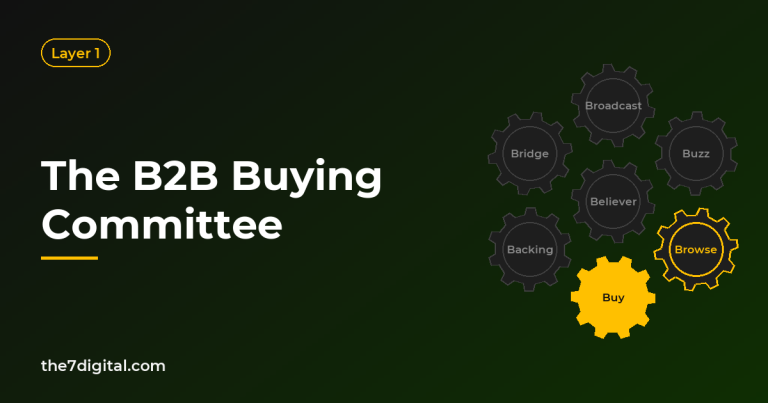
Buy and Browse together form the demand capture layer, the layer behind converting demand into orders. A TCO calculator is content the buyer uses to verify you at Browse before stepping into Buy. The loyalty loop closes here: a TCO proven on real numbers is a Believer’s real experience, and once the customer lets you tell it, it becomes Backing for the next buyer.
The three energy flows share the work. Owned: the calculator, the assumptions page, cases with numbers. Earned-and-shared: the PDF the customer forwards. Paid: search ads for cost-comparison queries. Each gear has a one-line definition in the 7B Glossary, and the 7B Model explains how the seven fit together. The 7B Model was developed by Nguyen Dinh Bao (Bao7) at The7 Digital and is set out in full in the book Mô hình 7B cho B2B (Stop Begging, Start 7B).
Selling B2B into Vietnam and ASEAN
The energy line moves. When the average retail price rose 4.8% to VND 2,204.0655 per kWh before VAT from 10 May 2025, the official explanation pointed to an unpredictable, rising USD exchange rate feeding generation costs, which make up about 83% of the cost of power production, and to low-cost hydropower covering only about 25% of output (EVN, 2025). For a TCO table, build the energy line in VND with the buyer’s own tariff, and let the buyer push it up or down a few percent in the calculator.
Efficiency is becoming law. Law No. 77/2025/QH15, passed by Vietnam’s National Assembly on 18 June 2025, amends the Law on Economical and Efficient Use of Energy and took effect on 1 January 2026. It defines the energy service company (ESCO), which carries out efficiency projects under an energy efficiency contract that is the basis for the client’s payment, and says covered equipment must be labeled before it is marketed (LuatVietnam, 2025). In my reading, an ESCO is typically paid out of savings it can measure, so buyers will meet more offers priced that way, and a TCO claim nobody can measure will lose to one that can.
Singapore already sets the floor. From 1 December 2025, existing energy-intensive industrial facilities, which account for about 80% of Singapore’s primary energy consumption, must have their chilled water systems meet minimum energy efficiency standards (MEES); the remaining industrial facilities, which are less energy-intensive, have until 1 December 2029 (Allen & Gledhill, 2025). The law firm wrote this in March 2025, before the rules took effect. For chilled water systems in Singapore, energy performance is already a compliance line, not a nice-to-have.
Speak in VND per unit, in Vietnamese. Put the calculator in Vietnamese, ungated, with VND inputs per operating hour or per kilometer. Show local spare parts and service response as cost lines, not slogans, and give the Vietnamese champion a one-page PDF to forward. Michelin’s audit-first approach travels well: agree what the customer pays today before you promise what they will pay tomorrow.
Measure after delivery. Agree the baseline before signing, read the real numbers with the customer, and with permission publish them. A verified number is the kind of proof customers pass to one another in private channels, where no sales rep can follow.
Conclusion: Buyers pay the price once and the cost every day
Back to 1 November 2026. Whatever the tariff does next, a supplier whose TCO lives in the buyer’s own spreadsheet, with the buyer’s own tariff, can follow it. A supplier whose TCO lives in a brochure cannot.
Sellers who beg ask how much off the customer wants. Sellers who lead ask what the customer pays for each machine hour, then prove it can be smaller.
Next, cost-to-serve and unbundling asks which customers deserve a commitment like this, and Rolls-Royce sells flying hours goes on to paying by outcome. For the wider map, read the pillar article, international B2B marketing with the 7B Model; to choose your place in the market, start with B2B positioning.
Frequently asked questions
What is total cost of ownership in B2B?
Total cost of ownership (TCO) is the full cost a buyer carries to acquire and use a product, not only the purchase price. Lisa Ellram (1995) calls it a methodology and philosophy that looks beyond the price of a purchase.
How is TCO different from life-cycle cost?
The two overlap. Life-cycle cost is usually counted per product: Grundfos defines it as the total cost of all system components over their lifetime. TCO in purchasing looks at the relationship with the supplier: Ellram (1993) describes the true cost of doing business with a supplier, well beyond price.
Should a TCO calculator sit behind a form?
No. The Mô hình 7B cho B2B book (chapter 6) advises against hiding content behind a gate. The champion needs to enter their own company’s numbers and forward the result to other seats, and AWS lets people use its cost-estimation tool without an account. If you want contact details, offer a button that sends the PDF after the result appears.
Do buyers in Vietnam calculate TCO?
No count is available, but they have reasons to: five tariff changes since 2023, the latest a 2% cut on 1 November 2026 (VnEconomy, 2026), and an amended energy-efficiency law in force since January 2026 that sets rules for energy service companies and equipment labels. Offer TCO in Vietnamese and VND, with inputs the buyer can change.
International B2B with the 7B Model · Part 13 of 24 · Previous: The Value Stack: Five Buyers, Five Products · Next: Cost-to-Serve and Unbundling · Pillar article: International B2B Marketing: The 7B Model
References
- Tạp chí Công Thương (2026). Giá bán lẻ điện bình quân giảm 2% từ ngày 1/11/2026 (Average retail electricity price down 2% from 1 November 2026, in Vietnamese). https://tapchicongthuong.vn/gia-ban-le-dien-binh-quan-giam-2–tu-ngay-1-11-2026-562569.htm
- VnEconomy (2026). Giá điện chính thức giảm sau 20 năm (Electricity price officially cut after 20 years, in Vietnamese). https://vneconomy.vn/gia-dien-chinh-thuc-giam-sau-20-nam.htm
- Tuoi Tre News (2025). Vietnam’s electricity prices rise 4.8%, marking 4th hike since 2023. https://news.tuoitre.vn/vietnams-electricity-prices-rise-48-marking-4th-hike-since-2023-103250510145117726.htm
- Hydraulic Institute (n.d., accessed 9 November 2026). Pump Pros Know: Lifecycle Cost Analysis. https://pumps.org/pump-pros-know-lifecycle-cost-analysis
- Bossard (n.d., accessed 9 November 2026). Total Cost of Ownership (TCO) in Fastening. https://www.bossard.com/ch-en/services/benefits/tco-in-fastening/
- Ellram, L. M. (1993). A Framework for Total Cost of Ownership. The International Journal of Logistics Management, 4(2). https://www.emerald.com/insight/content/doi/10.1108/09574099310804984/full/html
- Ellram, L. M. (1995). Total cost of ownership: an analysis approach for purchasing. International Journal of Physical Distribution & Logistics Management, 25(8). https://www.emerald.com/insight/content/doi/10.1108/09600039510099928/full/html
- Grundfos (n.d., accessed 9 November 2026). Lifecycle cost equation for pump systems. https://www.grundfos.com/ca/learn/research-and-insights/lifecycle-cost-equation-for-pump-systems
- HDT Truckinginfo (2021). Peterbilt Launches EV Operating Cost Calculator. https://www.truckinginfo.com/news/peterbilt-launches-ev-operating-cost-calculator
- Peterbilt Motors Company (n.d., accessed 9 November 2026). Peterbilt Launches EV Operating Cost Calculator. https://www.peterbilt.com/news-and-events/press-releases/peterbilt-launches-ev-operating-cost-calculator
- Michelin (2026). Connected Solutions. https://www.michelin.com/en/group/activities/services
- Michelin solutions (2015). Michelin solutions launches EFFITIRES with fuel commitment at CV Show 2015. https://news.cision.com/michelin-solutions/r/michelin-solutions-launches–effitires–with-fuel-commitment–at-cv-show-2015,c9755554
- Michelin solutions (2017). Michelin solutions secures De Rijke Northern Europe renewal (press release, 13 April 2017). https://gk.news/michelin-truck-bus/press-release/michelin-solutions-secures-de-rijke-northern-europe-renewal
- Michelin North America (2026). Michelin Fleet Solutions. https://business.michelinman.com/services/michelin-fleet-solutions
- G2 (2026). G2’s 2026 Buyer Behavior Report: The Evaluation Maze. https://company.g2.com/news/buyer-behavior-2026
- Amazon Web Services (n.d., accessed 9 November 2026). Getting started, AWS Pricing Calculator User Guide. https://docs.aws.amazon.com/pricing-calculator/latest/userguide/getting-started.html
- EVN (2025). Adjusting average retail electricity prices from 10 May 2025. https://en.evn.com.vn/d/en-US/news/Adjusting-average-retail-electricity-prices-from-10-May2025-60-142-500699
- LuatVietnam (2025). Law on Economical and Efficient Use of Energy revised, No. 77/2025/QH15 (English translation of the text in the Official Gazette of 24 July 2025). https://english.luatvietnam.vn/cong-nghiep/law-on-economical-and-efficient-use-of-energy-revised-no-77-2025-qh15-404895-d1.html
- Allen & Gledhill (2025). Amendments to Energy Conservation Act effective on 1 December 2025 to introduce minimum energy efficiency standards for all existing energy systems in industrial facilities. https://www.allenandgledhill.com/sg/publication/articles/30226/amendments-to-energy-conservation-act-2023-effective-on-1-december-2025-to-introduce-minimum-energy-efficiency-standards-for-all-existing-energy-systems-in-industrial-facilities