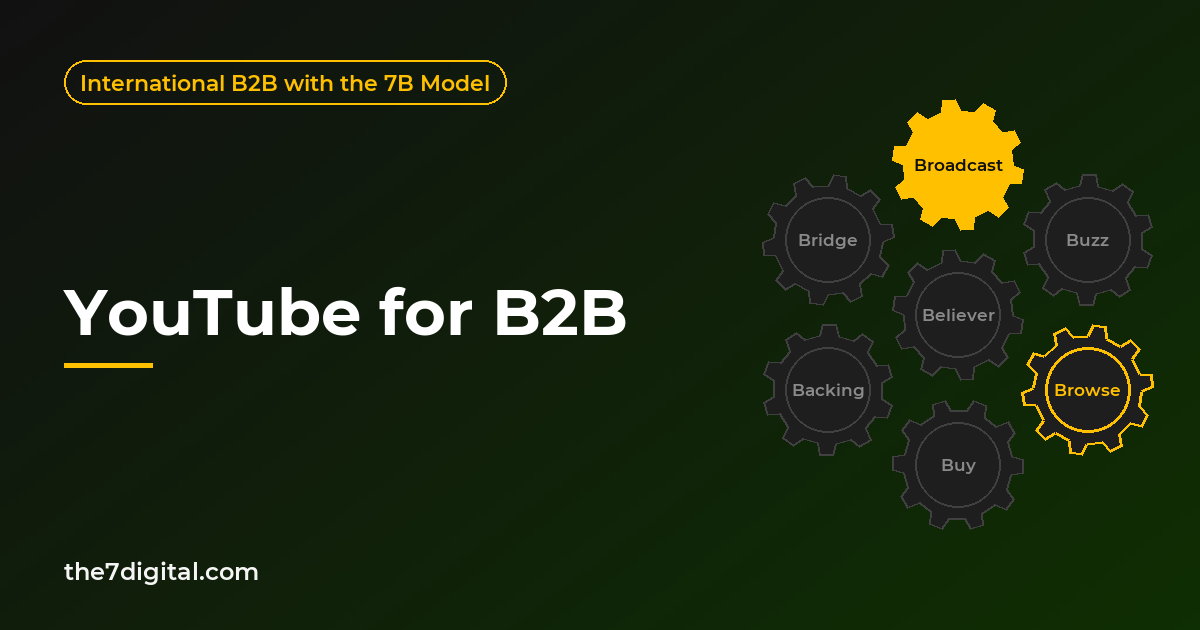
Summary: YouTube ads for B2B work when they put proof in front of buyers instead of a pitch: demos, factories and engineers. B2B buyers use YouTube to verify suppliers before they get in touch, so one good video both seeds your presence and meets people who are researching. In the 7B Model, YouTube sits in Broadcast and Browse.
Picture a shortlist meeting at a new electronics plant in northern Vietnam. Three suppliers of automated optical inspection systems are still in the running: German, Japanese and Korean. The engineers have read every datasheet. The owner, who will sign, has read none. The day before, he asks his purchasing manager one question: can you show me how each machine actually works?
Only one supplier has an answer he can watch on his phone: ten minutes of its machine catching defects on a real line, with Vietnamese subtitles. The others offer English brochures and an engineer’s visit next month. You can guess whose name survives the meeting.
Buyers want to see before they believe, and they go to YouTube to see. A Gartner (2023) survey found YouTube was the social media channel that most influenced a recent B2B purchase decision, ahead of LinkedIn. In February 2026, Gartner (2026) reported that YouTube had overtaken LinkedIn as the leading platform for B2B IT and high-tech buyers, with 53% of them relying on it for product and vendor decisions.
That covers technology buyers, not every industry, but the direction is clear. Below: which gears YouTube turns, five videos for the five people at the buying table, trust without a founder on camera, ad targeting, and how one video becomes seven outputs.
Which gears does YouTube turn for B2B buyers?
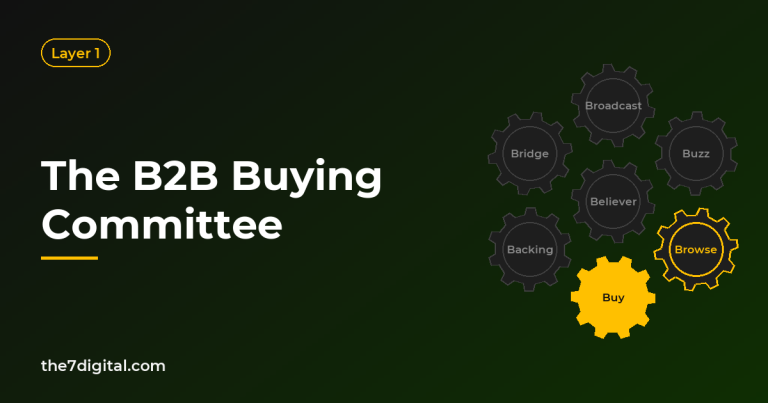
Two gears, at two moments in the same buyer’s life. Browse is when a buyer has a need and looks for proof. Broadcast is the long stretch before, when you seed your presence so your name is already in their head when the need arrives.
The 7B Model book (Mô hình 7B cho B2B, chapter 8) counts YouTube and podcasts among the six gateways of Browse, alongside search engines, conversational AI, review platforms, LinkedIn, and communities and forums. It answers questions text cannot. Is the factory real? Does the machine run as the brochure says? A datasheet can promise a five-micron tolerance; a close-up of the gauge shows what five microns looks like.
Waiting for buyers to search, though, serves only the small group that needs you today; the 95/5 rule explains why that group is small. For everyone else, YouTube is a Broadcast channel: a guide to choosing materials, a breakdown of common failures, a walk along a new line. People who watch long enough remember who taught them something, and that is how a name earns mental availability.
The prize is that one video serves both gears. Today you pay to show it to an engineering director with no project. Eighteen months later, when his plant needs a new line, he searches and the same video comes up. A social post is gone in days; a video on your channel stays and gets forwarded. That is why I treat a YouTube channel as an asset, not a campaign.
What five videos do the five people at the buying table need?
Your video rarely has an audience of one. According to Gartner (2025), B2B buying groups range from five to 16 people across as many as four functions. Each brings a different worry, and a generic company video answers only the least influential one. The article on the B2B buying committee covers that structure; here the question is simpler: what does each person need to see?
The 7B Model book (chapter 9) splits the table into five roles. Give each a video of its own:
- A demo for the direct user. Operators want to know whether the machine is easy to run. Show real operation up close, one function at a time, changeovers included, awkward parts left in.
- A summary for the champion. Champions believe in you but do not sign. Give them three minutes to send upstairs: problem, fix, result, next step.
- Evidence for the influencer. Consultants and chief engineers discount what suppliers say about themselves. They trust customers on their own shop floor, independent lab results and your engineer at an industry conference.
- Results for the approver. The CEO and CFO ask whether it is worth it and who like them has done it. Give them two minutes on lifecycle cost and payback at a peer company.
- Process for the veto holder. Procurement, quality and legal rarely say yes, but one late no can stop a deal. Show them quality control, certifications, packing and lot traceability.
None of this needs five shoots: most of the material comes from one good day of filming, cut again for each person and organized into playlists by role. To do it systematically, use the 7B Buying Table Map, introduced in the cross-cultural buying council and used in full in five buyers, five products.
Which formats build trust without putting the founder on camera?
The biggest barrier to B2B YouTube is rarely budget. It is who stands in front of the camera, and for many owners the honest answer is “not me”. Buyers do not need the founder. They need proof, and proof has many faces.
The first is the product: one technical claim, one test, one take, such as a machine running for twenty-four hours or a load at twice its rating. The second is the plant, filmed in one walk from raw materials to packing. The third is the engineer explaining one design decision in plain words. The fourth is the customer, speaking in their own facility. The fifth is animation, when what matters sits inside the machine.
Volvo Trucks: Letting the truck make the case
In November 2013, Volvo Trucks released a film in which the action star Jean-Claude Van Damme balances between two trucks. Volvo Group (2013) said it was meant to show the directional stability of Volvo Dynamic Steering; in the film, the system lets the two drivers reverse with immense precision (Volvo Group, 2014). The Epic Split was one of six YouTube videos in the Live Test campaign, which demonstrated the innovations of Volvo’s new truck range (Volvo Trucks, 2014).
By June 2014, it was the most watched automotive ad ever on YouTube, with more than 73 million views, and the series had passed 100 million views and nearly 8 million shares (Volvo Trucks, 2014). The release also cites a survey, without naming who ran it, in which almost half of the truck buyers who had seen the launch videos said they were now more likely to choose Volvo next time. In 2015 the campaign won the Creative Effectiveness Grand Prix at Cannes Lions, and Lars Terling, Volvo Trucks’ vice president of marketing and communication, said it proved a business-to-business company can make a global impact (Volvo Trucks, 2015).
The lesson is the structure, not the star. Each Live Test put one technical feature into a test anyone could judge, so viewers did not have to trust a claim. And the people honored afterwards were engineers: in April 2014, six of the people behind Volvo Dynamic Steering received the Volvo Technology Award (Volvo Group, 2014).
You do not need Van Damme. You need a technical promise worth checking and the nerve to film it in public: measurements before and after ten thousand cycles, a drop test from standard height. Those videos will never reach 73 million views. They only need the right few hundred people in your industry to watch closely.
How do YouTube ads reach the right B2B buyers?
YouTube is huge, so how do you keep your budget away from people who are only there to be entertained? Through targeting, and the tools have just changed. According to Google Ads Help, Demand Gen is replacing Video Action Campaigns: new ones could not be created from April 2025, and the final automatic upgrades were done by April 2026. Demand Gen runs in-stream, in-feed and Shorts video on YouTube and extends to Discover, Gmail and the Google Display Network.
Three levers matter most in B2B:
- Custom segments from search terms. Google lets you reach people who searched for your chosen terms on Google properties such as Google.com and YouTube, in Demand Gen and Video campaigns (Google Ads Help). Industrial buyers search in narrow language, such as standard numbers and material grades, so the more specialist the list, the better the audience.
- Customer lists. Customer Match uses your own online and offline data to reach and re-engage customers across Search, YouTube, Gmail and Display (Google Ads Help). Importers met at trade shows and the target accounts in your ABM program can become audiences.
- People who already engaged. Demand Gen can target website visitors and people who interacted with your YouTube videos or channel, and build lookalike segments from them (Google Ads Help). Someone who finished your demo gets the evidence video next, not a push to buy.
On budget, the 7B Model book says to pay to amplify valuable Broadcast content first and the pitch later, while keeping a share for Browse and demand capture (Mô hình 7B cho B2B book, chapters 5 and 7). The article on paid advertising in B2B explains why paying to amplify content differs from paying to amplify a pitch, and allocating cross-border B2B ad budgets will split the money by country.
And do not measure views. The book (chapter 14) proposes four signals: branded search volume, answers to an open “How did you hear about us?” question, engagement quality (the right people, not many people) and the content customers touched before closed deals. On YouTube, engagement quality shows up as watch time inside specialist segments, comments asking about specifications and prospects who mention the factory video to your sales team.
How does one video become seven outputs?
Video takes effort, so never film for a single use. The content machine in the 7B Model book (chapter 6) starts from one pillar piece, usually a long video of fifteen to thirty minutes, and splits it into branches: produce once, publish seven times or more. For a foreign firm building presence in Southeast Asia, one day of filming can become:
- A long video on your channel, subtitled in each target market’s language.
- Three to five clips of 60 to 90 seconds for Shorts and LinkedIn.
- An article on your local-language site that search engines and AI tools can read.
- Four social posts, one idea each.
- A newsletter for customers and distribution partners.
- A slide document your champion can forward internally.
- Five role cuts for the five people at the buying table.
You do not have to start from zero: a recorded B2B webinar is a ready-made pillar video. A coming article on content repurposing in B2B covers the cutting craft; the one rule here is that every output must stand on its own.
Rhythm beats spectacle. The book sets the ideal pace at one video a week, or one every two weeks for a small team. On the 7B timeline of three months to seed, six to sprout and twelve to bear fruit, a steady channel becomes, within a year, a library competitors cannot rebuild in weeks.
Where does YouTube for B2B fit in the 7B Model?
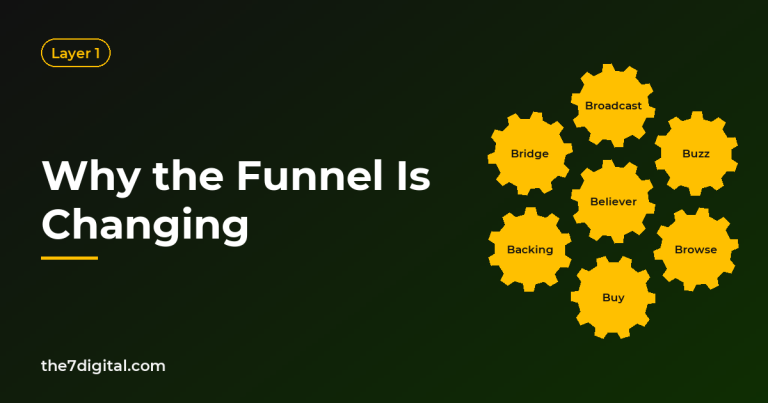
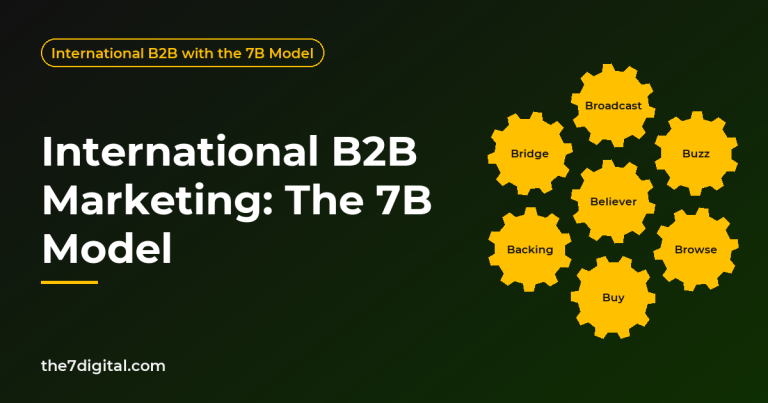
YouTube for B2B turns two main gears. Broadcast: Seeding valuable presence into the market, clear, steady and sharp enough that the right people know you exist. Browse: Where emotion meets reason: buyers verify and compare you through six gateways. Video reaches emotion and reason within minutes: viewers see the people and the plant, and the number on the gauge.
The three operating layers are Demand creation (Broadcast, Buzz), amplification (Backing, Bridge), demand capture (Browse, Buy); Believer is the connecting loop. A good video works in both the demand creation and the demand capture layer, and when customers share it or film their own, it turns Buzz and Backing too.
It also runs on all three energy flows: Paid, owned, earned-and-shared. Your channel is owned, Demand Gen is paid, and the links passed around a buying committee’s group chat are earned-and-shared, mostly in dark social, where analytics cannot see.
This article launches no new tool; the 7B Buying Table Map matches videos to people, and every term is defined in the 7B Glossary. The 7B Model was developed by Nguyen Dinh Bao (Bao7) at The7 Digital and is set out in full in the book Mô hình 7B cho B2B (Stop Begging, Start 7B). If the model is new to you, start with what the 7B Model is.
Selling B2B into Vietnam and ASEAN
Start with why the market deserves the effort. Goods classed as means of production made up 93.6% of Vietnam’s merchandise imports in 2025, worth US$426.11 billion, according to Vietnam’s National Statistics Office (2026). Registered foreign investment reached US$50.36 billion in the first nine months of 2026, up 76.4% year on year (NSO, 2026). Every new plant behind those numbers needs equipment, materials and services, and a buying committee to choose them.
Then look at where those buyers spend their screen time. DataReportal’s Digital 2026: Vietnam report (2025) cites Google’s advertising resources showing 62.1 million YouTube users in Vietnam in late 2025, against 10.0 million LinkedIn members. LinkedIn counts registered members rather than monthly active users, so this is not like for like, but the gap in scale is hard to ignore. Google also held 93.38% of Vietnam’s search engine market in October 2026 (StatCounter, 2026), so video that is easy to find on YouTube and Google meets Vietnamese buyers where most of their searching happens.
Language is where many foreign suppliers lose the room. In the EF English Proficiency Index 2025, Vietnam ranked 64th with a score of 500, and purchasing and procurement staff scored 495 (EF Education First, 2025). Thailand ranked 116th with 402 and Malaysia 24th with 581. Automation will not close the gap yet: in November 2026, YouTube Help listed English videos as eligible for automatic dubbing into 20 languages, including Indonesian, but not Vietnamese or Thai. Budget for Vietnamese and Thai subtitles checked by someone who knows your industry’s vocabulary.
Who watches matters as much as what they watch. On Hofstede’s model as published by The Culture Factor (2026), Vietnam scores 70 on power distance: hierarchy is accepted and centralization is popular. Engineers may run the evaluation, but expect the final call to sit higher up. Give the owner a two-minute results video in Vietnamese, the engineers the long demo and procurement the process video: same footage, cut three ways.
Across ASEAN, treat each country as a machine of its own. A playlist that works in Kuala Lumpur will not carry a buying committee in Bangkok without Thai subtitles. Keep the core footage, rebuild the language layer and local proof for each market, and measure each country separately.
Conclusion: B2B video is evidence, not a pitch
Go back to that shortlist meeting in northern Vietnam. The supplier that survived did not have the biggest budget or a famous actor. It had already answered, in the owner’s language, the question he was about to ask.
YouTube for B2B is not a stage for telling buyers how good you are. It is where every person at the table can check it for themselves. Firms that understand this stop asking how many views a video got and start asking what each member of the buying committee has seen.
The previous article, LinkedIn Ads for cross-border B2B, covers the other paid channel behind Broadcast. The next, trade shows in the 7B machine, turns a booth into a film set. For the full map, read international B2B marketing with the 7B Model, then the total product in B2B to see why demos serve the pre-sale stage too.
Frequently asked questions
Should B2B companies run YouTube ads?
Yes, once you have something worth watching. According to Gartner (2026), 53% of IT and high-tech buyers rely on YouTube for product and vendor decisions. Ads only amplify what you have, so if your channel is empty, build the Browse videos first.
How long should a B2B YouTube video be?
There is no single right length. The 7B Model book (chapter 6) suggests a pillar video of fifteen to thirty minutes, cut into three to five clips of 60 to 90 seconds for Shorts and social feeds. Demos for users can run long; videos for approvers should be short.
Can YouTube ads reach B2B decision makers?
Yes, if you go beyond broad demographics. Use custom segments built from terms buyers searched on Google and YouTube, your own customer lists through Customer Match, and people who already watched your videos or visited your site, all inside a Demand Gen campaign.
How do I make B2B videos if I do not want to be on camera?
Let your product, plant, engineers and customers appear instead. A single-take test, a walk along the line, an engineer explaining a design choice or a customer on their own shop floor all build trust. Volvo Trucks’ Live Test series, built around tests of technical features, passed 100 million YouTube views (Volvo Trucks, 2014).
Your demos, your factory and your engineers, placed in front of B2B buyers while they research. The7 plans and runs YouTube Ads for B2B. Talk to us.
International B2B with the 7B Model · Part 9 of 24 · Previous: LinkedIn Ads for Cross-Border B2B · Next: Trade Shows in the 7B Machine · Pillar article: International B2B Marketing: The 7B Model
References
- Gartner (2026). Don’t Ignore YouTube in Your Demand Gen Mix (research summary by Sarah Brennan and Isoke Mitchell, February 10, 2026; copy on Gartner’s content server, same as www.gartner.com/en/documents/7424462). https://gcom.pdo.aws.gartner.com/en/documents/7424462
- Gartner (2023). Gartner Marketing Survey Finds B2B Buyers Value Third-Party Interactions More Than Digital Supplier Interactions, as reported by CIO Tech Asia (June 14, 2023): B2B buyers place greater value on third-party interactions. https://ciotechasia.com/b2b-buyers-place-greater-value-on-third-party-interactions/
- Gartner (2025). Gartner sales survey on B2B buying groups (press release of May 7, 2025), as reported by IT-Online (May 16, 2025): B2B buyer teams demonstrate “unhealthy conflict”. https://it-online.co.za/?p=296904
- Volvo Group (2013). Jean-Claude Van Damme se equilibra entre dois caminhões graças à direção eletro-hidráulica Volvo (news item of November 19, 2013, in Portuguese). https://www.volvogroup.com/br/news-and-media/news/2013/nov/news-145460.html
- Volvo Group (2014). Award for technology behind “The Epic Split”. https://www.volvogroup.com/en/news-and-media/news/2014/apr/news-146839.html
- Volvo Trucks (2014). Epic triumph for Volvo Trucks’ campaign at Cannes Lions (press release, June 22, 2014). https://news.cision.com/volvo-trucks/r/epic-triumph-for-volvo-trucks–campaign-at-cannes-lions,c9604614
- Volvo Trucks (2015). Grand Prix for Volvo Trucks in Cannes (press release, June 24, 2015). https://news.cision.com/volvo-trucks/r/grand-prix-for-volvo-trucks-in-cannes,c9796290
- Google (n.d., accessed November 7, 2026). Video Action Campaigns are being upgraded to Demand Gen, Google Ads Help. https://support.google.com/google-ads/answer/15110871?hl=en
- Google (n.d., accessed November 7, 2026). About custom segments, Google Ads Help. https://support.google.com/google-ads/answer/9805516?hl=en
- Google (n.d., accessed November 7, 2026). About Customer Match, Google Ads Help. https://support.google.com/google-ads/answer/6379332?hl=en
- Google (n.d., accessed November 7, 2026). Demand Gen audiences overview, Google Ads Help. https://support.google.com/google-ads/answer/15594567?hl=en
- YouTube (n.d., accessed November 7, 2026). Use automatic dubbing, YouTube Help. https://support.google.com/youtube/answer/15569972?hl=en
- General Statistics Office of Vietnam, now the National Statistics Office (2026). Báo cáo tình hình kinh tế xã hội quý IV và năm 2025 (Socio-economic situation report, Q4 and full year 2025). https://www.nso.gov.vn/du-lieu-va-so-lieu-thong-ke/2026/01/bao-cao-tinh-hinh-kinh-te-xa-hoi-quy-iv-va-nam-2025/
- National Statistics Office of Vietnam (2026). Một số nét chính tình hình kinh tế xã hội quý III và 9 tháng năm 2026 (Key socio-economic highlights, Q3 and first nine months of 2026). https://www.nso.gov.vn/bai-top/2026/10/mot-so-net-chinh-tinh-hinh-kinh-te-xa-hoi-quy-iii-va-9-thang-nam-2026/
- DataReportal, Kepios (2025). Digital 2026: Vietnam. https://datareportal.com/reports/digital-2026-vietnam
- StatCounter Global Stats (2026). Search Engine Market Share in Viet Nam, October 2026. https://gs.statcounter.com/search-engine-market-share/all/viet-nam
- EF Education First (2025). EF English Proficiency Index 2025: Vietnam. https://www.ef.com/wwen/epi/regions/asia/vietnam/
- EF Education First (2025). EF English Proficiency Index 2025: Thailand. https://www.ef.com/wwen/epi/regions/asia/thailand/
- EF Education First (2025). EF English Proficiency Index 2025: Malaysia. https://www.ef.com/wwen/epi/regions/asia/malaysia/
- The Culture Factor Group (2026). Country comparison tool: Vietnam (Hofstede’s cultural dimensions). https://www.theculturefactor.com/country-comparison-tool?countries=vietnam