Summary: A B2B marketing team works best organized by gear rather than by channel or department: each of the seven gears has exactly one captain, the captain changes as a deal moves, and sometimes the captain is a partner. In the 7B Model, the team turns all seven gears, and the 7B Gear Captain Matrix names who steers each.
Picture the plan headquarters has just approved for Vietnam: a country manager in Ho Chi Minh City, two sellers, a marketing executive, a service engineer shared with Thailand, and a distributor in Hanoi who has promised to open doors. On paper, that is your Vietnam team.
Your first serious prospect, if it resembles the typical decision in Forrester’s 2026 buyer research, involves 13 internal stakeholders and nine outside influencers (Forrester, 2026). And many of the people who will shape your reputation are not on your team list: the engineer who restarts a line at midnight, the finance clerk whose invoices never need fixing, the regional director whose LinkedIn analysis the customer’s engineers still keep.
Evert Gummesson named this gap in 1991 with the part-time marketer: someone who does not belong to the marketing or sales department yet carries out marketing activities, influencing customer relations whatever unit they sit in (Gummesson, 1991, as summarized by Miles, 2026). Which raises the obvious question. If everyone markets, who is accountable when the machine stops?
This article answers it for anyone building a B2B marketing team, at home or in a new market such as Vietnam, and introduces the 7B Gear Captain Matrix along the way.
Does “total marketing” mean everyone does marketing?
I borrow the phrase total marketing from Professor Dae Ryun Chang of Yonsei University. In his International B2B Marketing course on Coursera, B2B marketing is cross-functional: the buyer arrives with a committee, so the seller needs a matching team, which he calls the selling center, and the person leading the selling effort, who need not be a marketer, changes from stage to stage. The idea of a rotating marketing captain is his; my contribution is to map it onto the seven gears.
But total marketing does not mean equal accountability. The Mô hình 7B cho B2B book insists that every goal carries one person’s name, not a department’s, because responsibility shared by all ends up owned by none (Mô hình 7B cho B2B book, chapter 13). Everyone touches the machine; each gear has one captain. Most companies do the opposite and split marketing by channel, so the work between departments, from collecting references to protecting a customer’s first months, belongs to no dashboard.
Buyers notice. According to Gartner (2025), 69% of B2B buyers report inconsistencies between a supplier’s website and what its sellers tell them. A Gartner (2024) survey of 412 marketing and sales leaders found that the two functions typically collaborate on only three of 15 commercial activities. That is the second operating principle of the 7B Model at work: one stuck gear slows the whole flywheel, and the first gear to stick is the one nobody owns.
Where does a lone seller lose against a buying committee?
Forrester (2024) found that on average 13 people within an organization are involved in a B2B buying decision, and that 89% of purchases involve two or more departments. Against that, many companies still send one account manager and a borrowed engineer. Professor Chang’s point is that a lone seller is outnumbered in headcount and in expertise. In practice the loss happens in three places.
Depth: the engineer asks about tolerances, the finance lead about five-year cost, IT about data security, procurement about penalties, and one person rarely answers all four at the depth each of them trusts. Procurement carries real weight: Forrester (2026) found that procurement professionals are decision-makers in 53% of business buying cycles.
Time: Salesforce’s survey of 4,050 sales professionals found that the average seller spends only 40% of their time selling (Salesforce, 2026). Someone serving four roles and twenty-odd people will miss a conversation, usually the one that decides.
Reach: Bain & Company (2026) cites a LinkedIn and Bain analysis in which hidden buyers in procurement, finance and IT hold half of the influence over the purchase decision. A 2025 LinkedIn and Edelman report, summarized by Marketing-Interactive (2025), found that more than 40% of B2B deals stall because of internal misalignment within buying groups.
The fix is not more sellers but matching people to people: engineer to engineer, finance to finance, executive to executive, with the seller keeping time. For the people who never attend, you need content good enough to be forwarded through dark social. The same logic drives account-based marketing: a large account is a group of people, so serve it with one.
When should engineers, finance or the CEO take the helm?
Professor Chang answers by stage: engineers lead while the customer works through a technical problem, sales and marketing lead the bidding and negotiation, and technical support leads after delivery. The 7B Model adds that real deals rarely move in order. Customers can enter anywhere, through a referral in Bridge or an AI answer in Browse, so whichever gear a deal touches, that gear’s captain steps forward and the rest drop back into the crew.
Engineers take the wheel when buyers need to see rather than be told. More than 60% of business buyers now use a trial, and 78% of those making purchases of $10 million or more run one first (Forrester, 2026). In a trial, the most credible answer comes from someone who built the thing.
Finance takes the wheel when the question turns from “will it work?” to “is it worth it?” G2 (2026) reports that finance involvement in software decisions jumped from 31% to 46% in a single year, and that nearly half of software buyers said their CFO vetoed an approved deal in the last year. Send your own finance lead, with a lifetime cost model the customer can check.
The CEO takes the wheel twice: in the final round of Buy, when only the top of your company can give the commitment, and in Bridge, where strategic partnerships tend to open at leadership level. Otherwise the CEO belongs in the crew, as a voice in Broadcast rather than a hand on every wheel.
None of this is a handoff. Gartner (2018) argued that the marketing-to-sales handoff should no longer exist, a post-handoff world in the words of Gartner’s Brent Adamson. When engineers captain a trial, marketing still supplies the material and sales still runs the calendar. Change the captain, not the crew.
IBM Client Engineering: The pilot before the pitch
IBM has made rotation structural. Its IBM Client Engineering unit describes agile teams of business technology leaders, technology engineers, solution architects, designers and data scientists who co-create pilots with clients to prove value, within days to weeks (IBM, n.d.). In the City of Helsinki story on the same page, workshops with the city shaped the pilot, and the city went on to choose watsonx.ai as its new translation tool.
What carried the client to a decision was a pilot led by technologists, not a sales deck. In 7B terms, IBM hands the verification round of Browse and the first round of Buy to engineers, then talks about growing with the client toward enterprise scale, which passes the wheel to Believer. You do not need IBM’s size, only a written rule, agreed before the trial starts, that an engineer captains it.
When should a partner captain a gear?
A new country office cannot staff seven gears from payroll, and even large marketing teams feel short: in Gartner’s 2026 CMO Spend Survey, 56% of CMOs said their marketing organization lacks the budget to deliver its 2026 strategy, and 54% reported insufficient resources (Gartner, 2026). So the question is which gears to hand over, and how far.
The three energy flows give the rule. The Mô hình 7B cho B2B book describes Browse as leaning on owned and paid energy, Buzz as mostly earned because real buzz cannot be bought, and Believer as almost entirely owned (Mô hình 7B cho B2B book, chapter 5). The paid flow is the easiest to hand over, the owned flow should stay in-house, and the earned-and-shared flow can only be sparked, never outsourced.
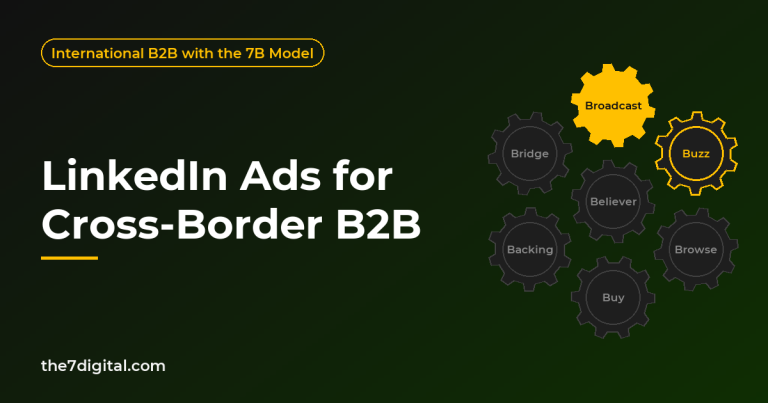
Partners captain best in three places: the paid side of Broadcast and Browse, which needs scale and daily attention (see paid advertising in B2B); Bridge and Believer in markets where you have no people yet, through distributors, integrators and service partners; and the ecosystem layer of Backing, through trade media and associations. Deep product knowledge and long relationships stay inside, and the article on agency or in-house covers how to choose.
Hand over the wheel, never the keys. Ad accounts, customer data and the relationship with decision-makers stay in your name, because partnerships end: in Gartner’s 2025 CMO Spend Survey, 39% of CMOs planned to cut agency budgets, with streamlining agency rosters among the top cost-saving moves (Gartner, 2025). In Vietnam, that paid side of Broadcast and Browse is the work The7 takes on for clients through its comprehensive digital marketing services. Whoever you pick, put them in the matrix as a named captain with a signal, not as a black box.
Caterpillar: Dealers at the wheel, except in Japan
For partner captaincy at scale, read Caterpillar’s annual report. In its Form 10-K for fiscal 2025, the company says it distributes its machines principally through a worldwide dealer network, 41 dealers in the United States and 109 outside it, serving 190 countries (Caterpillar, 2026). The dealers are not exclusive, but in most cases selling and servicing Caterpillar products is their principal business.
In 7B terms, dealers hold the wheel for Buy and Believer almost everywhere. Now look at how Caterpillar keeps the keys. Each relationship sits in a standard sales and service agreement: dealers buy, sell and service products within a defined territory and must employ adequate sales and support staff, while Caterpillar defends its intellectual property and provides warranty and technical support to the dealer. Either side can terminate at will, usually with 90 days’ written notice.
In Japan, Caterpillar goes further, owning and operating a dealership that covers about 80% of the market, Nippon Caterpillar Division (Caterpillar, 2026). Same company, same gear, a different captain by country, which is exactly why the matrix has to be filled in market by market.
What does the 7B Gear Captain Matrix look like?
The 7B Gear Captain Matrix combines the RACI chart from project management with Professor Chang’s rotating captain and applies both to the seven gears. RACI sorts people into Responsible, Accountable, Consulted and Informed, and its golden rule, as Mind Tools (2024) puts it, is one, and only one, accountable person. In the matrix, that person is the captain: they own the gear’s signal, settle disputes and answer first when it sticks. Below is a sample for a mid-sized foreign B2B company building its Vietnam operation; print it and write real names in the last column.
| Gear | Captain | Crew | Consulted | Informed | Partner support | Signal | Captain’s name |
|---|---|---|---|---|---|---|---|
| Broadcast | Regional content lead | Experts, engineers | Sales | Country manager | Ad agency | Branded search | |
| Buzz | Regional content lead | Sales, experts | Service | Country manager | Industry groups | Unprompted mentions | |
| Browse | Local digital lead | Engineers, sales | Service | Country manager | Search agency | Five-gateway score | |
| Buy | Country manager | Engineers, finance | Marketing | Regional MD | Distributor | Win rate | |
| Believer | Service lead | Sales, engineers | Marketing | Country manager | Service partner | Retention | |
| Backing | Marketing lead | Service, sales | Legal | Country manager | Trade media | New cases, reviews | |
| Bridge | Regional MD | Sales, service | Finance | Marketing | Channel partners | Referred deals | |
| The 7B Model · the7digital.com | |||||||
Five rules for filling it in:
- One captain per gear, named as a person, never as a department.
- Two gears per person at most, ideally from the same operating layer, such as Broadcast and Buzz.
- The captain owns the gear’s signal; the work is shared out to the crew.
- A partner goes in the captain column only when it truly leads the gear in a market or an energy flow, and whoever manages that partner then sits in the Consulted column.
- Review the matrix every quarter, alongside the seven-gear diagnosis.
Small teams can run it. The Mô hình 7B cho B2B book puts the whole machine at about 25 to 30 hours a week (Mô hình 7B cho B2B book, chapter 13); split across three or four people, that is roughly seven to eight hours each, which is still manageable. The one thing you cannot allow is a gear with no name next to it, because an unnamed gear is the next one to stick.
How do you reward departments for turning one machine?
A matrix dies if the pay plan says otherwise. Professor Chang stresses that cross-functional effort lasts only if evaluation and rewards recognize the supporting roles, not just whoever signs the contract. The data shows the gap: in Gartner’s 2024 survey, 90% of marketing and sales executives said their functional priorities conflict, while teams that share buyer journey insights were 1.6 times more likely to exceed revenue growth expectations (Gartner, 2024).
The 7B Model rewards on two layers. The first is each gear’s own signal, the signal column of the matrix. The second is four shared goals, one per layer: branded search for demand creation; the share of deals buyers say came from content, word of mouth or referrals for amplification; pipeline value, win rate and revenue for demand capture; and success stories, reviews, referrals and retention for the loyalty loop (Mô hình 7B cho B2B book, chapter 13). Pay partly on your gear and partly on the machine.
The second layer is where the crew gets credit. Tracking the content customers touched before closed deals shows whose engineering article sat on the path to which contract, and an open question, “How did you hear about us?”, shows which technician sparked a referral. What you can credit, you can reward.
Then keep the rhythm the book proposes: fifteen minutes a week on the content machine, thirty minutes a month on the dashboard, and two hours a quarter to re-diagnose all seven gears and rewrite the matrix (Mô hình 7B cho B2B book, chapter 13). The article on sales and marketing alignment goes deeper.
Where does the B2B marketing team fit in the 7B Model?
The team belongs to no single gear; it is the set of hands that turns all seven. Its anchor in the 7B Model is the two operating principles: Customers can enter anywhere; one stuck gear slows the whole flywheel. The first means every gear needs someone on duty, and the second explains why the ownerless gear sticks first. If the gears are new to you, start with the 7B Model.
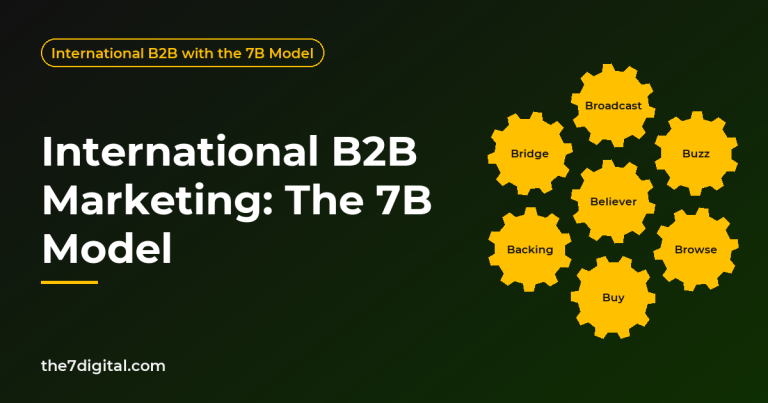
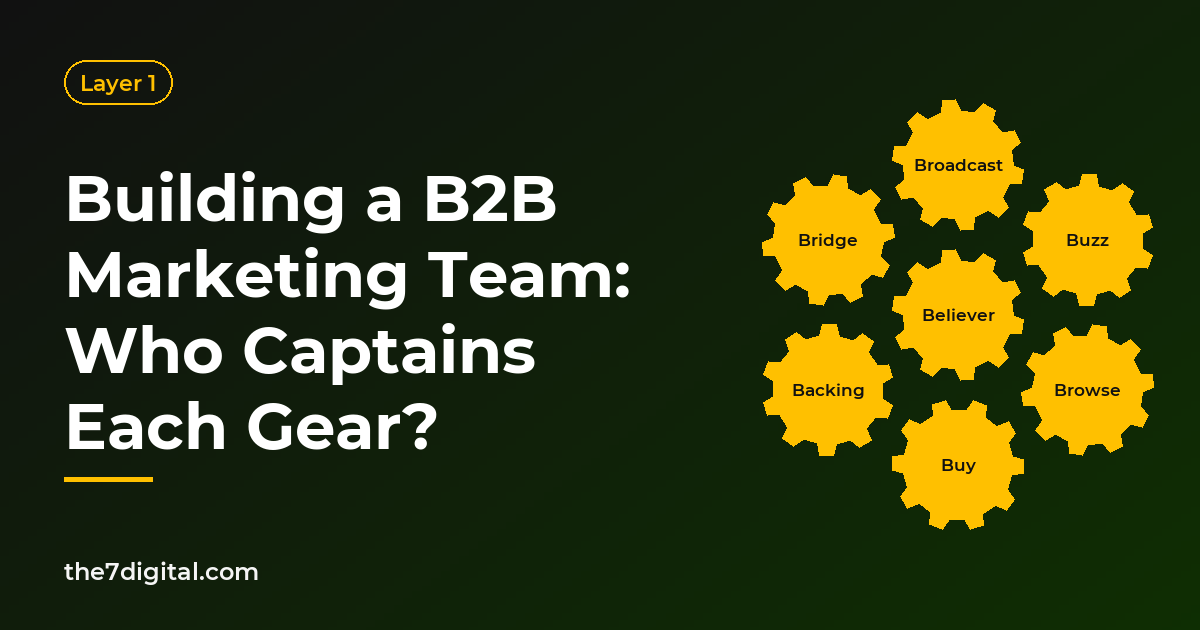
The gears sit in three operating layers: Demand creation (Broadcast, Buzz), amplification (Backing, Bridge), demand capture (Browse, Buy); Believer is the connecting loop. Demand creation needs expert storytellers and a steady content machine (see B2B content marketing), demand capture needs people who can carry a quarterly number, amplification needs relationship builders, and Believer needs someone customers can reach at midnight.
The three energy flows, paid, owned and earned-and-shared, decide what a partner can take over. The 7B Gear Captain Matrix, one of five named tools in the 7B Model, assigns an owner to every gear; definitions for every term are in the 7B Glossary.
The 7B Model was developed by Nguyen Dinh Bao (Bao7) at The7 Digital and is set out in full in the book Mô hình 7B cho B2B (Stop Begging, Start 7B).
Selling B2B into Vietnam and ASEAN
Staffing a Vietnam operation starts with a paradox. In EuroCham’s third-quarter 2026 survey, human capital was the most cited competitive advantage of Vietnam (52%), yet talent shortages were among the most cited obstacles (49%) (EuroCham Vietnam, 2026). Good people are there, and you will compete for them, so hire captains for the gears that must be local and borrow the rest from your regional hub or your partners.
Language decides who can captain Browse. In the EF English Proficiency Index 2025, Vietnam ranked 64th with a score of 500; by job function, marketing professionals scored 511, sales 507 and purchasing and procurement 495 (EF Education First, 2025). The procurement team reading your English contract may be less at ease in English than the sellers presenting it, so technical documents and the facts an AI assistant repeats about you should exist in Vietnamese, owned by a captain who writes it well.
Hierarchy and the in-group shape Buy and Bridge. On Hofstede’s model as published by The Culture Factor, Vietnam scores 70 on power distance, where hierarchy is accepted and centralization is popular, and 30 on individualism, a collectivistic society with long-term loyalty to the in-group. Your last round of Buy may need someone senior enough to face the customer’s top decision-maker, and a local partner already inside the in-group is a natural Bridge captain.
Mind the audience your Broadcast captain inherits. In late 2025, LinkedIn counted 10.0 million members in Vietnam, and its ads could reach 13.5% of people aged 18 and over (DataReportal, 2025). That is a meaningful professional audience but not the whole buying group, so build the paid plan around the people in the matrix rather than around one platform.
Finally, do not force one matrix onto the region. Intra-ASEAN trade reached US$822 billion in 2024, according to the ASEAN Secretariat’s end-term review as published by Vietnam’s Ministry of Industry and Trade (2025). If you run Vietnam from Singapore or Bangkok, the hub can captain Broadcast and Backing, the voice and the proof that travel well, while Browse, Buy and Believer need a country captain. The article on choosing international markets introduces the 7B Market X-Ray for scoring each country.
Conclusion: Do not ask who does marketing; ask who captains which gear
Headquarters counted five people and a distributor. Your customers will count the engineer, the finance clerk and the regional director who earned their trust. Both counts are right, and the gap between them is where the machine sticks.
Total marketing does not ask everyone to market. It asks for an owner on every gear, a wheel that passes as the deal moves, partners on the parts that need scale or local presence, and a pay plan that sees the crew. Do not ask who does marketing. Ask who captains which gear, and which gear has nobody.
For the in-house question, read agency or in-house; for working as one team, read about sales and marketing alignment. The previous article in the series, on early vendor involvement, shows why engineers should captain before the RFQ arrives, and the next, on push and pull in B2B, takes the machine into demand creation.
Frequently asked questions
Should a B2B marketing team be organized by channel or by gear?
By gear. Channel teams build skill but leave the work between departments unowned, such as keeping the website and the sellers consistent. A gear structure gives each gear one captain, who pulls in sales, engineering, service, finance and partners as crew.
How is the 7B Gear Captain Matrix different from a RACI chart?
It keeps RACI’s roles, but each row is a gear, not a project task. It adds partner support and a signal for each gear, and it builds in rotation, following Professor Dae Ryun Chang’s idea of a rotating marketing captain: the captain owns the gear, while the lead on a deal moves to whichever gear the deal is touching.
How do you staff the gears with a team of two or three people?
Give each person at most two gears from the same operating layer, let the most senior person hold Bridge, and hand the paid side of Broadcast and Browse to a partner. The Mô hình 7B cho B2B book puts the machine at about 25 to 30 hours a week, so a small team can run it with a steady rhythm. What matters most is that no gear goes unnamed.
When should a partner captain a gear?
When the gear needs scale, tools or local presence you lack, such as paid media, after-sales service in a distant market or distribution abroad. Keep the ad accounts, the data and the decision-maker relationships in your name, and invest in making your partner a better captain.
International B2B with the 7B Model · Part 5 of 24 · Previous: Early Vendor Involvement: Win Before the RFQ · Next: Push and Pull in B2B · Pillar article: International B2B Marketing: The 7B Model
References
- Forrester (2026). Forrester’s 2026 Buyer Insights: GenAI Is Upending B2B Buying As Leaders Face Mounting Pressure To Justify Every Dollar Spent. https://www.forrester.com/press-newsroom/forrester-2026-the-state-of-business-buying/
- Miles, C. (2026). Constructions of marketing work: a critical review. Journal of Marketing Management, 42(3-4), 324-354; Bournemouth University repository copy, citing Gummesson, E. (1991), Marketing-orientation Revisited: The Crucial Role of the Part-time Marketer. https://eprints.bournemouth.ac.uk/41380/1/Constructions%20of%20marketing%20work%20%20a%20critical%20Review.pdf
- Chang, D. R., Yonsei University (n.d.). International B2B (Business to Business) Marketing, course on Coursera (accessed November 7, 2026). https://www.coursera.org/learn/b2b-marketing
- Gartner (2025). Gartner Sales Survey Finds 61% of B2B Buyers Prefer a Rep-Free Buying Experience (copy on Gartner’s content server). https://gcom.pdo.aws.gartner.com/en/newsroom/press-releases/2025-06-25-gartner-sales-survey-finds-61-percent-of-b2b-buyers-prefer-a-rep-free-buying-experience
- Gartner (2024). Gartner Survey Reveals Marketing and Sales Functions Collaborate on Only Three Out of 15 Commercial Activities (copy on Gartner’s content server). https://gcom.pdo.aws.gartner.com/en/newsroom/press-releases/2024-06-03-gartner-survey-reveals-marketing-and-sales-functions-collaborate-on-only-three-out-of-15-commercial-activities
- Forrester (2024). Forrester: To Master B2B Buying Mayhem, Providers Must Prioritize Buyers’ Needs. https://www.forrester.com/press-newsroom/forrester-the-state-of-business-buying-2024/
- Salesforce (2026). The Productivity Gap: New Survey Shows 9 in 10 Sellers Are Betting on AI and Agents To Help. https://www.salesforce.com/news/stories/state-of-sales-report-announcement-2026/
- Bain & Company (2026). Raising the Odds on a Deal: How Likelihood to Buy Rewires B2B Growth. https://www.bain.com/insights/raising-the-odds-on-a-deal-how-likelihood-to-buy-rewires-b2b-growth/
- Marketing-Interactive (2025). Report: Over 40% of B2B deals stall due to hidden buyers (on the LinkedIn and Edelman report Invisible Influence). https://www.marketing-interactive.com/report-over-40-of-b2b-deals-stall-due-to-hidden-buyers
- G2 (2026). New G2 Research: AI Is Reshaping How B2B Software Deals Are Won and Lost. https://company.g2.com/news/buyer-behavior-2026
- Gartner (2018). Gartner Says the Marketing-to-Sales Handoff Should No Longer Exist (copy on Gartner’s content server). https://gcom.pdo.aws.gartner.com/en/newsroom/press-releases/2018-10-09-gartner-says-the-marketing-to-sales-handoff-should-no-longer-exist
- IBM (n.d.). IBM Client Engineering (accessed November 7, 2026). https://www.ibm.com/client-engineering
- Gartner (2026). Gartner 2026 CMO Spend Survey Finds CMOs Allocate 15.3% of Marketing Budgets to AI But Only 30% Are Ready to Scale AI Capabilities (copy on Gartner’s content server). https://gcom.pdo.aws.gartner.com/en/newsroom/press-releases/2026-05-11-gartner-2026-cmo-spend-survey-finds-cmos-allocate-15-point-3-percent-of-marketing-budgets-to-ai-but-only-30-percent-are-ready-to-scale-ai-capabilities
- Gartner (2025). Gartner 2025 CMO Spend Survey Reveals Marketing Budgets Have Flatlined at 7.7% of Overall Company Revenue (copy on Gartner’s content server). https://gcom.pdo.aws.gartner.com/en/newsroom/press-releases/2025-05-12-gartner-2025-cmo-spend-survey-reveals-marketing-budgets-have-flatlined-at-seven-percent-of-overall-company-revenue
- Caterpillar (2026). Form 10-K for the fiscal year ended December 31, 2025. https://www.sec.gov/Archives/edgar/data/18230/000001823026000008/cat-20251231.htm
- Mind Tools (2024). The RACI Matrix. https://www.mindtools.com/agn584l/the-raci-matrix
- EuroCham Vietnam (2026). EuroCham Business Confidence Index Q3 2026: Translating Economic Gains Into Business Opportunities. https://eurochamvn.org/eurocham-business-confidence-index-q3-2026-translating-economic-gains-into-business-opportunities/
- EF Education First (2025). EF English Proficiency Index 2025: Vietnam. https://www.ef.com/wwen/epi/regions/asia/vietnam/
- The Culture Factor Group (n.d.). Country comparison tool: Vietnam (accessed November 7, 2026). https://www.theculturefactor.com/country-comparison-tool?countries=vietnam
- DataReportal (2025). Digital 2026: Vietnam. https://datareportal.com/reports/digital-2026-vietnam
- Vietnam Ministry of Industry and Trade (2025). Review of the Implementation of the ASEAN Economic Community Blueprint 2025. https://vntr.moit.gov.vn/news/tong-ket-trien-khai-ke-hoach-tong-the-cong-dong-kinh-te-asean-2025