Summary: A B2B value stack is the set of layers one product offers, from price and specifications to safety and the sponsor’s reputation. Each person on the buying committee buys a different layer, so restack the offer for each seat instead of pitching the whole table. In the 7B Model, this sits in the Buy and Browse gears.
On 6 November 2026, during the National Assembly’s debate on the draft revised Law on Bidding, a delegate asked for something that sounds technical and is not. Nguyen Vu Trung, a Ho Chi Minh City delegate, proposed that when a bid package carries significant operating, maintenance or consumables costs, the tender documents must define and publish how life-cycle cost will be evaluated. Low price, he argued, is not the same as best value: a health facility that buys on the cheapest upfront price can pay heavily later for consumables, chemicals, maintenance and downtime (VietTimes, 2026). It was a proposal, not a rule.
The argument is about whether a buyer must see more than one layer of the product. If a parliament has to debate that, ask what your own customers see: in a private factory, every seat reads a different layer of your offer right now.
This article covers what a value stack is, why procurement and engineering read different layers, when to restack or de-feature, the full 7B Buying Table Map, and what changes when the table sits in Vietnam.
What is a value stack?
A B2B product is not an object. It is a stack: the item and its specifications; the terms around it, such as price, payment and delivery; the service that surrounds it; the risk it removes; and what it does for the standing of whoever proposed buying it. Each seat looks at that stack from a different height, so each pays for a different layer. In his International B2B Marketing course on Coursera, Professor Dae Ryun Chang of Yonsei University credits this value stack concept to Das Narayandas of Harvard Business School.
Bain & Company (2018) publishes a map of the layers: 40 elements of value in a five-tier pyramid, from table stakes through functional, ease of doing business and individual to inspirational. The base is objective value; the higher you climb, the more subjective and personal it gets, and for some purchases reputation and reduced anxiety play a large role.
In a 2006 Harvard Business Review story, a chip maker (unnamed by the authors) hoped to supply 5 million chips for a customer’s next-generation product, and a rival was 10 cents cheaper per unit. The customer’s own value model said the chip, though 10 cents dearer, was worth 15.9 cents more; its lead engineer had urged the purchasing manager to buy it. The supplier’s service was worth 0.2 cents. Having overlooked the two elements the customer valued most, the salesperson cut his price by 10 cents and left at least half a million dollars on the table (Anderson, Narus and Van Rossum, 2006).
Levitt’s layers in the total product describe what a product contains; the value stack asks who buys which layer.
Why does procurement see the price while engineering sees the features?
Because each seat is graded on its own scorecard. Procurement is judged on unit price and savings, engineers on whether the equipment runs right, the plant manager on machine hours, the champion on not looking wrong in front of the boss. A seat does not misunderstand your product; it reads the line it answers for.
Bain shows the gap at scale. According to Harvard Business Review (2018), procurement teams evaluate vendors rigorously and run total cost of ownership models, yet meeting price and specification criteria is now only table stakes. Bain surveyed more than 2,300 corporate decision makers in two industries, IT infrastructure and commercial insurance. In IT infrastructure, respondents ranked cost reduction first, but product quality, expertise and responsiveness predicted loyalty best, and cost reduction was not even in the top 10. On average, 43% said they were highly likely to buy again from companies that excelled on many elements, against 21% for companies with no excellent scores (Bain & Company, 2018).
What buyers say they buy and what they reward sit on different layers of the same product.
Sandvik Coromant: The tool is the smallest line on the bill
In January 2026, two trade publications covered Pay per Part, a service from Sandvik Coromant, the metal-cutting tools maker. The company’s own research, according to Machinery Market (2026), shows that tooling accounts for only 3 to 5 percent of total production costs. Yet poor tool management brings operator downtime, scrap and emergency purchases, and as much as 20 percent of an operator’s time can be lost searching for the right tool, according to Engineering News (2026). Neither article names a customer, so these are the company’s claims, not results measured at a real shop.
Pay per Part takes that burden off the shop floor. The customer pays a fixed cost for every finished component instead of buying tools as consumables, and Sandvik Coromant reviews the tooling strategy, selects tools and machining parameters, and keeps optimizing. Johan Huss, its vice president of digital products and services, says the future lies in business models that remove complexity from the shop floor and tie costs directly to output (Machinery Market, 2026). Engineering News (2026) sums up the promise in a quoted line: “Costs become transparent and predictable, with no hidden expenses.”
My reading, not the company’s: three seats, three products, one box of inserts. Procurement buys the unit price of an insert, finance buys a number it can forecast, and the shop-floor manager buys running machine hours and an operator who is not hunting for tools. Pay per Part restacks the same product in the shop’s own unit, cost per finished part. That is Buy, since each seat purchases a different product, and Browse, since each seat verifies with its own number.
Ask what share of your customer’s cost your item really is and who carries the rest. Total cost of ownership shows how to count it; Rolls-Royce sells flying hours shows how to sell the outcome itself.
When does restacking or de-featuring pay?
Restacking keeps every layer but changes the order and the unit for each seat and moment; de-featuring drops a layer that a customer group, or one seat, does not pay for. Professor Chang also discusses reconfiguring or trimming the stack depending on the situation.
Restacking is cheaper than it sounds because the raw material exists: according to the 7B Model book (chapter 9), most of the content for the five roles is already on your shelf, and the work is packaging it by role.
Anderson, Narus and Van Rossum (2006) describe a maker of high-performance gas chromatographs for research laboratories. It took its most basic model to commercial laboratories, but its salespeople kept praising sample integrity. The prospects scoffed: they routinely tested soil and water samples, where integrity was no concern. My reading: the basic model was the cut; the mistake was a pitch still aimed at the old buyers. The article adds that a supplier might even cede to the next best alternative the differences customers value least, to focus on the one or two they value most.
The counterexample is cutting the wrong layer. Bain (2018) tells of a US telecom firm that upgraded its fiber-optic video service with a China-based vendor chosen for the lowest price. The network suffered outages, technical support was 12 hours away and major changes launched without notice. The firm eventually switched vendors, at a heavy cost in time, money and reputation with its own customers. My reading: the cheapest bid had cut the layers the accountable person needed.
Three tests before I cut. Does the layer matter little to the seat that decides? Does the saving go into the difference this customer values most, or into price parity to pass the procurement door? Does the cut leave intact the layer that protects the accountable person? Pass all three and cut; fail one and restack instead.
How do you fill in the full 7B Buying Table Map?
The 7B Buying Table Map debuted in the cross-cultural buying council with six seats (the five people in the 7B Model book, chapter 2, plus the gatekeeper) and a weight column per country; the 7B Glossary defines it.
Drawing the table is an old idea: Bain & Company (2018) advises mapping who is on the buying team, who influences it, and each person’s priorities and sources of value, and Professor Dae Ryun Chang bundles who, when, what and weight into his 4W approach. The 7B map adds the gear each seat enters through and the gateway where it verifies you; here a seventh column, the value layer each seat buys, sits third.
Here is an illustrative fill-in: a European industrial sensor maker pitching a Korean-owned electronics plant in Bac Ninh. It is hypothetical, no real company is named, and the 1 to 5 weights are scores the mapper assigns, not data.
| Seat at the table | Who sits here | Value layer they buy | Weight | Gear they enter through | Gateway they verify you on | What they need to see before they nod |
|---|---|---|---|---|---|---|
| Champion | Vietnamese process engineer | Looking right to the Korean boss | 3 | Broadcast | A one-page brief in Korean and Vietnamese | |
| Signer | Korean plant director | Cost per unit, steady supply | 4 | Backing | Conversational AI | A Korean reference plant |
| Influencer | HQ R&D engineer in Korea | Accuracy, integration | 4 | Buzz | Specialist review platforms | Third-party test data |
| Direct user | Line supervisor | Fewer stops, training in Vietnamese | 2 | Browse | YouTube | A setup video in Vietnamese |
| Veto holder | QA and IT security | No risk to the line or the data | 5 | Browse | Search | Certificates and a security note, ungated |
| Gatekeeper | Purchasing assistant | A complete file | 3 | Broadcast | A tender-ready document pack | |
| The 7B Model · the7digital.com | ||||||
The core value line, one point of parity and two of difference: price on par with the incumbent, qualified to the plant’s standard from the first lot, faster to integrate on the line.
The signer and the influencer sit in Korea, the users in Bac Ninh, each reading in a different language. The veto seat, QA and IT security, weighs 5: it buys no risk and will search for your certificates before it speaks to you. The value column says what to make; the gear column says when. If you run account-based marketing (ABM), every target account is one map.
How do you write for five people without sending five messages?
The B2B buying committee showed how content that panders to each person can split a table. The way out is not five messages but one message translated five times.
Anderson, Narus and Van Rossum (2006) sort the ways suppliers use “value proposition” into three: all benefits, favorable points of difference, and resonating focus, meaning one or two points of difference, perhaps with one point of parity, proven and documented. The first kind collapses into claims every rival can make.
Sonoco shows the opposite discipline. In the same article, the global packaging supplier from Hartsville, South Carolina, proposed a packaging redesign to a large European customer. The redesign had six favorable points of difference, but Sonoco chose to lead with three: the same price as the current packaging (parity, since the customer would not consider a redesign at a higher price); faster closing that let the customer’s fill lines move from a seven-day, three-shift schedule at peak to five days and two shifts; and a look consumers found more appealing, lifting the customer’s revenue and profit.
My reading: one sentence, three seats. Procurement hears “same price”, the plant hears “two shifts, not three”, marketing hears “shoppers like it more”. That is restacking inside a single message; five separate messages risk becoming a list of reasons nobody remembers. The 7B method has three steps: write one value line for the whole table; translate it into each seat’s unit, such as unit price, shifts, defect rate, cost forecast or standing; and place each translation at the gateway where that seat verifies you, when it steps in (the 7B Model book, chapter 9).
The paid flow of the machine suits this work. LinkedIn lets advertisers target by job function, title and industry, and from API version 202603 by Buyer Groups (Microsoft Learn, 2026). According to diginomica (2025), Buyer Groups is an AI-powered way to find decision makers and key stakeholders at a company, including hidden buyers in procurement, finance, legal and operations.
The7 runs LinkedIn Ads on this logic as part of its full-service digital marketing in Vietnam: each layer of the stack reaches the function that buys it.
Where does the value stack fit in the 7B Model?
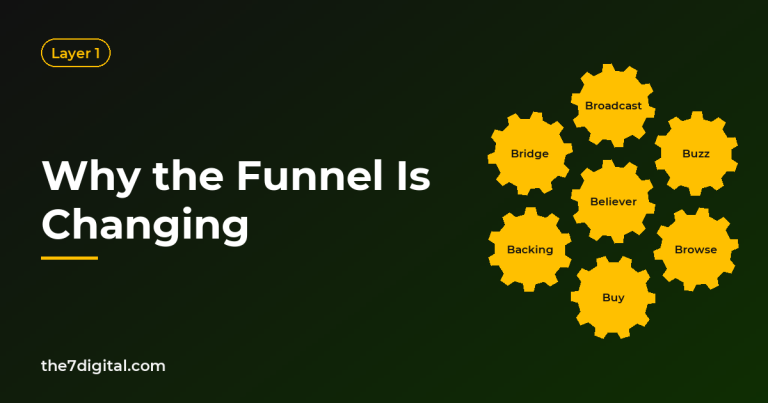
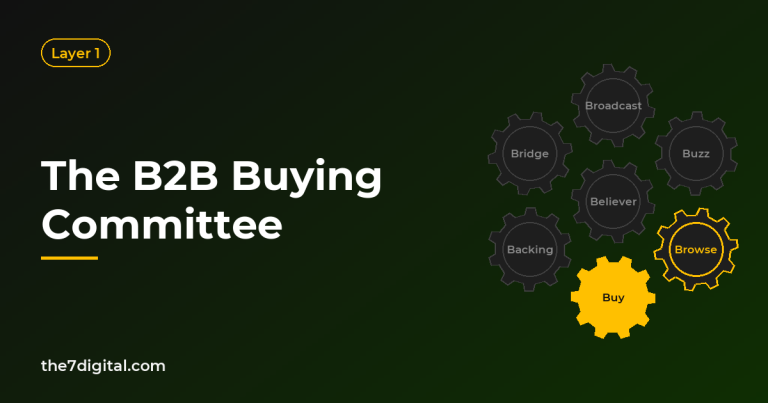
The value stack explains why “many people” in the Buy gear is more than a head count. The Buy gear is defined this way: A process of many people and many rounds; a door, not the final wall. Each person buys a different layer, each round opens one seat’s layer, and the value line must still hold after the signature, when users check their layer again.
The Browse gear: Where emotion meets reason: buyers verify and compare you through six gateways. Each seat verifies its own layer at its own gateway: engineers watch a video, the quality department searches for documents, the signer asks conversational AI about similar customers.
Both gears sit in the demand capture layer, the stage that converts demand into orders, although champions and signers have often entered earlier, through Broadcast and Backing (the 7B Model book, chapter 2). The three energy flows divide the work: owned is a content library organized by layer, as B2B content marketing describes; paid puts each layer in front of the function that buys it; earned-and-shared is a colleague of the veto seat speaking for you.
If the model is new to you, start with what the 7B Model is. The 7B Model was developed by Nguyen Dinh Bao (Bao7) at The7 Digital and is set out in full in the book Mô hình 7B cho B2B (Stop Begging, Start 7B).
Selling B2B into Vietnam and ASEAN
The table often sits in two countries. In JETRO’s survey for fiscal year 2025, Japanese manufacturers in Vietnam sourced 38.1% of their parts and raw materials locally, against 42.9% across ASEAN (JETRO, 2026). “Local” includes Japanese and other foreign suppliers based in Vietnam, so the rest is imported. My reading: where much of the supply is imported, a change of supplier often has seats in two places, the workshop and quality department in Vietnam, design and purchasing at headquarters. Map both rooms, in both languages.
The price layer is contested. In the same survey, 30.8% of the 334 Japanese manufacturers in Vietnam that answered named Chinese companies as their most competitive rivals, up from 24.6% a year earlier (JETRO, 2026). Many firms facing Chinese competition work on their cost position through price and cost cuts. If you sell to such a plant, expect its purchasing seat to press on price. A discount answers that one seat; restacking answers the table.
Public buyers write the weights down. The Assembly debate that opened this article is the public sector arguing about which layers a buyer may count. Whether or not the life-cycle proposal ever becomes law, read the evaluation method in every tender you answer: the layer that counts is written there.
Reach each seat in its own language. Vietnamese for the line and the plant floor, the parent company’s language for headquarters. LinkedIn can target by job function and Buyer Groups, as above, so a cost model can reach finance and a quality file can reach the quality department. For each target account, fill in the map with a local partner who has sat at these tables, write the core value line once, and translate it into each seat’s unit before you discuss price.
Conclusion: Never discount for a question nobody asked
Back to the delegate and the chip seller. One asked that a buyer be made to see more than the price; the other, asked why his product was better, answered first with service and then with 10 cents. Price is the layer everyone sees, and the other layers decide who wins the table.
The table does not need you cheaper. It needs you to speak to the right layer to the right person.
Read next: total cost of ownership in B2B for when finance asks for the full bill, the total product for the layers of what you sell, international B2B marketing with the 7B Model for the overall picture, and B2B positioning for the difference worth keeping.
Frequently asked questions
What is a B2B value stack?
It is the set of layers one product offers, from the item, price and terms to service, risk reduction and the sponsor’s reputation. Each member of the buying committee buys a different layer. Professor Dae Ryun Chang credits the concept to Das Narayandas of Harvard Business School.
How is a value stack different from a value proposition?
The stack lists every layer; the proposition picks the one or two that matter most to this customer. Anderson, Narus and Van Rossum (2006) call the best version a resonating focus: one or two points of difference, perhaps with one point of parity, proven and documented.
When should a B2B supplier de-feature its offer?
When the layer you remove matters little to the seat that decides, when the saving goes into the difference customers value most, and when you keep the risk reduction the accountable person needs.
How do I map a buying table at a foreign-owned factory in Vietnam?
Draw two rooms: the plant in Vietnam, where users and quality sit, and headquarters, where design and purchasing often decide. Fill one row per seat in the 7B Buying Table Map, in each seat’s language, and check the weights with a local partner.
International B2B with the 7B Model · Part 12 of 24 · Previous: The Total Product in B2B · Next: Total Cost of Ownership in B2B · Pillar article: International B2B Marketing: The 7B Model
References
- VietTimes (2026). Sửa Luật Đấu thầu: Đề xuất tính chi phí vòng đời khi mua thiết bị y tế (Revising the Law on Bidding: a proposal to count life-cycle cost when buying medical equipment). https://viettimes.vn/sua-luat-dau-thau-de-xuat-tinh-chi-phi-vong-doi-khi-mua-thiet-bi-y-te-post208059.html
- Chang, D. R., Yonsei University (n.d., accessed November 9, 2026). International B2B (Business to Business) Marketing, Coursera course. https://www.coursera.org/learn/b2b-marketing
- Bain & Company (2018). The B2B Elements of Value (Harvard Business Review). https://www.bain.com/insights/the-b2b-elements-of-value-hbr/
- Anderson, J. C., Narus, J. A. and Van Rossum, W. (2006). Customer Value Propositions in Business Markets. Harvard Business Review. https://hbr.org/2006/03/customer-value-propositions-in-business-markets
- Almquist, E., Cleghorn, J. and Sherer, L. (2018). The B2B Elements of Value. Harvard Business Review. https://hbr.org/2018/03/the-b2b-elements-of-value
- Machinery Market (2026). Is 2026 the time to rethink tooling costs? https://www.machinery-market.co.uk/news/41556/Is-2026-the-time-to-rethink-tooling-costs
- Engineering News (2026). Rethink tooling costs, the rise of payment per part. https://engineeringnews.co.nz/2026/01/21/rethink-tooling-costs-the-rise-of-payment-per-part/
- Microsoft Learn (2026). Ad Targeting, LinkedIn Marketing API documentation. https://learn.microsoft.com/en-us/linkedin/marketing/integrations/ads/advertising-targeting/ads-targeting
- diginomica (2025). LinkedIn wants to sharpen B2B ad targeting with its Company Intelligence API and Buyer Groups. Will it work? https://diginomica.com/node/29399
- JETRO (2026). FY2025 JETRO Survey on Business Conditions of Japanese Companies Operating Overseas (Asia and Oceania). https://www.jetro.go.jp/ext_images/en/reports/survey/pdf/2025/EN_Asia_and_Oceania_2025_r.pdf