Summary: Standardization vs adaptation in international B2B is not an either-or choice. Carry the core across borders: your philosophy, product core and content ideas. Rebuild the doors in each country: where buyers verify you, the language they read, the proof they trust and the procedure they follow. In the 7B Model, it is a decision for all seven gears.
Open Microsoft’s page listing where Dynamics 365 Business Central is available and scroll down to Vietnam. The second column says who localized the product, and the answer is one word: Partner (Microsoft Learn, 2026). The same word sits next to Japan, South Korea and every Southeast Asian market in the table, and the Vietnamese translation of the application is a partner app too.
A software company as global as Microsoft keeps one international core and lets local partners build the Vietnamese layer on top. It did not choose between standardizing and localizing. It chose which layer to standardize.
If you sell into Vietnam, you face the same question about everything you offer: what travels, and what must be rebuilt. Export, license or joint venture covers how to enter a country. This article starts where it stops. I cover the forty-year debate, what “equivalent” means, the 7B Equivalence Map that launches here, why proof needs a visa, which channel runs in which country, and what to rebuild first in Vietnam.
Has the standardize-or-localize debate been settled?
In 1983, Theodore Levitt opened “The Globalization of Markets” in Harvard Business Review with a line that still reads like a manifesto: “A powerful force drives the world toward a converging commonality, and that force is technology.” Three years later, in the same magazine, John Quelch and Edward Hoff noted that many managers thought the popular idea of global marketing went too far to be workable.
In 2007, Pankaj Ghemawat wrote that an international strategy exists to deal with the big differences that appear where one market ends and another begins, while business leaders and academics typically saw the central challenge as balancing scale against local responsiveness.
I read the arc differently. Forty years without a winner suggests the question, “which side?”, is badly framed. In B2B the answer lives in layers. Specifications, quality, philosophy and even the position you hold in buyers’ minds (B2B positioning) usually cross a border almost intact. Where buyers verify you, the language they read, the proof they trust and the procedure they must pass do not. Textbooks call the pair standardization and adaptation. I call them the core and the doors.
Microsoft: One core for every country, local layers built by partners
Business Central runs on one international version, called W1. In a group of countries, mostly in Europe and North America, Microsoft builds the local version itself. Everywhere else, partners build localizations as apps on Marketplace, on top of W1. Even where Microsoft does the work, local features are being pushed to the edge: the UK base app moved to W1 with the 2025 release wave 2, and its local features are now apps, as in Sweden and Iceland before it (Microsoft Learn, 2026).
The page is candid about the cost of sharing the job. Microsoft supplies the W1 cloud service and partners supply the local apps, so a planned availability date is the earliest possible one, and it slips if partners do not publish their apps in time. The localization of an environment also decides which Azure geography holds its data. For Vietnam, that is Asia Pacific.
My reading, not Microsoft’s: it chose which layer stays identical everywhere, and who builds the rest. The local layer is exactly what the 7B Model calls the doors: interface language for Browse, tax, law and reporting for Buy, and where the data sits. In Vietnam a partner builds that layer, so Bridge carries the localization, and when the partner is slow the whole country waits. Choosing international B2B channels covers how to pick that partner.
What does “equivalent” mean between two markets?
Professor Dae Ryun Chang of Yonsei University, in the cross-country growth module of his International B2B Marketing course on Coursera, uses “equivalence” as a test. What held at home cannot be assumed to hold in the target country: each part of the marketing mix has to be checked again there.
I keep the word but read it more narrowly. Two things that look alike may not be equivalent, as K-ISMS and ISO/IEC 27001 show below. Two things that look different may be, like a messaging app at home and another one in the target country.
Take Browse. An English page with a translated menu is not equivalent to a page in the buyer’s language. Google Search Central recommends a separate URL for each language version of a page, advises against automatically redirecting users from one language version to another, and calls translating only the boilerplate while leaving most of the content in one language a bad user experience (Google Search Central, accessed 2026).
Take Buy. The people around the table, and how they reach a yes, also change by country, which is the subject of the cross-cultural buying council.
I extend the test to all seven gears, with three possible answers for each. Keep: same job, same means. Adapt: same job, different means, such as language, channel or format. Rebuild: the job needs a new asset in the target country, such as a reference customer, a partner or a certification.
Equivalent does not mean identical. It means doing the same job for the buyer there.
The 7B Equivalence Map: which gears do you keep, and which do you rebuild?
This tool launches here. Its input is the 7B Market X-Ray from choosing international markets, which shows which gears turn and which jam in a given country. Its output is one decision per gear and the name of whoever builds the local layer. One map per country. The two middle columns are the model’s defaults; the last two are yours to fill in.
| Gear | Usually travels | Usually needs a local equivalent | In the target market, what does this job? | Keep, adapt or rebuild? Who builds it? |
|---|---|---|---|---|
| Broadcast | Core ideas, pillar content | Language, channels | ||
| Buzz | Stories worth retelling | Where people talk: messaging apps, private groups | ||
| Browse | Original technical documents | Verification gateways, language, keywords | ||
| Buy | Product core, core terms | Buying procedure, paperwork, mandatory certifications | ||
| Believer | Experience standard | Who serves, support hours and language | ||
| Backing | International certifications | Reference customers, national certifications, trade press | ||
| Bridge | Partner program | Local partners and communities | ||
| The 7B Model · the7digital.com | ||||
Keep what buyers cannot see a difference in, rebuild what they decide on. The closer a gear sits to the moment a buyer verifies you and signs, the more you rebuild.
The core travels once; outputs travel many times. The 7B Model book (chapter 6) builds its content machine from one pillar piece into seven or more outputs. For several countries, I read the pillar as the standardized part and the outputs as what you make in each country’s language and channels. B2B content marketing covers how to build the pillar.
Do not rebuild all seven gears at once. The book (chapter 13) defines strategy as choosing what to drop: pick two or three priority gears. Start with the ones your X-Ray colored red in demand capture.
Here is a trial fill for a firm from Seoul, Tokyo or Shenzhen entering Vietnam. Buzz: at home it runs on KakaoTalk, LINE or Weixin, and in Vietnam it runs on Zalo and Messenger. Same job, different vehicle: adapt. Buy: if your product touches local law, tax or language, a local partner usually builds that layer, as Business Central shows, so rebuild it with a partner. Core ideas for Broadcast: keep.
The map does not tell you to rebuild everything. It tells you not to rebuild the wrong thing.
Why doesn’t a case study from one country work as Backing in the next?
The 7B Model book (chapter 11) splits Backing into three tiers, and each one localizes in its own way. Tier one is customers speaking for you, but buyers in a new country look for people like themselves (relationships in Asian B2B). Tier two is the ecosystem that vouches for you: trade press, associations and certifiers in that country (B2B PR). Tier three is AI citing you, and it draws on the two tiers below, so where they are missing it has nothing to say.
The clearest example I know comes from Korea. K-ISMS is South Korea’s own information security management scheme, set up under Article 47 of the Act on Promotion of Information and Communications Network Utilization and Information Protection. According to Microsoft Learn (2023), its procedures overlap significantly with ISO/IEC 27001 control objectives but are not identical, and it checks requirements in more detail than a general ISO/IEC 27001 assessment. KISA, under the supervision of the Ministry of Science and Information Technology, is the certifying authority; a certificate lasts three years and needs an annual audit. Azure holds K-ISMS for its Korea Central and Korea South regions.
Some Korean organizations are legally required to hold their own K-ISMS, such as higher general hospitals with annual revenue of at least $150 million and schools with at least 10,000 enrolled students, and they can build on Azure’s certification to meet their part. For them, an ISO/IEC 27001 certificate looks similar and may not be equivalent; that is my judgment. K-ISMS certifies an organization’s information security. It is not a license to sell.
The EU goes the other way. EUCC has applied EU-wide since February 27, 2025, on a voluntary basis, and a certificate issued under the framework is recognized in every member state (European Commission, accessed 2026). Where a bloc has merged its schemes, part of your proof standardizes for the whole bloc. Where nothing has merged, each country is a visa.
The most portable proof, I think, is a third party present in both countries. SGS describes a network of over 2,500 laboratories and business facilities across 115 countries (SGS, accessed 2026).
So plan your first reference customer in each new country, and interview them in their language with the book’s four questions (chapter 11): what things looked like before, how the rollout went, what the results were, and what they would tell a colleague who asked whether to pick you.
Proof does not carry a passport. It needs a visa in every country.
Which channel in which country: LinkedIn, Naver, WeChat, LINE or Kakao?
The job of Broadcast and Buzz is the same everywhere: reach the right people and get them talking. Where that happens is not.
In China, LinkedIn sunset its localized product, launched the InCareer jobs app in December 2021 and announced its shutdown in 2023 (CNBC, 2023). Weixin and WeChat from Tencent had 1,439 million combined monthly active users on June 30, 2026, up 2% year over year (Tencent, 2026).
In Japan, LINE had 100 million monthly active users in the country at the end of March 2026 (LY Corporation, 2026), and companies pay to talk to customers there: LY Corporation’s account advertising revenue rose 12.5% year over year in the six months to September 30, 2026, on more paid LINE Official Accounts (LY Corporation, 2026).
In Korea, KakaoTalk had about 49.68 million domestic monthly active users in the third quarter of 2026, and Kakao’s business messaging revenue rose 7% year over year (Kakao, 2026). Search there runs through Naver, which choosing international markets already measured. All of these are users in general, not B2B buyers.
I read it this way: these apps are where each country’s dark social flows. You cannot buy a seat in a closed group, but you can give the people inside something worth forwarding (7B Model book, chapter 7). LinkedIn remains the professional gateway in many markets, and LinkedIn Ads for cross-border B2B covers how to run it country by country. If you sell from one of these three countries, the Buzz you rely on at home runs on an app that is not the default in Vietnam, which the Vietnam section below picks up.
Your ideas are the passengers; channels are the vehicles. Change vehicles at each border, not passengers.
Where does standardization vs adaptation fit in the 7B Model?
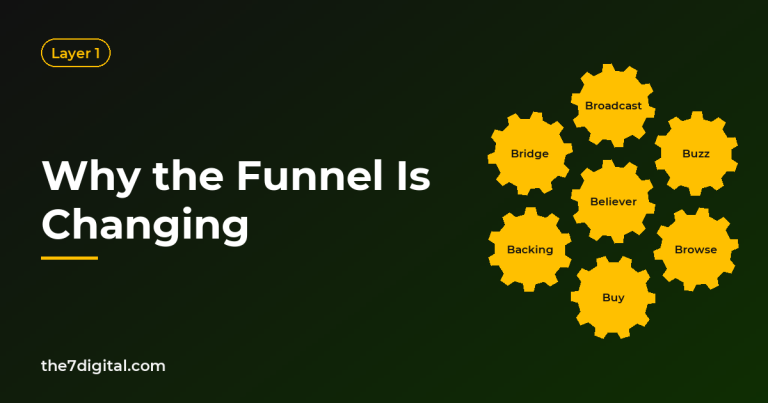
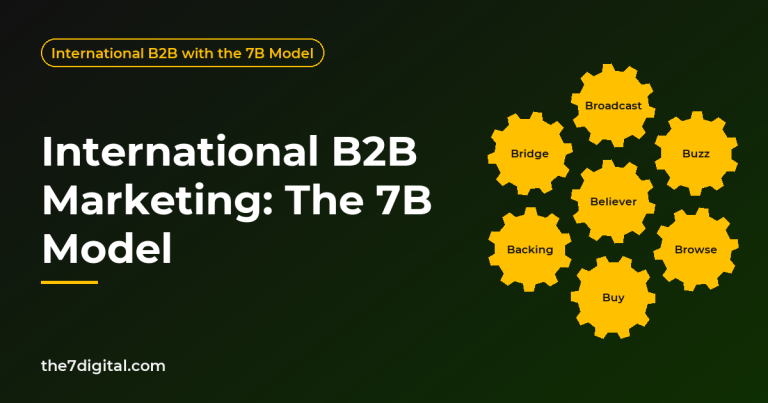
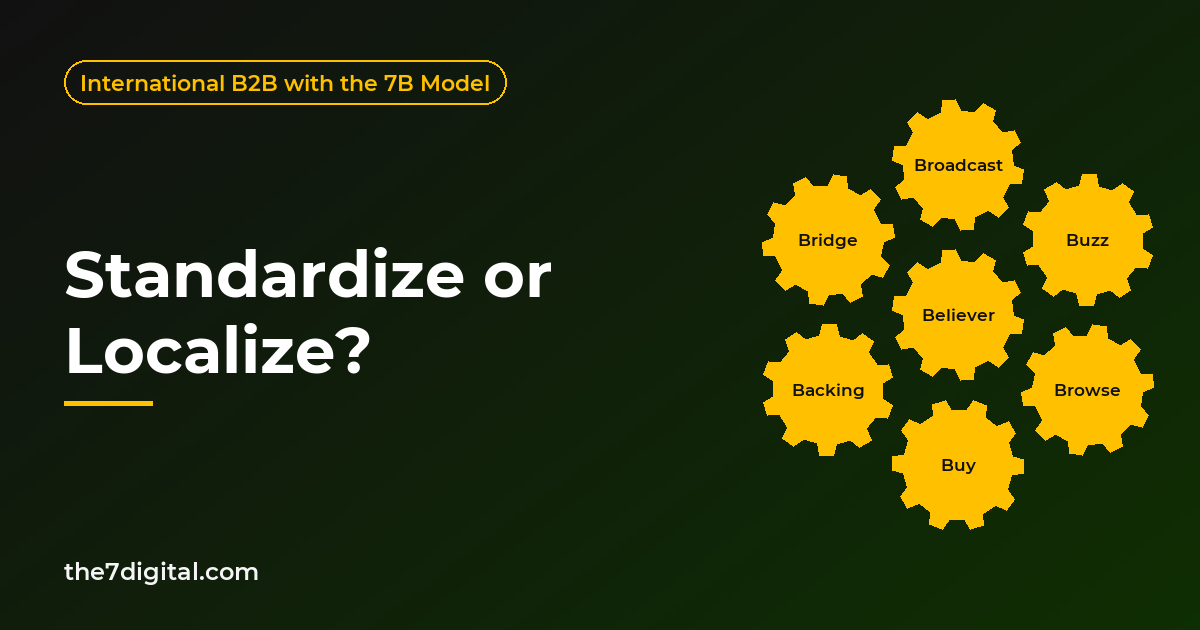
The question does not belong to one gear. It is asked of all seven, Broadcast, Buzz, Browse, Buy, Believer, Backing and Bridge, so this article rests on two of the model’s foundation definitions.
The three operating layers: Demand creation (Broadcast, Buzz), amplification (Backing, Bridge), demand capture (Browse, Buy); Believer is the connecting loop. Read by layer: demand creation keeps the idea and changes language and channel; amplification is rebuilt on the ground, because proof and partners live inside each market; demand capture keeps the original documents and rebuilds the gateways and the procedure; Believer keeps the experience standard and changes who serves and in which language.
The two operating principles: Customers can enter anywhere; one stuck gear slows the whole flywheel. A buyer in Vietnam may find you through an English article, but if your quote, your documents for the purchasing office and your reference customers have no Vietnamese version, every door you open leads to a wall.
The three energy flows: Paid, owned, earned-and-shared. Paid is a separate campaign for each country, owned is a separate page for each language, and earned-and-shared is Buzz on LINE, KakaoTalk, Weixin and Zalo plus the Backing of local customers.
The 7B Equivalence Map launches in this article, linking the 7B Market X-Ray to the one-page 7B strategy. Terms are defined in the 7B Glossary. The 7B Model was developed by Nguyen Dinh Bao (Bao7) at The7 Digital and is set out in full in the book Mô hình 7B cho B2B (Stop Begging, Start 7B). New readers can start with what the 7B Model is.
Selling B2B into Vietnam and ASEAN
Buzz runs on different apps here. Zalo had 78.3 million monthly active users in Vietnam when DataReportal produced its report, and 91.4% of the country’s internet users were also on Zalo (DataReportal, 2025). Ads on Messenger reached 57.8 million people in late 2025 (DataReportal, 2025). The KakaoTalk, LINE or Weixin habits you bring from home are not the default here, so rebuild Buzz instead of translating it. These are users in general, not buyers.
The local layer is usually built by locals. Microsoft leaves Vietnam’s local layer to partners, as it does for Singapore, Thailand, Malaysia, Indonesia and the Philippines (Microsoft Learn, 2026). A mid-size firm without Microsoft’s reach should decide early who will hold its own Vietnamese layer: the language, the paperwork and the buying procedure.
Browse in Vietnamese means a Vietnamese URL. Google recommends separate URLs per language, no automatic redirects between them and more than a translated template (Google Search Central, accessed 2026). Put the documents your buying committee reads first in Vietnamese: specifications, quotes and a company profile.
Bring proof, then earn local proof. Certifications and case studies from home are indirect proof. Ask buyers in the first round which documents they accept, then plan your first Vietnamese reference customer and interview them in Vietnamese with the book’s four questions (chapter 11). Which certificates your product needs under Vietnamese rules is a question for your buyer and local counsel.
Test country by country. Use one pillar piece with separate outputs for Vietnam and for each ASEAN market, and measure the four signals from the book (chapter 14) per country, one map each. The7 runs country-by-country LinkedIn Ads campaigns within its full-service digital marketing in Vietnam, and multi-channel ones within its comprehensive digital marketing services.
Conclusion: Carry the core, rebuild the doors
Levitt saw the world converging, and Quelch and Hoff saw the limits. Microsoft kept one core and let partners build the local layers. K-ISMS and EUCC show proof that sometimes needs a visa and sometimes travels on one shared form.
The question was never standardize or localize. It is which part of you is common enough to carry, and which part people there must rebuild with you.
Read next: export, license or joint venture covers how to enter a country; B2B marketing budgets, next in the series, splits the money per country; the one-page 7B strategy puts the X-Ray and the map on one page for each market; and international B2B marketing with the 7B Model is the overview.
Frequently asked questions
What is the difference between standardization and adaptation in B2B marketing?
Standardization means one product, message and sales approach in every country; adaptation means rebuilding them for each market. In B2B the two usually live on different layers of the same company: the product core and the content ideas travel, while language, proof and the buying procedure have to be rebuilt locally.
What should stay the same when you enter Vietnam?
Keep the product core, your positioning and the ideas behind your content. Rebuild the doors: a Vietnamese site and documents, local references, and the paperwork your buyer’s procedure needs. Even Microsoft lists Vietnam as localized by partners for Business Central, built on the same international core (Microsoft Learn, 2026).
How should I build a Vietnamese version of my website?
Give each language its own URL and translate the substance, not just the template. Google recommends a different URL for each language version, advises against automatically redirecting visitors from one language version to another, and calls translating only the boilerplate a bad experience (Google Search Central, accessed 2026).
How is the 7B Equivalence Map different from the 7B Market X-Ray?
The 7B Market X-Ray tells you which gears turn and which stick in a given country. The 7B Equivalence Map takes that result and decides, gear by gear, whether to keep, adapt or rebuild, and who builds the local layer. The X-Ray is the diagnosis; the map is the prescription.
International B2B with the 7B Model · Part 22 of 24 · Previous: Export, License or Joint Venture? · Next: B2B Marketing Budgets, Including Cross-Border Ad Spend · Pillar article: International B2B Marketing: The 7B Model
References
- Theodore Levitt (1983). The Globalization of Markets. Harvard Business Review. https://hbr.org/1983/05/the-globalization-of-markets
- John Quelch, Edward J. Hoff (1986). Customizing Global Marketing. Harvard Business Review. https://hbr.org/1986/05/customizing-global-marketing
- Pankaj Ghemawat (2007). Managing Differences: The Central Challenge of Global Strategy. Harvard Business Review. https://hbr.org/2007/03/managing-differences-the-central-challenge-of-global-strategy
- Microsoft Learn (2026). Country/Regional Availability and Supported Languages, Business Central. https://learn.microsoft.com/en-us/dynamics365/business-central/dev-itpro/compliance/apptest-countries-and-translations
- Microsoft Learn (2023). Korea K-ISMS, Azure Compliance (updated 2026). https://learn.microsoft.com/en-us/azure/compliance/offerings/offering-korea-k-isms
- European Commission (n.d., accessed 9 November 2026). The EU cybersecurity certification framework. https://digital-strategy.ec.europa.eu/en/policies/cybersecurity-certification-framework
- SGS (n.d., accessed 9 November 2026). About us, SGS e-Customs. https://ecustoms.sgs.com/about-us/
- Coursera, Yonsei University (n.d., accessed 9 November 2026). International B2B (Business to Business) Marketing, Professor Dae Ryun Chang. https://www.coursera.org/learn/b2b-marketing
- Google Search Central (n.d., accessed 9 November 2026). Managing multi-regional and multilingual sites. https://developers.google.com/search/docs/specialty/international/managing-multi-regional-sites
- DataReportal (2025). Digital 2026: Vietnam. https://datareportal.com/reports/digital-2026-vietnam
- CNBC (2023). LinkedIn lays off 716 employees, kills China jobs app. https://www.cnbc.com/2023/05/09/linkedin-layoffs-2023-716-employees-hit-and-china-app-discontinued.html
- Tencent (2026). Tencent Announces 2026 Second Quarter Results. https://www.tencent.com/wp-content/uploads/2026/08/Tencent-Announces-2026-Second-Quarter-Results.pdf
- LY Corporation (2026). LINE Official Account (LINE for Business, Japanese). https://www.lycbiz.com/jp/service/line-official-account/
- LY Corporation (2026). Results for the Six Months Ended September 30, 2026 (FY2026-2Q) [IFRSs]. https://www.lycorp.co.jp/en/ir/news/manual_20261105153006/main/0/link/pdfFile.pdf
- Kakao (2026). 3Q 2026 Earnings Release (Korean). https://t1.kakaocdn.net/kakaocorp/admin/ir/results-announcement/6111.pdf