Summary: International B2B channels are services you hire so that buyers abroad get stock, support and enough confidence to buy. Settle distributor vs agent only after you list what buyers need and score each option. In the 7B Model, channels sit in the Bridge and Browse gears, while Broadcast and Backing must still carry your name.
Many foreign B2B firms start in Vietnam with a representative office. Under Vietnam’s Commercial Law, as LuatVietnam summarizes it, that office may run market surveys and some trade promotion. It may not directly conduct profit-generating activities, and it may not enter into contracts unless the chief representative holds a valid letter of authorization (LuatVietnam, 2022).
So on day one, someone else has to sell, deliver and service. Many firms hand all three jobs to one distributor and hope. The office keeps the business cards; the partner keeps the customers.
Cost-to-serve and unbundling chose which customers deserve your service. This article asks who serves them for you, and what you must keep when someone else does.
What do buyers in another country need a channel to do?
Start with the menu of a Swiss market expansion services provider. DKSH works in 35 markets with 26,840 specialists, and its menu runs from sourcing and market insights to marketing and sales, eCommerce, distribution and logistics, and after-sales services (DKSH, 2026). Those are the company’s own figures. Logistics is one line on the menu.
Buyers far from your factory need more than a truck. They need stock near where they use it, small lots and spare parts, and a wide range from one contact. They need someone to cut, blend, fit or adjust a product for the job, and an engineer who turns up when a machine stops. They need invoices, paperwork and credit terms in the local language and under local law, and enough information to verify you before they buy. That list is my reading, not survey data.
You are not renting a road. You are renting the jobs you cannot do yourself in someone else’s country.
Hahn and Chang (1992) looked at both ends of a channel. According to the abstract, manufacturers want a steady flow and stock, end users want variety and short waits, and end users set the priorities. Intermediaries must “differentiate in order to retain their niche and avoid being taken over” (Hahn and Chang, 1992), because manufacturers and end users can do many of their functions themselves. Needs also change by country: choosing international markets scores each market, and this article scores each channel.
Direct, distributor or agent: what is the real difference?
Three questions separate the options: who owns the goods, who carries inventory and credit risk, and who holds the customer relationship. Selling direct means your own team, branch or subsidiary holds all three. Under Vietnam’s Commercial Law of 2005, an agent sells in its own name for the principal, and the goods stay the principal’s until they reach the customer. A distributor buys the product, owns it and resells it on its own terms (Russin & Vecchi, 2024).
A team of your own is mostly fixed cost: salaries, an office, vehicles, a warehouse. Agents and distributors are mostly variable cost: commissions and discounts that move with sales. Below a certain sales level, renting is cheaper; above it, owning is. Break-even is the team’s fixed cost divided by the gap between the partner’s commission rate and the team’s variable cost rate. That comparison ignores the cost of leaving, which the Vietnam section prices and a case further down shows. Setting up a branch or company is a market-entry question for export, license or joint venture.
Hilti: Selling direct to keep listening
Hilti, the Liechtenstein maker of tools and services for construction, sells direct. Its 2025 annual report names differentiation and direct customer relationships as two of its strategic choices. Hilti says those direct relationships keep it close to customers, which helps it understand their needs better, and that its hardware, software and services are delivered through direct sales (Hilti, 2026).
Hilti’s Hong Kong site describes the model: the company works with customers online, on the phone and onsite; sales reps and field engineers go out to them; what they learn goes back to the design labs; and Hilti runs its own Hilti Centers (Hilti, accessed 2026). In 2025 sales reached CHF 6.3 billion, and the group had 34,420 team members at year-end (Hilti, 2026). The fleet management offer in the total product is that kind of bundle of hardware, software and services.
Selling direct carries the fixed cost of an organization that size, and not everyone in it sells. It works only when the product is different enough to pay for it. In return you hold all seven gears, Bridge included, and every jobsite conversation feeds Browse (what customers ask) and Believer (service on the spot). In Vietnam, direct also means a branch or company that may trade, not a representative office. Selling direct is expensive. Hilti pays that price to hear the market with its own ears.
How do you score channel options against what buyers need?
Here is a five-step scoring method:
- List six to eight things buyers in that market need.
- Give each need a weight from 1 to 3, by how much buyers there care about it.
- Score each option from 0 to 2 on real evidence (reference customers, stock, engineers, languages), not on promises.
- Multiply scores by weights, add them up and compare.
- Add one line that is not scored: who ends up holding the customer data.
A typical case:
| Buyers need | Sell direct | Distributor | Agent | Marketplace |
|---|---|---|---|---|
| Stock near the site | Costly | Strong | Weak | Weak |
| Small lots, spare parts | Costly | Strong | Weak | Medium |
| Wide range, one contact | Weak | Strong | Medium | Strong |
| Engineer on site | Strong | Depends | Weak | Weak |
| Local credit, paperwork | Medium | Strong | Weak | Medium |
| Information to verify | Strong | Medium | Medium | Strong |
| Long-term relationship | Strong | Strong | Strong | Weak |
| Customer data stays yours (not scored) | Strong | Weak | Medium | Weak |
The cells are my reading of a typical case, not survey data. Convert them to points: Strong 2, Medium 1, Weak 0. Costly means possible but expensive: score 1 and note the cost. Depends means score each partner on its own evidence in each country.
The answer is often a mix: direct for a few strategic accounts, a distributor for small customers who need stock on the shelf, a marketplace for sample orders. A mix needs rules on who gets credit for a deal, how prices relate across channels and who holds the customer list.
The table shows who should hold Buy and Believer on the ground. Broadcast and Backing are not up for scoring. Write the captain of each gear into the contract, the way the 7B Gear Captain Matrix does.
Why can’t you hand Broadcast to your distributor?
David Arnold opens a Harvard Business Review (2000) article with a scene many exporters will know: an established corporation enters an emerging market through an independent local distributor, sales take off, then plateau, and managers conclude the distributor “has run out of ideas and is now underperforming.” I read it differently: nobody was hired to create new demand under the maker’s name. That job cannot be handed over, for three reasons.
You are one line in their catalog. A distributor carries many brands, so what it broadcasts is about itself.
Backing follows the name. Cases, reviews, trade press and AI answers credit whatever name appears on them. If your specs and case studies live only on the distributor’s site, buyers and AI credit the distributor. The Mô hình 7B cho B2B book (chapter 11) treats AI citation as Backing’s third tier, which appears only when customers and the ecosystem, tiers one and two, are strong. The ecosystem tier is the work of B2B PR.
Every contract ends. When it does, whoever the customers remember owns the market. Hitachi Construction Machinery, at the end of this section, is the example.
The right way is to lend partners your name but certify them under it. According to a 2021 press release, Schneider Electric’s EcoXpert program is a global network of certified partners: more than 4,000 members from over 75 countries, among them system integrators, application providers and technology companies, who receive coaching, co-branding opportunities and access to a global community (Schneider Electric, 2021). Each certified partner can be seen as a voice carrying Schneider’s name, Backing at tier two, and also a bridge (Mô hình 7B cho B2B book, chapters 11 and 12).
A co-branded campaign is how you keep Broadcast while the distributor sells: you keep the creative and the audience, and inquiries go to the distributor in the customer’s territory. The paid side, across LinkedIn, YouTube, Google Search and retargeting, is work The7 takes on within its comprehensive digital marketing services, run by one team. What agents and customers say about you mostly travels through dark social.
Hitachi Construction Machinery: When the rented bridge expires
Since 2001, Deere and Hitachi Construction Machinery had combined their marketing and distribution efforts in the Americas. On August 19, 2021, they announced the end of their joint venture’s manufacturing and marketing agreements, expected to take effect on February 28, 2022, subject to regulatory approval. Deere was to acquire three factories and keep distributing Deere-branded excavators; for Hitachi-branded products in the Americas, “Hitachi will assume distribution and support for these products” (Deere, 2021).
In November 2022, nearly nine months after that date, North American Mining reported that Hitachi Construction Machinery Americas had awarded Texas and Oklahoma to ASCO, a dealer with 24 locations in Texas that also supports many other equipment brands (North American Mining, 2022). The article does not mention Deere; linking the two events is my reading.
For more than twenty years, Hitachi reached its customers in the Americas across a marketing bridge that Deere ran. When the agreement ended, Hitachi kept its name on the machines, but distribution and support had to be rebuilt region by region, while the landlord stayed in the market with Deere-branded machines. A rented bridge belongs to the landlord. When the contract ends, what stays with you is your name, and whatever that name has earned.
Are LinkedIn, a local-language website and B2B marketplaces channels?
Yes, but they distribute information and trust, and sometimes transactions. In the 7B Model they serve Browse, the gear with six gateways: search engines and AI summaries, conversational AI, industry review platforms, LinkedIn, YouTube and podcasts, and communities and forums (Mô hình 7B cho B2B book, chapter 8).
A website in the buyer’s language is an asset you own that feeds the search and AI gateways; see B2B content marketing. The book’s test (chapter 8) is to search your brand name and see what the first page shows. For channels, run it in the market’s language, Vietnamese in Vietnam, and check whether the results are your site or your distributor’s.
LinkedIn, one of the six gateways, is where your engineers and leaders show up under their own names: see LinkedIn marketing for B2B. A marketplace is rented ground at the review platform gateway. Information channels cannot replace stock and engineers, but they decide who gets shortlisted before a distributor picks up the phone.
Alibaba.com: A marketplace whose AI does the shortlisting
According to Alibaba Group, Alibaba.com served more than 48 million small and medium-sized enterprises from over 190 countries and regions in fiscal year 2024 (Alibaba Group, 2024). Its seller page lists more than 200,000 suppliers and more than 50 million active buyers (Alibaba.com, accessed 2026). Both are self-reported figures.
Digital Commerce 360 reported that Accio, an AI-powered B2B search engine from Alibaba International, reached 1 million users within five months of its launch (Digital Commerce 360, 2025). Nine months after launch it passed 2 million users. Its Accio Agent screens suppliers, lets users send inquiries to pre-vetted suppliers on Alibaba.com with one click, and was trained on 1 billion product listings and 50 million supplier profiles (Digital Commerce 360, 2025).
Tier three of Backing can happen right inside the marketplace: the AI screens suppliers and evaluates their performance. Among more than 200,000 suppliers, your profile and ranking live inside the marketplace’s system, so fill in your profile like a tender file, and never let the marketplace be the only place buyers see you. On a marketplace, the first one to shortlist you may not be a person. It may be an assistant reading your profile next to the others.
Where do international B2B channels fit in the 7B Model?
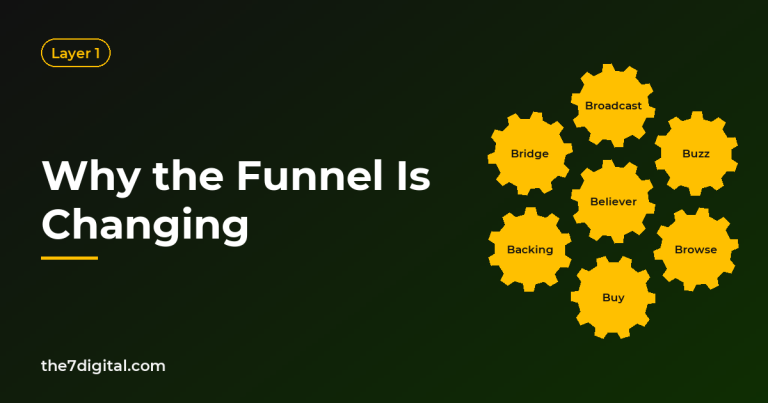
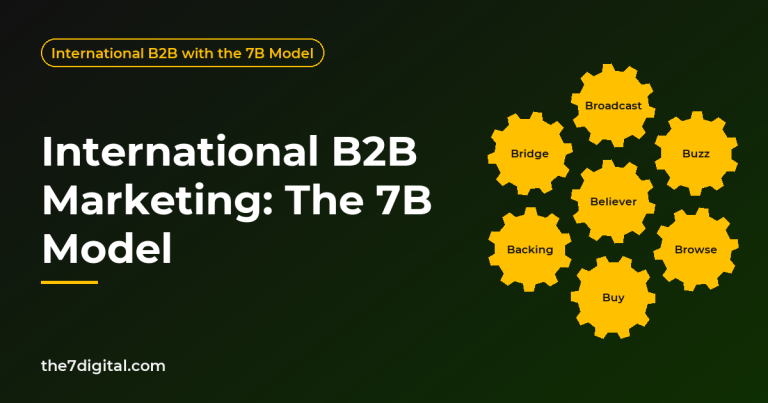
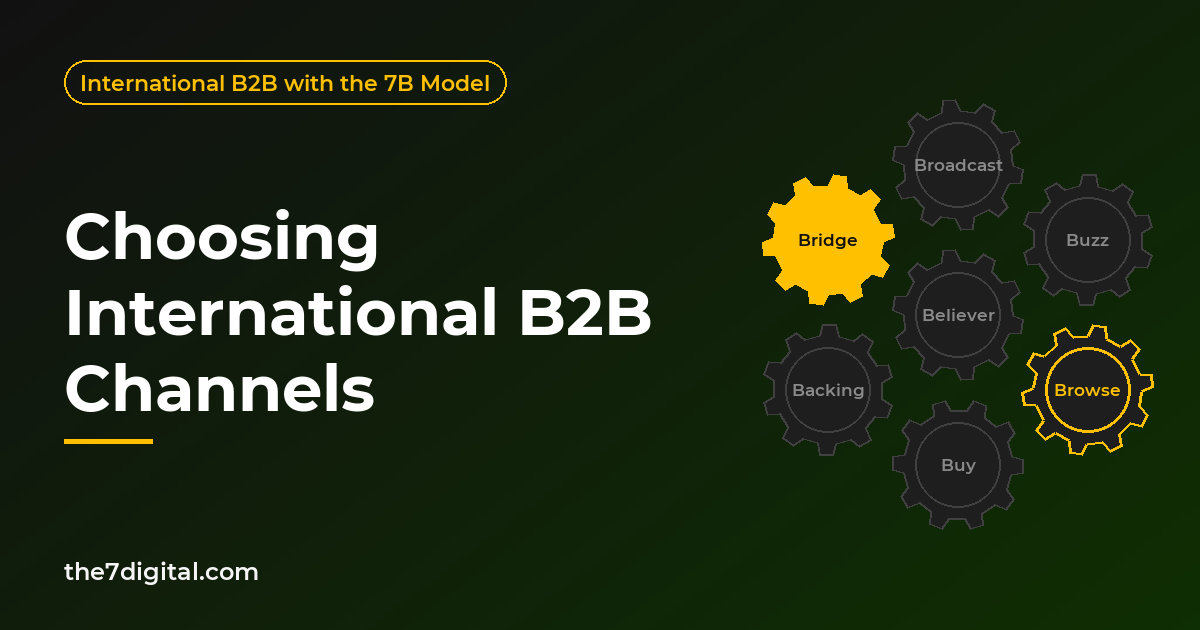
Distributors, agents and system integrators are a Bridge you pay for; LinkedIn, local-language websites and marketplaces serve Browse. By the standard definitions, the Bridge gear: Customers bring in others through referrals, communities and partners, and the flywheel amplifies itself. The Browse gear: Where emotion meets reason: buyers verify and compare you through six gateways.
Unlike the “same customers, different product” partners in the Mô hình 7B cho B2B book (chapter 12), distributors and agents sell your own product, so they need clear rules on territory, data, credit and exit.
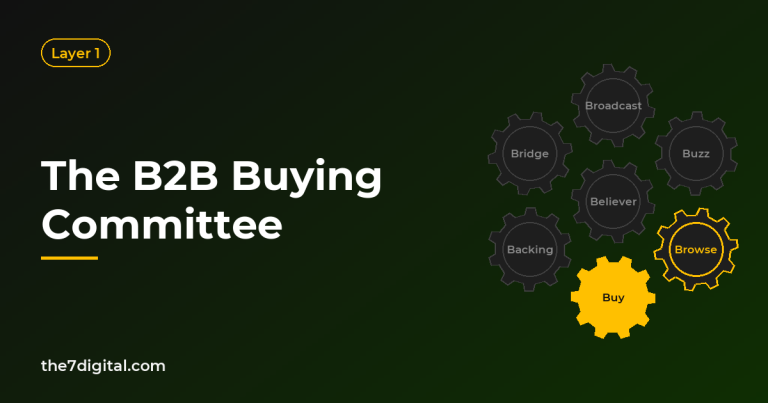
Bridge sits in the amplification layer with Backing, Browse in the demand capture layer with Buy, and Believer is the connecting loop. Two operating principles apply: customers can enter anywhere; one stuck gear slows the whole flywheel. A distributor that runs out of spare parts is a stuck gear slowing your whole machine in that country. The three energy flows share the work: paid is the co-branded campaign, owned is the website and technical library, earned-and-shared is partner word of mouth and joint case studies.
Before signing with a partner, send them the 7B Glossary so both sides name each gear the same way, and the 7B Model so they see how the gear they hold connects to the rest. The 7B Model was developed by Nguyen Dinh Bao (Bao7) at The7 Digital and is set out in full in the book Mô hình 7B cho B2B (Stop Begging, Start 7B).
Selling B2B into Vietnam and ASEAN
Know what each legal form can do. A branch may buy and sell goods, but the foreign trader needs at least five years of operation (LuatVietnam, 2022). Appoint an agent and, unless the contract says otherwise, the agency ends no earlier than sixty days after notice; if you end it, the agent can claim its average monthly remuneration for each year of the agency, at least one month (Russin & Vecchi, 2024). Price the exit into the decision, as with any rented bridge, and check current rules with local counsel; these sources date from 2022 and 2024.
Redraw the territory map. In June 2025 the National Assembly cut Vietnam’s provinces and centrally run cities from 63 to 34, with only 11 left unchanged (Viet Nam News, 2025). In my reading, distribution contracts that define exclusive territories by the old province names need rewriting, and exclusivity and territorial limits are subject to Vietnam’s Competition Law (Russin & Vecchi, 2024).
Rent the lab, keep the proof. DKSH set up innovation centers for its Performance Materials business in Ho Chi Minh City in 2011, moved them to larger premises in 2017 and upgraded them in 2020 for personal care, paints and coatings, and food (DKSH, 2020). A partner can run the lab work for you, but make sure the formulations, test results and case studies that come out of it carry your brand too.
Publish in Vietnamese, under your own name. Vietnamese users rank first in Southeast Asia for engagement with and trust in AI, according to the e-Conomy SEA 2025 Vietnam report by Google, Temasek and Bain & Company (Google, Temasek and Bain & Company, 2025). That covers users in general, not B2B buyers specifically. A Vietnamese spec sheet that lives only on your distributor’s site is likely to be cited under the distributor’s name.
ASEAN is many markets, not one channel. A regional partner can cover many countries; DKSH works in 35 markets (DKSH, 2026). Score channels country by country and rebuild Broadcast and Backing in each language. Choosing international markets shows how to score each market, and standardize or localize how much to adapt.
Conclusion: Rent the bridge, keep your name
I opened with a representative office that cannot sell, a reminder that presence and sales are different jobs. A channel decides who delivers to your customers. Broadcast and Backing decide whose name they remember when the contract ends.
Last time, cost-to-serve and unbundling chose which customers to serve. Next, relationships in Asian B2B goes on to the relationship with partners. The pillar article is international B2B marketing with the 7B Model.
Frequently asked questions
What is the difference between a distributor and an agent?
A distributor buys your goods, owns them and resells them on its own terms, carrying stock and credit risk and usually the customer relationship. An agent sells for you without owning the goods and earns remuneration, often a commission; in a Vietnamese sales agency, the goods stay the principal’s until they reach the customer (Russin & Vecchi, 2024).
When should you sell direct in a foreign market?
When expected sales can carry the fixed cost of your own team, the product needs your own engineers, and customers are few and large. Hilti treats direct customer relationships as one of its strategic choices (Hilti, 2026).
What does it cost to end an agency agreement in Vietnam?
Unless the contract says otherwise, an agency ends no earlier than sixty days after notice, and if the principal ends it, the agent can claim its average monthly remuneration for each year of the agency, at least one month. If the agent asks to leave, nothing is due (Russin & Vecchi, 2024). Check with local counsel.
Can a B2B marketplace replace a distributor?
It can replace part of how buyers find and screen suppliers, not the stock and engineers near the customer. On Alibaba.com, Accio Agent already screens suppliers for buyers (Digital Commerce 360, 2025). Use the marketplace to be found, and local partners to deliver and serve.
International B2B with the 7B Model · Part 15 of 24 · Previous: Cost-to-Serve and Unbundling · Next: Relationships in Asian B2B · Pillar article: International B2B Marketing: The 7B Model
References
- LuatVietnam (2022). Should a foreign company open branch or representative office? https://english.luatvietnam.vn/legal-news/should-foreign-company-should-open-branch-or-representative-office-4729-91748-article.html
- DKSH (2026). DKSH Continues to Deliver Solid EBIT Growth in 2025 and Further Top- and Bottom-Line Growth Acceleration in H2. https://www.dksh.com/global-en/home/investors/investor-news/dksh-continues-to-deliver-solid-ebit-growth-in-2025-and-further-top-and-bottom-line-growth-acceleration-in-h2
- Hahn, M., Chang, D. R. (1992). An Extended Framework for Adjusting Channel Strategies in Industrial Markets. Journal of Business & Industrial Marketing, 7(2), 31-43. https://www.emerald.com/insight/content/doi/10.1108/08858629210037191/full/html
- Russin & Vecchi (2024). Guide On Agency And Distribution Legislation In Vietnam. Legal 500. https://www.legal500.com/intelligence/vietnam/corporate-commercial-law/guide-on-agency-and-distribution-legislation-in-vietnam
- Hilti Group (2026). Hilti 2025 Annual Report: Our Strategy. https://reports.hilti.group/2025/our-strategy
- Hilti Hong Kong (n.d., accessed November 9, 2026). Our Business Model. https://hilti.com.hk/content/hilti/A1/HK/en/company/corporate-information/strategy/business-model.html
- Hilti Group (2026). Hilti Group Achieves Sales of CHF 6.3 Billion in 2025. https://www.hilti.group/content/hilti/CP/XX/en/company/media-relations/media-releases/2025-business-result.html
- Arnold, D. (2000). Seven Rules of International Distribution. Harvard Business Review, November-December 2000. https://hbr.org/2000/11/seven-rules-of-international-distribution
- Schneider Electric (2021). Schneider Electric Announces 2021 List of Master-level EcoXpert Partners in Critical Power & Substation Automation Solutions. https://www.se.com/ww/en/about-us/newsroom/news/press-releases/schneider-electric-announces-2021-list-of-master-level-ecoxpert%E2%84%A2-partners-in-critical-power-substation-automation-solutions-6035c7196cb500581e6d2114/
- Deere & Company (2021). John Deere and Hitachi Construction Machinery to End Joint Venture Manufacturing and Marketing Agreements (press release, exhibit 99.1 to Form 8-K). https://www.sec.gov/Archives/edgar/data/315189/000155837021011945/de-20210819xex99d1.htm
- North American Mining (2022). ASCO joins western U.S. Hitachi dealer network. https://northamericanmining.com/index.php/2022/11/10/asco-joins-western-u-s-hitachi-dealer-network/
- Alibaba Group (2024). Alibaba.com: A leading platform for global B2B e-commerce. https://www.alibabagroup.com/en-US/about-alibaba-businesses-1747711844698554368
- Alibaba.com (2026). What is Alibaba.com? https://seller.alibaba.com/about-alibaba
- Digital Commerce 360 (2025). Alibaba’s AI search engine surpasses 1 million users. https://www.digitalcommerce360.com/2025/03/11/alibaba-accio-ai-search-engine-one-million-users/
- Digital Commerce 360 (2025). Alibaba’s B2B search engine hits a milestone. https://www.digitalcommerce360.com/2025/08/14/alibaba-b2b-search-engine-accio-agent/
- Viet Nam News (2025). Parliament passes historic resolution to cut provinces and centrally-run cities from 63 to 34. https://vietnamnews.vn/politics-laws/1719423/na-passes-resolution-to-cut-provinces-and-centrally-run-cities-from-63-to-34.html
- DKSH (2020). DKSH upgrades its Performance Materials innovation centers in Vietnam. https://www.dksh.com/vn-en/home/media/news/dksh-upgrades-its-performance-materials-innovationcenters-in-vietnam
- Google, Temasek and Bain & Company (2025). e-Conomy SEA 2025: Vietnam. https://services.google.com/fh/files/misc/vietnam_e_conomy_sea_2025_report.pdf