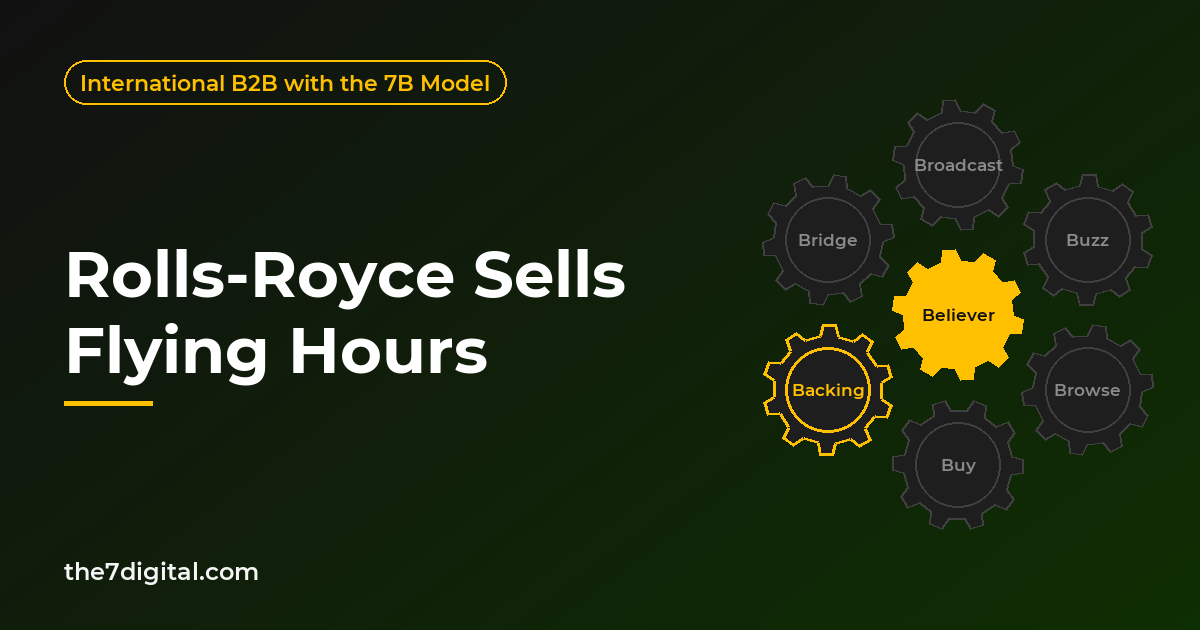
Summary: Power by the hour means the customer pays for each hour an engine flies, and the maker carries the cost of keeping it flying. Rolls-Royce traces the model to 1962, and today most of its large engines are maintained this way. In the 7B Model, this sits in the Believer and Backing gears.
In 2020, large Rolls-Royce engines on long-term service agreements (LTSAs) flew 43% of the hours they had flown in 2019, and the group’s free cash flow was minus £4.2 billion as COVID-19 hit and flying hour receipts fell (Rolls-Royce, 2021). Under power by the hour, the supplier’s receipts move with the customer’s flying, and that year the flying fell by more than half.
Five years on, large engine flying hours grew 8% in 2025, and Civil Aerospace posted an underlying operating margin of 20.5% (2024: 16.6%) (Rolls-Royce, 2026). The model survived its worst year, and Rolls-Royce says it kept lifting LTSA margins through improved commercial terms. Relationships in Asian B2B looked at trust between people. This article looks at trust written into how a supplier gets paid.
A buyer who has never worked with a foreign supplier tends to carry one quiet question: will you still care after the invoice is paid? A contract that pays you only while their operation runs answers it better than any brochure. Here is how that works, and what changes when you sell into Vietnam and ASEAN.
How does power by the hour work?
Every contract starts with a rate: the airline pays an amount per engine flying hour, and in return Rolls-Royce maintains the engine to an agreed standard (Rolls-Royce, 2024). A matrix in each contract prices factors such as stage length and take-off and climb thrust de-rate, because running an engine harder brings it to the shop sooner (Rolls-Royce, 2024). On its TotalCare page, Rolls-Royce says it takes on both time-on-wing risk (how long an engine stays on the aircraft between shop visits) and shop visit cost risk, planned and unplanned, while customers stay “in full operational control” (Rolls-Royce, accessed 2026).
The incentive follows the meter. Customers are charged by the hours flown, so if fewer shop visits are needed than expected, the contract margin could be higher (Rolls-Royce, 2024). Under power by the hour, the repair shop sits on the seller’s side of the ledger.
Vandermerwe and Rada named the wider trend in 1988: more and more firms adding value to their core offerings through services, selling “bundles” of goods, services, support, self-service and knowledge (Vandermerwe and Rada, 1988). They called it servitization. In my reading, power by the hour is the far end of that road, where the service is no longer an add-on to the price. It is the price.
Rolls-Royce: An engine maker that lives on its customers’ flying hours
It started small. Rolls-Royce says Power-by-the-Hour was invented in 1962 to support the Viper engine on the de Havilland/Hawker Siddeley 125 business jet: a complete engine and accessory replacement service on a fixed cost per flying hour. In the company’s words, it aligned the interests of the manufacturer and the operator, who “only paid for engines that performed well” (Rolls-Royce, 2012).
TotalCare came in the 1990s. Rolls-Royce calls it “market-defining” and says that was when it first spotted product and service becoming inseparable (Rolls-Royce, 2018). That is category design done through the price list.
In early 2024, Rolls-Royce had 248 large engine LTSA contracts against a fleet of about 4,000 engines, and over 90% of Trent engines were on LTSAs (Rolls-Royce, 2024). On widebody engines, first contracts typically run 12 years or more, and second contracts about 8 (Rolls-Royce, 2024). On November 14, 2023, Saudia renewed its existing TotalCare contract for the Trent 700 engines on all 31 of its A330s, beyond 2030 (Rolls-Royce, 2023). The second contract is the vote: a satisfied customer re-shops at renewal, while a believer renews by default (Mô hình 7B cho B2B book, chapter 10).
How does selling outcomes change the buying committee?
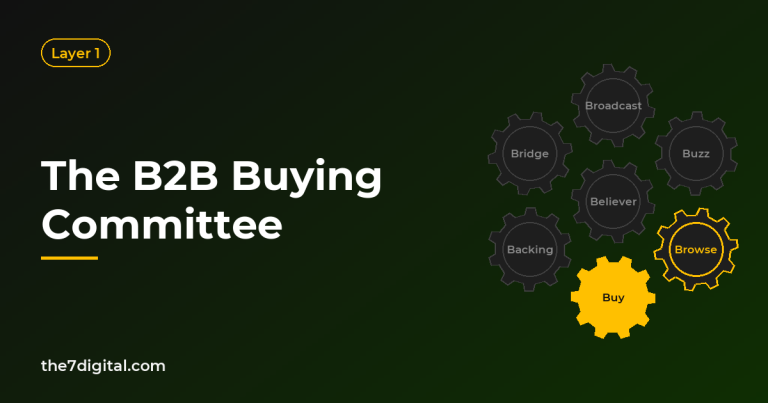
When you are paid by the hour, the decision moves up to the fleet purchase. LTSAs are normally struck at the point the airline buys the planes, and first contracts run 12 years or more (Rolls-Royce, 2024). That pulls the whole B2B buying committee to the table, and each seat asks a different question.
| Seat | Buying an engine, they ask | Buying flying hours, they ask |
|---|---|---|
| Finance | What does it cost? | Does the hourly cost track our revenue, in dollars we can forecast? |
| Engineering | Where are the parts and shops? | Who plans shop visits, and do we keep operational control? |
| Lessor | Often absent | What condition will the engines be in at return? |
| Legal | How long is the warranty? | What do we owe if we sell an aircraft early? |
The middle column is my reading; the right column follows Rolls-Royce (2024) and GE Aerospace.
Finance moves to the front. Rolls-Royce lists maintenance costs that are predictable and aligned with airline revenues, plus predictable US dollar cash flow for hedging, among the benefits to airlines (Rolls-Royce, 2024). Counting total cost of ownership used to be the buyer’s job; here the seller has folded maintenance into the hourly rate.
GE Aerospace sells the same logic as a menu. TrueChoice Flight Hour transfers risk from the customer to GE, paid in dollars per flight hour or cycle, with options such as guaranteed spare engine availability, remote diagnostics and return condition coverage, shaped around cost of ownership, cash flow or lease requirements (GE Aerospace, accessed 2026). Each option answers a different seat.
Buy happens twice, at signing and at renewal. You are no longer selling to the person who buys parts. You are selling to whoever answers for the next twelve years of cash flow. If you now deal mostly with a plant engineer in Vietnam, expect a finance director, and possibly headquarters, to join the conversation.
How does operating data create Backing?
Data protects the seller’s margin. Engine health monitoring analysis is part of every LTSA, fleet data allows rapid intervention, and Rolls-Royce says it prices contracts better on a growing amount of data (Rolls-Royce, 2024). In 2019 it reported that visual inspections and positive monitoring data had let the fleet-leader Trent XWB-84 engines keep flying for longer than first expected (Rolls-Royce, 2019). When you are paid by the hour, you have every reason to measure better than anyone.
Pooled data becomes proof that others repeat. On June 22, 2022, T’way Air signed its first TotalCare agreement, for three A330s, when the Trent 700 had passed 60 million flying hours worldwide and held more than 60% of the A330 market, passenger and freighter combined (Rolls-Royce, 2022). T’way’s vice president, Kim Hyung-yi, said: “We value this TotalCare agreement, which will maximise aircraft availability and efficiency.” The book describes pooled results from many customers as numbers the seller owns (Mô hình 7B cho B2B book, chapter 10). A new buyer is buying that record, not a brochure.
Backing comes from three directions, all through data. Customers say it when they renew: Saudia’s CEO, Captain Ibrahim Koshy, said TotalCare “goes beyond regular maintenance,” letting the airline focus on its core operations (Rolls-Royce, 2023). The ecosystem joins in: TotalCare is designed to work alongside aircraft leasing companies (Rolls-Royce, accessed 2026), and in a 2020 plan the reinsurer Munich Re was to finance TRUMPF’s machines, as the TRUMPF section below shows. And AI can only cite numbers that are public; a figure buried in an internal file is cited by no one, in my reading.
You do not need to be Rolls-Royce to do this. A data page and a FAQ document are B2B content marketing you own, and a renewal travels through dark social before it becomes a referral (customer advocacy and referrals). Data also reports bad news, and Backing holds only when the seller does not hide the numbers.
Where should a smaller supplier start with servitization?
Start with the evidence. In a sample of 10,028 firms in 25 countries, Neely (2008) found that “in smaller firms servitization appears to pay off while in larger firms it proves more problematic.” In aggregate, though, servitized manufacturers were larger in sales but earned lower profits as a share of sales. In my view, small size is not the weakness. Rushing is. Power by the hour itself started on a business jet engine in 1962 (Rolls-Royce, 2012).
TRUMPF: Selling cut parts, not laser cutters
On October 14, 2020, Munich Re and the German machine tool maker TRUMPF announced a plan for pay-per-part: customers pay a previously agreed price for each cut sheet metal part. Munich Re would finance the machine and bear the resulting investment risk, and its subsidiary relayr would provide the data analysis for the financing model (Munich Re, 2020).
On September 21, 2022, TRUMPF launched the model for its TruLaser Center 7030, a machine with cameras, sensors and remote control. TRUMPF schedules, programs and maintains it, and when the machine reports an error, TRUMPF acts “in its own interest” to fix it fast, because customers pay only for parts actually made (TRUMPF, 2022).
By September 2023, TRUMPF offered the model in Germany, Austria, the Netherlands and Switzerland. Customers are charged only for parts actually made, provided that a minimum agreed level of capacity utilization is met. One of the first to adopt it, Reiff Umformtechnik, a metal-processing company in Leipheim, Germany, said: “We have huge numbers of orders coming in, but too few staff to keep our machines working at capacity” (TRUMPF, 2023).
| Choice | Rolls-Royce | TRUMPF | A first step that fits |
|---|---|---|---|
| Charge by | Flying hour, rate varies with use | Part cut | A unit the buyer counts: machine hours, tons, meters |
| Floor for the seller | Minimum term, compensation if an aircraft is sold early | Minimum capacity utilization | A monthly base fee |
| Who holds the capital | Airlines usually buy their own spare engines | Munich Re (2020 plan) | Banks, leasing companies |
The middle columns follow the sources; the last column is my suggestion.
Write after-sales service into the terms first, as in the total product in B2B. Then pick a unit your customer counts, set a floor, and measure before you promise. Do not start with your biggest promise. Start with the smallest unit your customer already counts.
What are the risks of outcome-based contracts?
The first risk sits with the seller. After working with more than 30 equipment makers, Gebauer, Fleisch and Friedli named the service paradox: substantial investment in extending the service business leads to more service offerings and higher costs, without the correspondingly higher returns expected (Gebauer et al., 2005). Neely’s sample (2008) also held a greater proportion of bankrupt servitized firms, though that describes the sample, not a cause.
Rolls-Royce: The years the fleet stood still
The pandemic was not the first hard stretch. On November 7, 2019, Rolls-Royce put the in-service cash costs of its Trent 1000 problems at around £2.4 billion across 2017 to 2023, and flagged a likely exceptional charge of about £1.4 billion for 2019. The charge primarily covered customer disruption, remediation shop visits and expected losses on a small number of contracts (Rolls-Royce, 2019). The company aimed to bring aircraft on the ground down to single digits by the end of Q2 2020, and CEO Warren East said: “We deeply regret the ongoing disruption caused to customers” (Rolls-Royce, 2019).
Pricing can fail, too. At the end of 2022, around 10% of large engine contracts were onerous. In 2023 every renegotiation progressed or completed, releasing a £385 million provision, and in return Rolls-Royce can offer extensions or amended terms that bring operational benefits to the airline (Rolls-Royce, 2024). By 2025, improved commercial terms were lifting LTSA margins on in-production widebody engines (Rolls-Royce, 2026).
Name the risks. The seller carries three: volume (the customer’s demand, as in 2020), technical (its own durability, as with the Trent 1000) and pricing (its own estimates, as with the onerous contracts). The buyer carries one, lock-in: if an aircraft is sold or retired before the minimum term, Rolls-Royce could be entitled to claim compensation (Rolls-Royce, 2024). The mitigations are floors, inflation-linked escalation of the kind LTSAs include (Rolls-Royce, 2024), data before commitment, and choosing customers, which cost-to-serve and unbundling covers.
Where does selling by the hour fit in the 7B Model?
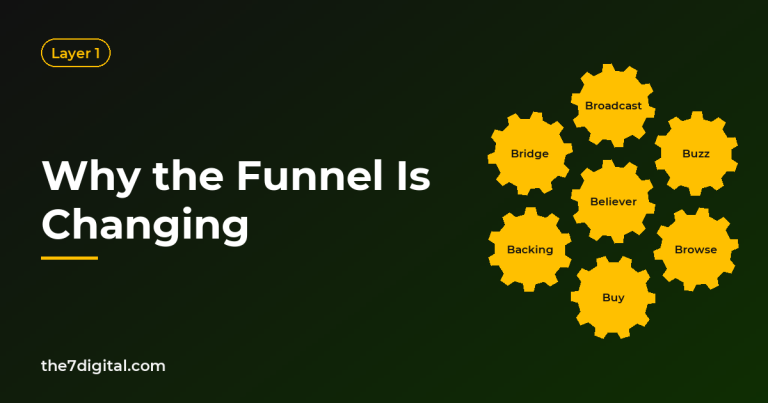
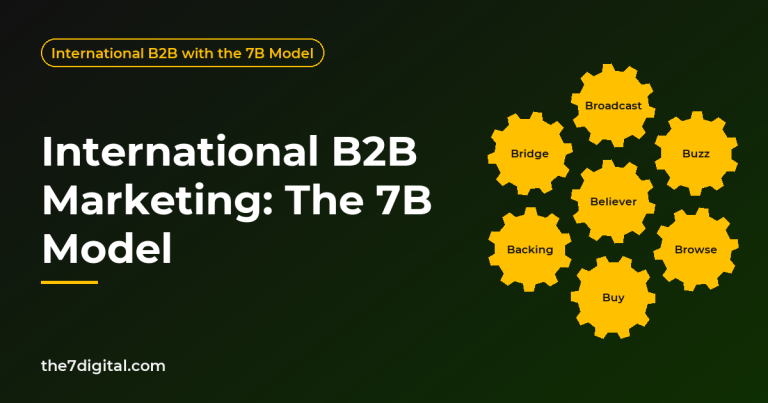
Two gears are in play. The Believer gear: Customers who do not just buy but believe, through real experience after the deal. The Backing gear: Customers, the ecosystem and AI speak up on your behalf.
Under power by the hour, Believer stops being a marketing goal that sits next to revenue. It is the revenue line, and the renewal is the test. The book says the Buy door must lead straight into Believer (Mô hình 7B cho B2B book, chapter 9); power by the hour writes that into the payment terms.
Backing sits in the amplification layer; Believer is the loop that connects all three layers. The loyalty loop closes here. Believers create Backing, Backing creates Bridges, and Bridges bring new people back into Broadcast, Browse and Buy. Saudia renewing is Believer, and its CEO saying so in public is Backing.
Of the three energy flows, paid, owned and earned-and-shared, the operating data lives in owned, renewals and customer quotes travel in earned-and-shared, and paid should amplify only stories that already carry numbers.
If you want the exact wording for each gear, the 7B Glossary has it; if you want to watch one renewal turn the whole machine, start with the 7B Model. The 7B Model was developed by Nguyen Dinh Bao (Bao7) at The7 Digital and is set out in full in the book Mô hình 7B cho B2B (Stop Begging, Start 7B).
Selling B2B into Vietnam and ASEAN
Most of what Vietnam imports feeds production. In the first ten months of 2026, Vietnam imported USD 511.31 billion of goods, and production inputs made up 94.1% of that (NSO, 2026). Machines, components and materials are goods whose value shows up as uptime and output, so an outcome offer fits the basket.
Buyers already pay foreign firms for services. Vietnam imported USD 34.31 billion of services in the first nine months of 2026 and ran a services deficit of USD 8.21 billion (NSO, 2026). Paying a foreign supplier for a service line is not new. Pricing it by the customer’s output would be the next step.
The region has bought engines by the hour for years. In February 2010, Malaysia Airlines signed its first TotalCare agreement, for the Trent 800 engines on 17 Boeing 777s, and Rolls-Royce said such agreements were in place or being finalized for 100% of Trent engines in service in Southeast Asia (Rolls-Royce, 2010). That is a 2010 snapshot, but it shows the idea is not foreign to the region.
Outcome promises need service you can reach. Rolls-Royce runs its Asia Pacific civil aerospace customer service team from its Seletar campus in Singapore, opened in February 2012, and repairs and overhauls Trent engines through SAESL, a joint venture with Singapore Airlines Engineering Company (SIAEC) (Rolls-Royce, accessed 2026). A year after launch, TRUMPF offered pay-per-part in four countries: Germany, Austria, the Netherlands and Switzerland (TRUMPF, 2023). Start in one industrial cluster you can reach within hours, with remote monitoring and a local service partner, before you guarantee anything.
Decide who carries the currency and the floor. Rolls-Royce lists predictable US dollar cash flow and the ability to forecast hedging among the benefits to airlines, and its LTSAs carry inflation-linked escalation (Rolls-Royce, 2024). If your customer earns in dong, a dollar rate per hour moves currency risk onto them. Decide that openly, add a usage floor like TRUMPF’s, and put the escalation formula in writing. Being paid on outcomes also moves you from vendor to partner at the table, as B2B positioning explains.
Conclusion: Let your revenue follow your customer’s success
I opened with a year when the planes stood still and a recovery five years later. Between them sit a 1962 engine, a customer renewing for 31 aircraft and a Leipheim shop short of staff.
Most suppliers get paid on delivery and hope the customer does well. Power by the hour reverses the order: you get paid only while the customer does well, so you make sure they do.
Last time, relationships in Asian B2B asked what happens to trust when the person leaves. Next, borrowing from other industries starts from one idea: new ideas in B2B often come from other industries. The pillar article, international B2B marketing with the 7B Model, holds the whole machine.
Frequently asked questions
What is power by the hour?
The customer pays an amount for each hour an engine flies, and the maker carries the cost of keeping it running well. According to Rolls-Royce (2012), the model dates to 1962 and the Viper engine; Rolls-Royce (2024) says over 90% of Trent engines are on long-term service agreements.
What is servitization?
It is the trend of manufacturers adding value to core products through services, support and knowledge, named by Vandermerwe and Rada (1988). It is not automatic: in a sample of 10,028 firms in 25 countries, Neely (2008) found servitized manufacturers larger in sales but earning lower profits as a share of sales.
What are the risks of outcome-based contracts?
You carry the customer’s bad years and your own mistakes. In 2020, large Rolls-Royce engines on long-term service agreements flew 43% of their 2019 hours (Rolls-Royce, 2021). Pricing errors cost too: at the end of 2022, around 10% of large engine contracts were onerous (Rolls-Royce, 2024).
Should a foreign supplier offer outcome-based contracts in Vietnam?
Yes, if you can keep the promise locally. Start with one customer and one site you can reach quickly, price by a unit the buyer already counts, set a usage floor, monitor remotely before you guarantee anything, and agree up front who carries currency risk. In the region, Rolls-Royce serves airlines from Singapore, where it also repairs and overhauls Trent engines through SAESL, a joint venture with SIAEC.
International B2B with the 7B Model · Part 17 of 24 · Previous: Relationships in Asian B2B · Next: Borrowing from Other Industries · Pillar article: International B2B Marketing: The 7B Model
References
- Rolls-Royce (2021). Rolls-Royce Holdings plc 2020 Full Year Results. https://www.rolls-royce.com/media/press-releases/2021/11-03-2021-rr-holdings-plc-2020-full-year-results.aspx
- Rolls-Royce (2026). Rolls-Royce Holdings plc 2025 Full Year Results. https://www.rolls-royce.com/media/press-releases/2026/26-02-2026-rr-holdings-plc-2025-full-year-results.aspx
- Rolls-Royce (2024). Long-Term Service Agreements (LTSA) FAQs. https://www.rolls-royce.com/~/media/Files/R/Rolls-Royce/documents/investors/rr-ltsa-faq.pdf
- Rolls-Royce (n.d., accessed 9 November 2026). TotalCare. https://www.rolls-royce.com/products-and-services/civil-aerospace/services/totalcare.aspx
- Vandermerwe, S., Rada, J. (1988). Servitization of business: Adding value by adding services. European Management Journal, 6(4) (EconPapers). https://econpapers.repec.org/RePEc:eee:eurman:v:6:y:1988:i:4:p:314-324
- Rolls-Royce (2012). Rolls-Royce celebrates 50th anniversary of Power-by-the-Hour. https://www.rolls-royce.com/media/press-releases-archive/yr-2012/121030-the-hour.aspx
- Rolls-Royce (2018). Rolls-Royce IntelligentEngine vision makes rapid progress. https://www.rolls-royce.com/media/press-releases/2018/16-07-2018-rr-intelligentengine-vision-makes-rapid-progress.aspx
- Rolls-Royce (2023). Rolls-Royce Renews TotalCare Service Contract for Trent 700 Engines with Saudia. https://www.rolls-royce.com/media/our-stories/discover/2023/rr-renews-totalcare-service-contract-for-trent-700-engines-with-saudia.aspx
- GE Aerospace (n.d., accessed 9 November 2026). TrueChoice Flight Hour. https://www.geaerospace.com/commercial/services/true-choice/flight-hour
- Rolls-Royce (2019). Rolls-Royce Holdings plc: Trading and Trent 1000 update. https://www.rolls-royce.com/~/media/Files/R/Rolls-Royce/documents/investors/trading-and-trent-1000-update-07-nov-2019.pdf
- Rolls-Royce (2022). Rolls-Royce signs TotalCare agreement with South Korean airline T’way as Trent 700 sets new milestone. https://www.rolls-royce.com/media/press-releases/2022/22-06-2022-poweroftrent-rr-signs-totalcare-agreement-with-south-korean-airline-tway.aspx
- Neely, A. (2008). Exploring the financial consequences of the servitization of manufacturing. Operations Management Research, 1 (Cranfield University repository). https://dspace.lib.cranfield.ac.uk/handle/1826/4012
- Munich Re (2020). Pay-per-part: TRUMPF and Munich Re plan new business model for the manufacturing industry. https://www.munichre.com/en/company/media-relations/media-information-and-corporate-news/media-information/2020/2020-10-14-pay-per-part.html
- TRUMPF (2022). Pay-per-part: TRUMPF offers new business model to utilize spare machine capacity. https://www.trumpf.com/en_INT/newsroom/global-press-releases/press-release-detail-page/release/pay-per-part-trumpf-offers-new-business-model-to-utilize-spare-machine-capacity/
- TRUMPF (2023). TRUMPF’s digital business model helps tackle shortage of skilled workers. https://www.trumpf.com/en_INT/newsroom/global-press-releases/press-release-detail-page/release/trumpfs-digital-business-model-helps-tackle-shortage-of-skilled-workers-8225/
- Gebauer, H., Fleisch, E., Friedli, T. (2005). Overcoming the Service Paradox in Manufacturing Companies. European Management Journal, 23(1) (IDEAS/RePEc). https://ideas.repec.org/a/eee/eurman/v23y2005i1p14-26.html
- National Statistics Office of Vietnam (NSO) (2026). Socio-economic situation report for October and the first 10 months of 2026 (Báo cáo tình hình kinh tế – xã hội tháng Mười và 10 tháng năm 2026). https://www.nso.gov.vn/bai-top/2026/11/bao-cao-tinh-hinh-kinh-te-xa-hoi-thang-muoi-va-10-thang-nam-2026/
- National Statistics Office of Vietnam (NSO) (2026). Press release on the socio-economic situation in Q3 and the first 9 months of 2026 (Thông cáo báo chí tình hình kinh tế – xã hội quý III và 9 tháng năm 2026). https://www.nso.gov.vn/du-lieu-va-so-lieu-thong-ke/2026/10/thong-cao-bao-chi-tinh-hinh-kinh-te-xa-hoi-quy-iii-va-9-thang-nam-2026/
- Rolls-Royce (2010). Rolls-Royce signs Totalcare services agreement with Malaysia Airlines. https://www.rolls-royce.com/media/press-releases-archive/yr-2010/100202.aspx
- Rolls-Royce (n.d., accessed 9 November 2026). Rolls-Royce in Singapore (Our locations, South East Asia). https://www.rolls-royce.com/country-sites/sea/our-locations/singapore.aspx