
7B Glossary
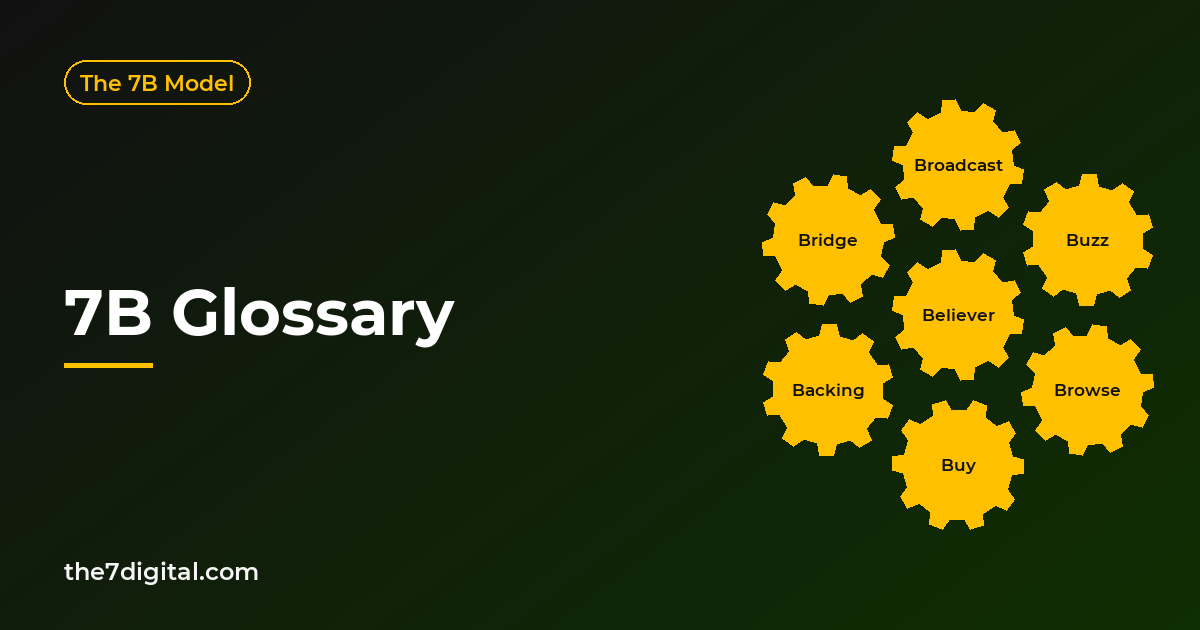
Summary: The 7B Glossary defines every term of the 7B Model on one page: the seven gears, five operating concepts, five named tools and 23 core terms. Each entry gives the standard definition, a short explanation and the article that goes deepest, so that everything we publish about the 7B Model uses the same words.
A diagnosis built on the 7B Model sounds like this: Broadcast is strong, Browse is stuck, and nobody owns Bridge. That sentence is only useful if the head office in Munich, the country manager in Ho Chi Minh City and the agency running the campaigns all mean the same thing by each word. They often do not, because the gear names are plain English. Backing sounds like funding, when in the 7B Model it means other people vouching for you. Bridge sounds like a partnership agreement, when it covers every route by which customers bring in new customers.
This page fixes the meaning. Every entry opens with a short definition (for the seven gears and the five operating concepts, the standard definition in bold, worded exactly as our articles use it in English and in Vietnamese). A few lines follow on where the term sits in the machine, then the article to read next. If you would rather see the whole machine before the parts, start with what the 7B Model is.
The 7B Model was developed by Nguyen Dinh Bao (Bao7) at The7 Digital and is set out in full in the book Mô hình 7B cho B2B (Stop Begging, Start 7B). Where an entry draws on the book, the chapter is given.
What are the seven gears of the 7B Model?
The seven gears are seven functions that run at the same time, not seven steps in a row. Their English names never change, whatever language the article is in. The table places each gear in its operating layer; the notes below summarize chapter 4 and chapters 6 to 12 of the book unless another chapter is cited.
| Gear | Operating layer |
|---|---|
| Broadcast | Demand creation |
| Buzz | Demand creation |
| Browse | Demand capture |
| Buy | Demand capture |
| Believer | Connecting loop |
| Backing | Amplification |
| Bridge | Amplification |
Broadcast
Seeding valuable presence into the market, clear, steady and sharp enough that the right people know you exist. Think of a weekly analysis on LinkedIn, an explainer video, a podcast episode or a newsletter that gives value on the spot, with no form to fill in first. It is the background signal of the machine: nobody notices it while it runs, and everybody feels it when it stops. For a foreign brand entering Vietnam, Broadcast is how the market gets to know you before your first distributor calls anyone. How to create demand in B2B covers the layer that Broadcast shares with Buzz.
Buzz
The market answers back: people discuss you and mention your name, mostly in dark social. Broadcast is what you say; Buzz is what others say about you when you are not in the room, in a long comment thread, a forwarded message or a remark over lunch. You can give people a reason to talk, with a sharp point of view or a surprising number, but money cannot buy the real thing. B2B PR treats PR as one of the main engines of this gear, and the dark social entry below explains why so little of it shows up in your reports.
Browse
Where emotion meets reason: buyers verify and compare you through six gateways. Once buyers have heard your name, they check you before they talk to anyone. Each member of the buying committee checks in a different way: the CFO wants a business case, the engineer wants documentation, the daily user wants to see the product working. When Browse is stuck, everything spent on Broadcast and Buzz leads to a closed door. What the 7B Model is has a full section on being present at the Browse gateways, and the B2B buying journey follows buyers through the jobs they keep repeating.
Buy
A process of many people and many rounds; a door, not the final wall. In B2B the signature comes after presentations, negotiations and approvals, and every round adds a voice. The Buy gear needs content for each role: comparison tables, a cost case, customer stories from the same industry, technical files for the engineers. Getting through the door is not the end either, because Believer starts on the other side. The B2B buying committee looks at the people around the table, and how to convert demand into orders explains why Buy is only one gear in seven.
Believer
Customers who do not just buy but believe, through real experience after the deal. One reason is enough to sign; staying takes many: a product that keeps its promise, an onboarding that runs smoothly, problems handled with care. The first 90 days after signing decide whether that belief takes hold (Mô hình 7B cho B2B book, chapter 10). In the three operating layers, Believer is the connecting loop: customers who believe become a fresh source of demand. Customer marketing goes deep on this gear, and the Believer section of what the 7B Model is shows how it meshes with the other six.
Backing
Customers, the ecosystem and AI speak up on your behalf. The book splits Backing into three tiers (chapter 11). First, customers tell their own results. Second, the market speaks: trade media quote you, industry podcasts invite you, partners mention you to their audiences. Third, AI assistants cite you when buyers ask, a tier that only appears once the first two are thick enough. In a new market, proof from home rarely carries the same weight; buyers want voices they recognize. Customer advocacy and referrals covers the first tier and generative engine optimization the third.
Bridge
Customers bring in others through referrals, communities and partners, and the flywheel amplifies itself. All three mechanisms have to be designed rather than hoped for (Mô hình 7B cho B2B book, chapter 12): a referral program that says when to ask, how to ask and what the referrer gets; a community you organize and your customers belong to; partners who serve the same customers with different products. For a foreign company in Southeast Asia, local partners are often the first Bridge worth building. B2B community marketing covers communities, and customer advocacy and referrals covers referrals.
How does the 7B Model run?
The next five terms are not gears. They describe how the seven gears mesh: the core philosophy, the layers, the energy sources, the operating rules and the loop that lets the machine amplify itself. All five come from chapters 3 to 5 of the book.
Chaos Logic Theory
You cannot predict which touchpoint triggers a decision, but you can design a system in which any touchpoint can. This is the philosophy underneath the 7B Model. Up close, a buyer’s path looks random: a post read and forgotten, a word of praise at a trade fair, six months of silence. From further back, those scattered touchpoints add up to probability. The job of marketing is therefore not to guess the winning touchpoint but to keep every gear ready to receive the buyer. Chaos Logic Theory goes deep on the idea, and what the 7B Model is has a section on it.
Three operating layers
Demand creation (Broadcast, Buzz), amplification (Backing, Bridge), demand capture (Browse, Buy); Believer is the connecting loop. Demand creation takes value to people who are not yet shopping. Amplification happens when content is good enough for others to carry it further. Demand capture is the familiar part: search, the website, demos, the sales process. The book splits resources by three starting points, 40/30/30 by default across creation, the loop and amplification, and capture, and says plainly that this is the author’s working rule (Mô hình 7B cho B2B book, chapter 5). Read on in how to create demand in B2B, how to convert demand into orders and the pillar article international B2B marketing with the 7B Model.
Three energy flows
Paid, owned, earned-and-shared. Paid is budget that pushes content to the right people. Owned is what sits on your own ground, such as the website, the newsletter and the video channel. Earned-and-shared is what others say and pass on without being paid. Each gear runs on its own mix: Buzz lives on earned-and-shared, Believer runs almost entirely on owned. For ad spend, the book’s rule is to pay to amplify valuable content first and the sales pitch later (Mô hình 7B cho B2B book, chapter 5). B2B marketing budgets goes deep on the split, and paid advertising in B2B explains why ads amplify rather than create.
Two operating principles
Customers can enter anywhere; one stuck gear slows the whole flywheel. The first principle drops the idea of a fixed entrance: one buyer starts from a colleague’s remark, another from a review, a third walks straight into Buy. The second is why you look at all seven gears: strong Broadcast with a stuck Browse means people know your name but cannot find what they need, and strong Buy with a stuck Believer means customers sign and then leave (Mô hình 7B cho B2B book, chapter 4). Chaos Logic Theory derives both principles, and building a B2B marketing team applies them to who does what.
Loyalty loop
Believers create Backing, Backing creates Bridges, and Bridges bring new people back into Broadcast, Browse and Buy. Every turn of the loop leaves fuel for the next one, which is why a 7B machine gets stronger over time. It only runs under three conditions: an experience after purchase that is genuinely good, a mechanism that turns belief into reviews and referrals, and content that keeps coming (Mô hình 7B cho B2B book, chapter 5). Do not confuse it with the loyalty loop in McKinsey’s customer decision journey, discussed in four alternative frameworks: that loop is about existing customers buying again, while the 7B loop is about existing customers bringing in new ones. Customer advocacy and referrals shows how to close it.
What are the five named tools of the 7B Model for?
Each tool launches in an article of the series International B2B with the 7B Model and comes as a table you can fill in by hand. Here is what each one does and where it first appears.
7B Gear Captain Matrix
Assigns an owner to every gear. In B2B, marketing is not one department’s job: sometimes an engineer should captain Browse because the buyer is reading technical documents, sometimes the CFO captains Buy because the deal has reached the price round, and some gears are best handed to a partner. The matrix combines the familiar RACI chart with Professor Dae Ryun Chang’s idea of a rotating marketing captain, applied gear by gear. It launches in building a B2B marketing team.
7B Buying Table Map
Matches content to each member of the buying committee. For every person at the table, the map records which gear they usually enter through, which gateway they use to verify you and what they need to see before they nod. That lets you write for the whole table without splitting into five messages that do not fit together. It is introduced in the cross-cultural buying council and used in full in five buyers, five products.
7B Market X-Ray
Scores which gears turn and which are stuck in each country. It grows out of the machine X-ray in chapter 13 of the book, where each gear is rated green, yellow or red against concrete criteria rather than gut feeling. The market version runs that check country by country, with questions of its own: which gateways buyers use there, who is credible enough to vouch for you, which channels carry Buzz and who sits in the buying process. Run it before you choose between, say, Vietnam, Thailand and Indonesia. It launches in choosing international markets.
7B Equivalence Map
Decides, gear by gear, whether to standardize or rebuild when you enter a new country. The philosophy and the core content usually travel; gateways, language, proof and buying processes rarely do. The map walks through the seven gears and marks what can be shared and what needs a local equivalent. Customer stories are the classic case: a reference from one country seldom works as Backing in the next. It launches in standardize or localize.
One-Page 7B Strategy
Pulls the whole series onto one page for each market. The original in chapter 13 of the book puts five parts on a single A4 sheet: the X-ray result, four twelve-month goals, the two or three priority gears, resources, and a weekly, monthly and quarterly review rhythm. The international version makes one such page per country. It stays short because strategy means choosing what to drop: only the priority gears get space in the middle of the page. It launches in the one-page 7B strategy.
Which core terms come with the 7B Model?
The terms below appear across many of our articles. The first four come from outside research and always carry their authors’ names; the rest come from the book, and the last 17 take their meaning from the book’s Appendix B.
Buying committee
The group of people who take part in an organization’s purchase decision. According to The Open University (2020), Webster and Wind (1972) were the first to classify its roles: users, influencers, buyers, deciders and gatekeepers. There is no standard headcount, and the 7B Model does not set one: Forrester (2024) counts an average of 13 people involved in each buying decision, with 89 percent of purchases involving two or more departments. The committee is the reason Buy is defined as a process of many people and many rounds. The B2B buying committee goes through it seat by seat.
Dark social
Sharing and discussion that happen where analytics cannot see: private messages, closed chat groups, forwarded emails, calls, coffee. Journalist Alexis Madrigal named it in The Atlantic in 2012, after noticing how much traffic without a referrer came from links people sent each other by email or chat, as The Scholarly Kitchen (2012) reported at the time. In the 7B Model, this is where Buzz and Bridge turn hardest, so a gear can be working while your dashboard stays silent. Dark social in B2B goes deep on the idea.
The 95/5 rule
A core term from research by Professor John Dawes of the Ehrenberg-Bass Institute, carried out for the LinkedIn B2B Institute (2021). In the 7B Model it is the reasoning behind the demand creation layer and behind how the book splits effort across the three layers. The numbers, the origin and the practical uses all live in the 95/5 rule; this page deliberately does not repeat them.
Mental availability
How easily your brand comes to mind when a buyer lands in a buying situation. Professor Jenni Romaniuk of the Ehrenberg-Bass Institute defines it as being easily thought of in buying situations, and calls the cues that trigger that memory category entry points (Romaniuk, 2022). In the 7B Model, demand creation builds it slowly, and the number of people searching for your brand name is the clearest sign that it is growing (Mô hình 7B cho B2B book, chapter 6). Mental availability in B2B goes deep on the concept.
The six gateways
The six places where B2B buyers verify you in the Browse gear: search and AI answers on the results page, AI assistants, review platforms, LinkedIn, YouTube and podcasts, and communities and forums (Mô hình 7B cho B2B book, chapter 8). Buyers can start at any gateway and move in any order, so being present at one is not enough. A quick test: search for your company name, ask an AI assistant about solutions in your category, and see whose names come up, in Vietnamese as well as English if Vietnam is your market. How AI chat is changing B2B buying covers the second gateway and YouTube for B2B the fifth.
The four signals
The measures the book uses instead of clicks (chapter 14): how many people search for your brand name; what customers answer when asked directly how they heard about you, in a blank field they fill in themselves; engagement quality, meaning the right people rather than many people; and the content customers touched before the deals you closed. None of them captures the full influence of content, but when all four rise together, the machine is turning. The B2B marketing dashboard puts them on one screen, and self-reported attribution covers the second signal.
The 7B Model
A system of seven gears, Broadcast, Buzz, Browse, Buy, Believer, Backing and Bridge, that mesh into one flywheel (Mô hình 7B cho B2B book, Appendix B). The book treats the 7B Model as an operating philosophy, not a tool: a tool gets used and put away, while a philosophy changes how you see every article, every sales call and every satisfied customer (chapter 3). What the 7B Model is goes through the gears one by one.
Flywheel
All seven gears working together (Mô hình 7B cho B2B book, chapter 4). Customers can touch any gear, one stuck gear slows the whole flywheel, and every satisfied customer adds fuel for the next turn, so the flywheel gains momentum over time. Do not confuse it with the content machine, a separate term for making one pillar piece and splitting it into many outputs (chapter 6). Chaos Logic Theory derives the two operating principles.
Funnel model
A way of picturing the buying journey as a straight line running downward, where many people enter at the top and are filtered step by step (Mô hình 7B cho B2B book, chapter 1). The book does not say the funnel was wrong from the start: it describes the seller’s sales process accurately but has never described buyer behavior. The 7B Model is not a funnel, so the word is used only when analyzing or criticizing that view. Why the funnel is changing and four alternative frameworks go deeper into the difference.
Champion
A person on the buying committee who is on your side (Mô hình 7B cho B2B book, chapter 2). It is one of five roles in the book’s own split, which differs from the five roles of Webster and Wind in the buying committee entry. A champion believes in you but does not sign the check, and has to win the internal argument in a meeting you are not in, so give them a short document they can forward (chapter 9). The B2B buying committee goes through each seat at the table.
Private channels
The places where dark social happens: messages, forwarded emails, closed groups and conversations offline (Mô hình 7B cho B2B book, chapter 2). App names change by market, Zalo in Vietnam for example, but the behavior is the same. Private channels carry weight because a recommendation arrives with the sender’s personal credibility, which no advertising can buy. Dark social in B2B goes deep on the phenomenon.
Thought leadership
Expert content that shapes how a market thinks (Mô hình 7B cho B2B book, Appendix B). It helps readers see their own problem more clearly instead of listing product strengths, and it is often passed along in private channels (chapters 1 and 3). Thought leadership is also a stance: rather than chasing customers, you create what makes customers come to you (chapter 3). Read next: B2B content marketing.
Zero-click content
Content posted so that readers get its full value on the platform itself, with no click needed (Mô hình 7B cho B2B book, chapter 6). Instead of an invitation to leave with a link, you hand over the substance: not only listing the common mistakes but showing each one and how to avoid it, so the reader takes away real understanding. The measure of this approach is being remembered, not being clicked. How to create demand in B2B covers the layer that Broadcast shares with Buzz.
Demand creation and demand capture
Two jobs for two operating layers: demand creation reaches the large majority of people who are not yet shopping, while demand capture serves the small minority who are (Mô hình 7B cho B2B book, chapter 5). Demand creation belongs to Broadcast and Buzz and demand capture to Browse and Buy, with amplification (Backing, Bridge) and the connecting loop of Believer sitting between them. How to create demand in B2B goes deep on the first job and how to convert demand into orders on the second.
Deal
A single sale between two businesses (Mô hình 7B cho B2B book, Appendix B). B2B deals rarely die loudly: buyers do not say no, they say they need to think and then vanish, and most of the time the reason is not price or product but one person on the buying committee who was never served (chapter 9). A stalled deal is not yet a lost one. Read next: how to convert demand into orders.
Pipeline
Deals the sales team is pursuing that have not closed yet, also called opportunities (Mô hình 7B cho B2B book, Appendix B). The book measures the demand capture layer by the value of the pipeline, the win rate and revenue (chapters 13 and 14). Read next: how to convert demand into orders.
Lead
A person or company that could become a customer (Mô hình 7B cho B2B book, Appendix B). The book files lead counts under the funnel’s way of measuring, because the funnel counts people one by one while a B2B buyer is really a whole committee; the 7B Model measures branded search, the sources customers name themselves, deals and referrals (chapter 1). Why the funnel is changing goes deeper into the difference.
Reference
A customer willing to vouch for you to other buyers (Mô hình 7B cho B2B book, Appendix B). For the people with influence on the buying committee, references, reviews and trade press are what build credibility in the market, which is exactly Backing (chapter 9). In a new market, one local reference customer tends to weigh more than many translated articles (chapter 14). Customer advocacy and referrals goes deep on recommendations.
Gating
A form or condition someone must pass before they can see content (Mô hình 7B cho B2B book, Appendix B). The book advises keeping proof in public places that machines can read, rather than locked behind a gate or sent only in private files (chapter 11). Read next: B2B content marketing.
Onboarding (the first 90 days)
The stretch from signing to the first review meeting (Mô hình 7B cho B2B book, Appendix B), in three phases, set out as the author’s working rule: weeks 1 to 2 so the customer sees they chose right, weeks 3 to 8 so they see proof, weeks 9 to 12 so they are ready to speak to others (chapter 10). It is the stretch in which the promise written in the contract has to be kept through real experience before it becomes belief, which makes it the work of the Believer gear. Customer marketing goes deep on this gear.
Demo
A session that shows a customer how a product or service works (Mô hình 7B cho B2B book, Appendix B). For the daily users on the buying committee, the book advises demonstrating along their everyday tasks, concrete rather than a general overview, with an honest comparison and a chance to try it (chapter 9). Read next: five buyers, five products.
Proof hub
The part of your website that gathers everything a buyer can verify (Mô hình 7B cho B2B book, Appendix B). All six Browse gateways lead here, and it serves two kinds of visitor, people and machines. The book lists what belongs there: a price or price range stated plainly, security and integration documents made public, success stories with numbers, every claim paired with proof, all presented in short blocks (chapter 8). Read next: generative engine optimization.
AI agent
AI software that does work in place of a person: searching, comparing and drafting files (Mô hình 7B cho B2B book, Appendix B). For B2B marketing, it means your documents may be read, summarized and compared by a machine before a human reads them, so the book advises clear, consistent information with numbers, split into short blocks (chapters 8 and 9). Read next: How AI chat is changing B2B buying.
Selling B2B into Vietnam and ASEAN
Every term on this page travels to Vietnam, but a few of them change shape on the way. Start with the six gateways, because Vietnamese buyers are already online and quick to use AI. DataReportal counted 85.6 million internet users in Vietnam at the end of 2025, a penetration rate of 84.2 percent (DataReportal, 2025). The e-Conomy SEA 2025 country report by Google, Temasek and Bain & Company ranks Vietnamese users first in Southeast Asia for AI engagement and trust, and across the region consumer interest in AI topics runs at three times the global average. The conversational AI gateway is already busy, so check what each gateway says about your name in Vietnamese, not only in English.
The buying committee and the Bridge gear behave differently, too. In The Culture Factor’s country comparison tool, which publishes Hofstede’s cultural dimensions, Vietnam scores 70 on power distance and 30 on individualism. Put plainly, the final word tends to sit high up, and loyalty to the in-group of family and community runs deep. For Buy, expect at least one round you never attend, the one where your champion takes the case to the top, and give that person a one-page summary they can carry without you. For Bridge and dark social, a recommendation from inside the circle travels further than any ad, so plan referrals, partners and local Backing from the start rather than after the first deals.
Then there is language. The gear names stay in English across our Vietnamese articles, so your team and a Vietnamese team can share the same words, but the content behind them should not stay in English. The EF English Proficiency Index ranks Vietnam 64th with a score of 500, and on the same page staff in purchasing and procurement score 495, below sales at 507 and marketing at 511 (EF Education First, 2025). The person who checks your terms may be the one reading English with the most effort, so the documents that serve Buy deserve a Vietnamese version first.
Finally, the markets themselves move. In the World Bank Group’s 2026-2027 income classifications, Vietnam and the Philippines both moved from lower-middle to upper-middle income (World Bank, 2026). A Market X-Ray is a snapshot, not a verdict: rerun it each year for every ASEAN market you sell into, and use the Equivalence Map to decide which gears the region can share and which need a local build.
Frequently asked questions
Why do the gear names stay in English, even in Vietnamese?
So that each gear has one name everywhere we publish. The book names every gear in English with a Vietnamese label beside it, such as Broadcast with Phát tín hiệu, and our Vietnamese articles keep the English name, adding the label in brackets on first mention. A team at your head office and a team in Hanoi can talk about the same gear without translating.
How is the 7B Model different from a marketing funnel?
A funnel draws one path in one direction, from awareness to purchase. The 7B Model draws no path at all: it describes seven functions that must run at once, because buyers can enter anywhere and come back at any time. Why the funnel is changing and four alternative frameworks go deeper into the difference.
Who developed the 7B Model?
The 7B Model was developed by Nguyen Dinh Bao (Bao7) at The7 Digital and is set out in full in the book Mô hình 7B cho B2B (Stop Begging, Start 7B). What The7 owns is the way the concepts are arranged into the seven-gear machine and the five named tools; the academic concepts that come with them are always credited to their authors.
Where should I start reading?
Start with what the 7B Model is for all seven gears, then Chaos Logic Theory for the philosophy underneath. After that, pick the gear that is most stuck in your business, or in the market you are entering, and read the article suggested in its entry. Every article, grouped by topic, is listed in the B2B marketing library.
References
- Nguyen Dinh Bao (Bao7). Mô hình 7B cho B2B: Đừng van xin nữa, bắt đầu 7B (Stop Begging, Start 7B), book, 2026-2027 edition, chapters 1 to 14 and Appendix B.
- The Open University (2020). Understanding your customers, 3.4 Business decision makers (citing Webster and Wind, 1972). https://www.open.edu/openlearn/money-business/understanding-your-customers/content-section-3.4
- Forrester (2024). Forrester: To Master B2B Buying Mayhem, Providers Must Prioritize Buyers’ Needs. https://www.forrester.com/press-newsroom/forrester-the-state-of-business-buying-2024/
- Kent Anderson, The Scholarly Kitchen (2012). Dark Social: A New Concept in Analytics That Explains Much of What We (Don’t) See. https://scholarlykitchen.sspnet.org/2012/10/19/dark-social-a-new-concept-in-analytics-that-explains-much-of-what-we-dont-see/
- Ehrenberg-Bass Institute (2021). Ehrenberg-Bass: 95% of B2B buyers are not in the market for your products. https://marketingscience.info/news-and-insights/ehrenberg-bass-95-of-b2b-buyers-are-not-in-the-market-for-your-products
- Jenni Romaniuk, Ehrenberg-Bass Institute (2022). Category Entry Points in a Business-to-Business (B2B) world. https://marketingscience.info/news-and-insights/category-entry-points-in-a-business-to-business-b2b-world
- DataReportal, Simon Kemp (2025). Digital 2026: Vietnam. https://datareportal.com/reports/digital-2026-vietnam
- Google, Temasek and Bain & Company (2025). e-Conomy SEA 2025: Vietnam country report. https://services.google.com/fh/files/misc/vietnam_e_conomy_sea_2025_report.pdf
- Google, Sapna Chadha (2025). ASEAN’s $300 billion digital economy enters the AI reality. https://blog.google/around-the-globe/google-asia/sea-economy-2025/
- The Culture Factor Group (n.d., accessed November 2026). Country comparison tool: Vietnam. https://www.theculturefactor.com/country-comparison-tool?countries=vietnam
- EF Education First (2025). EF English Proficiency Index 2025: Vietnam. https://www.ef.com/wwen/epi/regions/asia/vietnam/
- World Bank Group, Eric Metreau, Kathryn Elizabeth Young and Shwetha Grace Eapen (2026). Who moves up and why? A closer look at the 2026-2027 release of the World Bank Group Country Income Classifications. https://blogs.worldbank.org/en/opendata/who-moves-up-and-why–a-closer-look-at-the-new-world-bank-group-