Summary: International B2B marketing means selling to a buying committee in another country, where the table is larger, dark social runs deeper and every market behaves like a machine of its own. That is why the straight line from awareness to purchase breaks sooner abroad. In the 7B Model, the topic spans all seven gears.
Picture a meeting in Ho Chi Minh City. Your regional director has flown in from Singapore, the plant’s technical manager has nodded through every slide, and the general director wants a proposal by Friday. You send it on Thursday. Then nothing happens for five months, apart from a polite email every few weeks saying the proposal is under internal review.
In month six, the contract goes to a competitor your team had barely tracked. The purchasing team had heard its name from a sister plant in Thailand, watched a few of its videos, read a Vietnamese-language datasheet and asked a distributor it already trusted. The decision was made in conversations you were never part of, in a language your deck was not written in.
If you sell B2B into Vietnam or anywhere in ASEAN, some version of this has probably happened to you. The instinct is to blame the market. I think the problem is usually the map we bring with us. This is the pillar article of a 24-part series, International B2B with the 7B Model. It covers why cross-border selling breaks the straight line sooner, whose demand decides your order, how the seven gears turn abroad, how the operating layers and energy flows apply, what Chaos Logic Theory says about cross-border buying, and how to read the other 23 articles.
Why does cross-border B2B break the funnel faster?
The familiar sales map rests on three assumptions: the buyer moves in a straight line, one person decides, and the journey ends at the signature. I have explained why those assumptions wobble even at home, in why the funnel is changing and four frameworks that replace the funnel. Abroad, each crack gets wider. I count four.
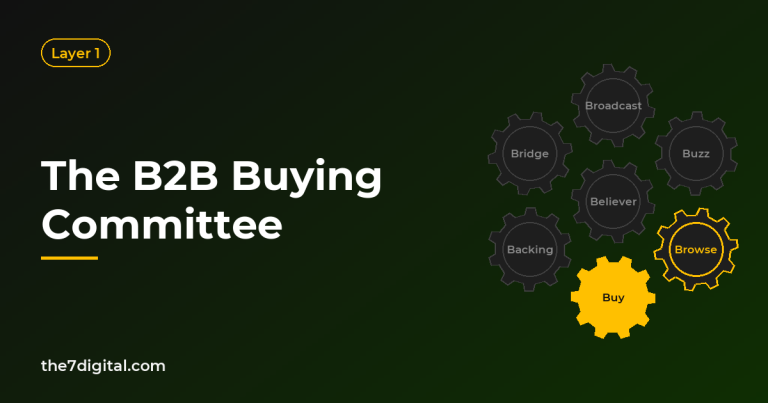
The first crack is the size of the table. According to Forrester (2026), the typical buying decision now includes 13 internal stakeholders and nine external influencers, and the count climbs for complex or strategic purchases. A foreign supplier tends to add seats: someone for import and customs, someone for local standards and certification, sometimes a local distributor with a voice of its own. Every extra seat has to be persuaded in its own language, on its own terms.
The second crack is the list in the buyer’s head. Bain & Company (2026) notes that around 90% of buyers purchase from their Day 1 list, meaning the vendors already in their heads when the buying process starts. That list forms over years of trade press, peer conversations and association meetings, where local competitors play at home. A foreign entrant starts from zero, and often does not know it.
The third crack is distance, and it is not measured in kilometers. Writing in Harvard Business Review, Pankaj Ghemawat (2001) warned that companies routinely overestimate the attractiveness of foreign markets. His CAGE model measures the distance between two countries along four dimensions: cultural, administrative, geographic and economic (LibreTexts, 2023). Each one adds friction the sales map never shows: a different technical standard, a different payment habit, a different way of saying “not yet”.
The fourth crack is trust. Gartner (2023) found that B2B buyers value third-party interactions 1.4 times more than digital supplier interactions. In a new market, your website is a stranger introducing itself. Buyers believe local customers, testing bodies and partners they already know, and most of what those people say travels through dark social, where you are not present.
Buyers abroad are not more difficult. They decide inside a network you do not belong to yet, based on signals you have not sent. What you need is not a longer map with more stages but a machine that is present in many places at once.
Whose demand decides your order when your customer’s customer is abroad?
Here is a question I like to ask export teams: who is your customer’s customer? Almost everyone can describe the plant, carmaker or distributor placing the order. Far fewer can describe the end user at the bottom of the chain, where demand is actually born.
Economists have a name for this. In Principles of Economics, Alfred Marshall (1890) used the building trades to make the point: the demand for the labour of plasterers, he wrote, is only an indirect or derived demand, created by the demand for the house itself. Swap plasterers for components, software or logistics and you have most B2B firms. Your order is the shadow of a demand further down the chain. Abroad, that demand lives in another market, on another cycle, under other policies, so you have to listen to two layers of demand at once.
CATL: Selling batteries to drivers it will never meet
The clearest example I know is CATL, the Chinese battery maker. Its direct customers are carmakers, but how many shifts a European battery plant runs depends on whether Europeans buy electric cars.
In 2019, BMW Group announced it was raising its CATL battery cell order from four billion euros, announced in mid-2018, to 7.3 billion euros for a contract running from 2020 to 2031, and said BMW was the first customer of the CATL cell plant then under construction in Erfurt, Germany (BMW Group, 2019). Notice who is speaking: a German carmaker putting its own name in its own press release. For an Asian supplier entering Europe, that is proof no advertising budget can buy.
Three years later, CATL announced that CATT, its first plant outside China, in the German state of Thuringia, had started serial production of cells on schedule, and that the locally produced cells had passed all tests required of CATL’s products globally (CATL, 2022). Matthias Zentgraf, CATL’s president for Europe, said the production kickoff “proves that we kept our promise to our customers as a reliable partner of the industry.”
In December 2024, CATL and Stellantis announced up to €4.1 billion of investment in a 50-50 joint venture for an LFP battery plant in Zaragoza, Spain, targeting production by the end of 2026 and up to 50 GWh of capacity (Stellantis and CATL, 2024). The telling part is the condition: that capacity is subject to the evolution of the electrical market in Europe and continued support from Spanish and EU authorities. A multi-billion-euro B2B plant states in writing that its scale depends on people buying cars.
Those car buyers are moving. According to ACEA (2026), 1,880,370 new battery-electric cars were registered in the EU in 2025, a 17.4% market share, up from 13.6% a year earlier. Each percentage point is an order for a carmaker, and then a cell order for a supplier like CATL.
In September 2025, in Munich around IAA Mobility, CATL launched its Shenxing Pro battery for Europe and described its path as moving from exporting batteries “to Europe” to building “in Europe, for Europe”. The company said it had invested over €11 billion in European operations and presented a version with 9% degradation after the first 200,000 km, tailored to Europe’s leasing markets (CATL, 2025).
Put together, those milestones show a B2B supplier selling to more than a purchasing team. It sends signals where the European auto industry gathers, speaks in numbers that drivers and leasing firms care about, builds plants near its customers and lets those customers speak for it.
How do the seven gears turn when the buyer is in another country?
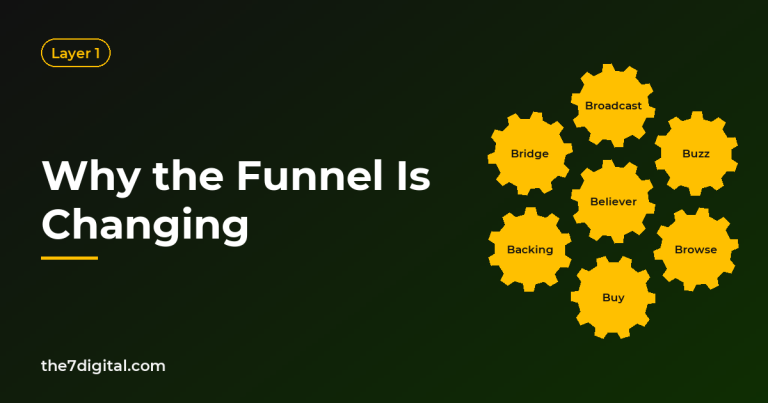
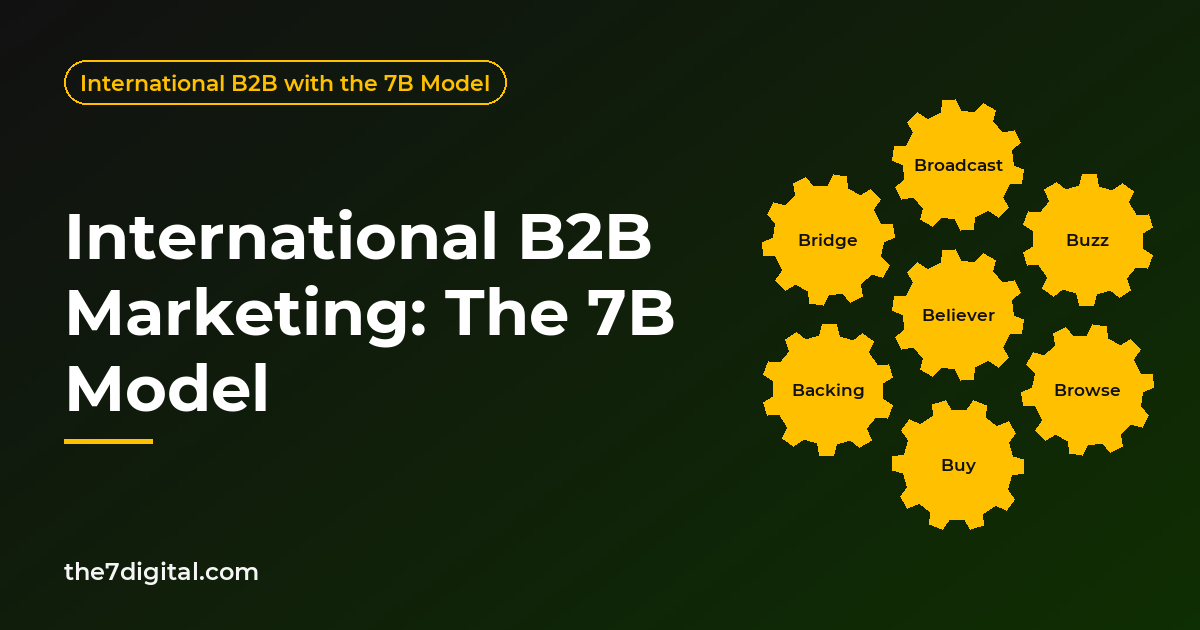
The 7B Model replaces the straight line with seven gears that turn at the same time for the whole market. Abroad, the gears keep their names, but each one turns differently. Here they are, with the model’s standard definitions.
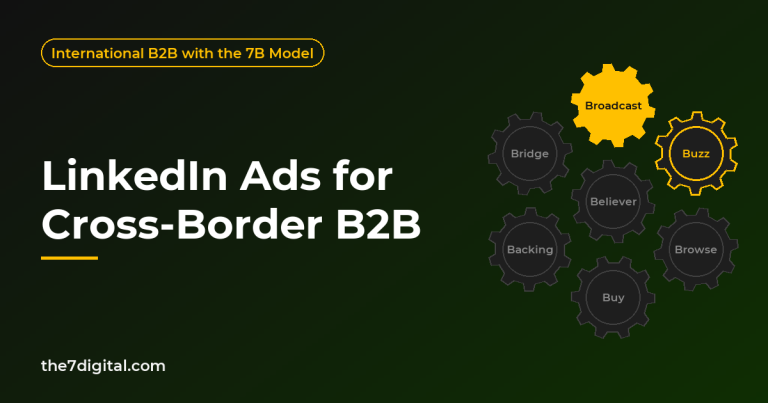
Broadcast: Seeding valuable presence into the market, clear, steady and sharp enough that the right people know you exist. Across a border, “the right people” is harder than “steady”: it means the language they read at work, the channels they use and the events they attend. CATL did not launch its battery for Europe in China; it launched it in Munich. For a foreign firm entering Vietnam, Broadcast starts with a small question that decides a lot: in which language does the plant engineer read a datasheet?
Buzz: The market answers back: people discuss you and mention your name, mostly in dark social. Abroad, that dark social speaks another language, runs on other messaging apps and lives inside associations you have not joined. Your job is to give insiders something worth forwarding: a standards comparison, a cost analysis, a test video. Forwardable material crosses borders faster than any business trip.
Browse: Where emotion meets reason: buyers verify and compare you through six gateways. The six are search engines with their summarized answers, conversational AI, specialist review platforms, LinkedIn, YouTube and podcasts, and communities and forums (Mô hình 7B cho B2B book, chapter 8). Even the first gateway changes from country to country.
In October 2026, Google held 93.38% of search in Vietnam, but in South Korea Naver still held 42.25%, and in China Baidu held 49% against Google’s 6.83%, according to StatCounter (2026). A site tuned only for Google works in one market and is close to invisible in another.
The AI gateway ignores borders. G2 (2026) found that 51% of B2B software buyers start their research with an AI chatbot more often than with Google. That is a narrow buyer group, but the point travels: an accurate AI answer, like a good YouTube video, can work in several countries at once.
Buy: A process of many people and many rounds; a door, not the final wall. Across borders, the rounds multiply: samples, certification, payment terms and currency, a check with a local partner. Culture changes how much each seat weighs, as the cross-cultural buying council explains. Do not treat a “very positive” call with your champion abroad as a round completed. Ask who else must agree, where, and under which procedure.
Believer: Customers who do not just buy but believe, through real experience after the deal. With a distant customer, real experience includes delivery times, spare parts, technical support in their time zone and documentation in their language. Zentgraf’s line matters because it is about keeping a promise, not about features. A foreign buyer takes on risk by choosing you, and Believer is where you give that peace of mind back.
Backing: Customers, the ecosystem and AI speak up on your behalf. It is the gear firms selling abroad lack most and need most. BMW naming itself the first customer of CATL’s German plant is Backing in its strongest form: a local name vouching for a newcomer. Certificates from international testing bodies, analysis in the local trade press and the answer an AI assistant gives in the buyer’s own language are Backing too.
Bridge: Customers bring in others through referrals, communities and partners, and the flywheel amplifies itself. In a new market, Bridge often comes before Broadcast: a distributor, an integrator or a joint venture opens doors faster than any campaign. CATL’s venture with Stellantis is Bridge at industrial scale; for a smaller firm, it may be one customer in Thailand who mentions you to its sister plant in Vietnam. A distributor is a gear you rent, though, and choosing international B2B channels explains why you still have to own Broadcast and Backing.
How do the three layers and three energy flows apply when you sell abroad?
The 7B Model groups the seven gears into three layers, demand creation, amplification and demand capture, with Believer as the loop that connects them. The reason for the grouping is the 95/5 rule, which I will not repeat here. The question is what the grouping changes when your market is in another country.
Many firms entering a new country put almost everything into demand capture: trade shows, B2B marketplaces, tenders. That layer matters, but it is the hardest game for a newcomer, because buyers who are already searching have a Day 1 list without your name on it. You end up competing on price with suppliers the buyer already knows, and a lower price rarely offsets the risk of an unfamiliar name.
The Mô hình 7B cho B2B book splits resources by starting point, by default roughly 40% to demand creation, 30% to the loop and amplification and 30% to demand capture, and says plainly that this is the author’s working rule, not a ratio that fits every company (Mô hình 7B cho B2B book, chapter 5). Across borders, I read it market by market. A market with long-standing customers can lean toward amplification. A brand-new market needs early investment in demand creation, because nobody searches for a name they have never heard, provided a curious buyer has somewhere to verify you.
The three energy flows, paid, owned and earned-and-shared, cross borders at different speeds. Paid is fastest: a campaign can reach the right job titles in another country from day one. Owned is slower, because content has to be rebuilt in the local language with local proof. Earned-and-shared is the hardest and the most valuable, because it only flows once customers or partners in that country talk about you.
That is why the book recommends spending to amplify content rather than sales pitches: money goes first to valuable content and the pitch comes later, while Browse keeps enough paid presence to be there when buyers search (Mô hình 7B cho B2B book, chapters 5 and 7). A sales ad from an unknown name is easy to scroll past, while a useful analysis that reaches the right person is the most courteous way to ask for a place on the Day 1 list. Splitting that budget by country is the subject of allocating cross-border B2B ad budgets.
Then there is time. The book describes three months of sowing, six months to see shoots and twelve months to see fruit (Mô hình 7B cho B2B book, chapter 5). I see no reason to expect faster results in unfamiliar soil. A board that judges a new country after a single trade show is pulling up the plant to check its roots.
What does Chaos Logic Theory say about cross-border buying journeys?
The theory underneath the 7B Model is Chaos Logic Theory: You cannot predict which touchpoint triggers a decision, but you can design a system in which any touchpoint can. In the opening scene, the trigger was a mention at a sister plant in Thailand, which appeared in nobody’s plan.
The invisible part of the journey is growing. According to Dreamdata (2026), 81% of the B2B customer journey now happens outside the sales pipeline, up from 70% the year before, and buyers have an average of 88 touchpoints, up from 76. The data comes from Dreamdata’s own customers, and Dreamdata sells measurement software, so treat it as a directional signal rather than a benchmark.
It fits a survey of B2B buyers in North America, Europe and Asia-Pacific by 6sense (2025): 94% of respondents had ranked their shortlisted vendors by preference before contacting any vendor, and they ultimately bought from their top-ranked vendor 77% of the time. Across borders, the part of the journey before first contact runs through languages and relationships your home team cannot see.
Chaos Logic Theory does not tell you to give up in the face of that. It tells you to stop guessing and start designing, so that every market has enough touchpoints for any one of them to become the trigger: a Vietnamese-language datasheet, a technical seminar with a distributor in Thailand, an accurate AI answer about the standards you meet, a customer willing to take a prospect’s call. You cannot know which point will fire. You can know which points are still empty.
In what order should you read the other 23 articles?
The series uses Professor Dae Ryun Chang’s International B2B (Business to Business) Marketing course from Yonsei University on Coursera as a topic map, and borrows his cross-country, cross-industry lens, which he calls CCCI. It does not follow the course order. It follows the gears and operating layers of the 7B Model, in six parts.
| Part | Main gears | The question it answers |
|---|---|---|
| I. The cross-border buying table | Browse, Buy | Who decides, and how, when they sit in another country? |
| II. Creating demand across borders | Broadcast, Buzz | How do the right people abroad learn that you exist? |
| III. Value and decisions | Browse, Buy | What value does each seat see, and what price will it accept? |
| IV. Trust and amplification | Believer, Backing, Bridge | How do foreign customers speak for you and bring in others? |
| V. Into new markets | All seven | Which country, which entry mode, what to keep and what to rebuild? |
| VI. Running the machine | Three energy flows | How do you split money and work by market? |
Parts I and II. Start with the cross-cultural buying council, then the theory behind nonlinear buying, early vendor involvement and building a B2B marketing team, where the 7B Gear Captain Matrix gives each gear an owner. Part II opens with push and pull in B2B, the sequel to the CATL story, and from AIDA to 7B, then covers three channels: LinkedIn Ads for cross-border B2B, YouTube for B2B and trade shows in the 7B machine.
Parts III and IV. The total product in B2B, five buyers, five products with the 7B Buying Table Map, total cost of ownership, cost-to-serve and unbundling and the channels article cover value and decisions. Part IV turns to trust: relationships in Asian B2B, Rolls-Royce sells flying hours, borrowing from other industries and cross-industry growth.
Parts V and VI. Choosing international markets introduces the 7B Market X-Ray, which scores which gears turn and which stick in each country. Export, license or joint venture picks an entry mode by the gears you must keep in your own hands, and standardize or localize uses the 7B Equivalence Map to decide what to rebuild. The series closes with the budget article and the one-page 7B strategy, one page per market.
Short on time? If you are choosing a country, start with Part V. If deals abroad keep stalling, read Parts I and III. If you have customers abroad but no referrals, read Part IV. In series order, the next article is the one on the cross-cultural buying council.
Where does international B2B marketing fit in the 7B Model?
International B2B marketing does not sit in one gear. It is the whole machine, multiplied by the number of markets you sell into. Each country has its own seven gears turning at their own speed, and a gear that turns well in Germany guarantees nothing in Vietnam.
So the core definition for this article is the three operating layers: Demand creation (Broadcast, Buzz), amplification (Backing, Bridge), demand capture (Browse, Buy); Believer is the connecting loop. For a firm selling abroad, each layer is a question to answer country by country. Do the right people there know you yet? Does anyone there speak for you? Can buyers who search find and verify you? Do your existing customers want to tell the story?
The two operating principles fit cross-border selling closely: Customers can enter anywhere; one stuck gear slows the whole flywheel. A buyer abroad may arrive through a distributor, a trade press article or an AI answer, and a single stuck gear in one country, such as no technical documentation in the local language, is enough to slow that whole market.
The machine runs on three energy flows: Paid, owned, earned-and-shared. The loyalty loop turns one opened market into a springboard for the next: Believers create Backing, Backing creates Bridges, and Bridges bring new people back into Broadcast, Browse and Buy. A satisfied customer in Thailand can be your bridge into Vietnam.
The series introduces five named tools for running that machine market by market: the 7B Gear Captain Matrix, the 7B Buying Table Map, the 7B Market X-Ray, the 7B Equivalence Map and the One-Page 7B Strategy. Every term is defined in the 7B Glossary.
The 7B Model was developed by Nguyen Dinh Bao (Bao7) at The7 Digital and is set out in full in the book Mô hình 7B cho B2B (Stop Begging, Start 7B). If the model is new to you, what the 7B Model is is the best place to start.
Selling B2B into Vietnam and ASEAN
Start with what Vietnam buys. Goods classed as means of production made up 93.6% of Vietnam’s merchandise imports in 2025, worth US$426.11 billion, according to the National Statistics Office of Vietnam (2026). The country mostly imports what businesses use to produce, which makes it a B2B market first. It is also accelerating: GDP grew an estimated 9.01% year on year in the first nine months of 2026, and foreign investment registered in the year to September 30, 2026 reached US$50.36 billion (National Statistics Office of Vietnam, 2026). Every new plant forms buying committees that have not heard of you yet.
Browse in Vietnam runs through Google, which held 93.38% of search in October 2026 (StatCounter, 2026). Video reaches much further than LinkedIn: DataReportal (2025) counts 62.1 million YouTube users in Vietnam in late 2025, against 10.0 million LinkedIn members. LinkedIn reaches the leadership seats, but a plan built only around it may miss the engineers who will judge your trial. Vietnamese-language video and search content can reach them.
Buy follows the shape of the culture. On Hofstede’s model as published by The Culture Factor, Vietnam scores 70 on power distance, meaning hierarchy is accepted and centralisation is popular, and 30 on individualism, a collectivistic society in which work relationships are seen in moral, family-like terms. Expect the final word to sit high in the organization, and expect trust to travel through in-groups. A respected local partner or customer who vouches for you does work no deck can do, and in Vietnam that Backing often has to come before the first meeting rather than after the last one.
ASEAN is ten machines, not one. The e-Conomy SEA 2025 report from Google, Temasek and Bain & Company, the first edition to cover all ten Southeast Asian countries, says the region’s digital economy is poised to surpass $300 billion in 2025 (Google, Temasek and Bain & Company, 2025). The bloc’s goods trade rose from US$2.2 trillion in 2015 to US$3.8 trillion in 2024, US$822 billion of it among ASEAN members themselves (Ministry of Industry and Trade of Vietnam, 2025). The scale invites one regional plan, yet language, search habits and buying cultures change at every border. Run a 7B Market X-Ray per country before you budget per region.
Finally, design the Believer gear around paperwork. EuroCham’s Business Confidence Index for Vietnam stood at 78.3 in Q3 2026, and the obstacle respondents cited most often was administrative procedures and paperwork, at 60% (EuroCham Vietnam, 2026). A supplier who takes care of import documents, certification files, bilingual contracts and Vietnamese-language manuals removes the friction businesses here complain about most, and that is the experience customers remember when someone asks them for a referral.
Conclusion: every market is a machine of its own
Back to Ho Chi Minh City. Your team did nothing wrong: it presented well, sent the proposal on time and followed up politely. It simply used a straight-line map in a market that does not move in straight lines, and read silence as a delay instead of a signal. The winning competitor was already inside the network, through a sister plant that spoke on its behalf.
Selling B2B internationally is not about exporting your home machine. It is about building a machine for each market from shared gears: the same philosophy and core content, but a different language, different verification gateways and different people speaking for you. Accept that early and you stop asking why buyers abroad go quiet, and start asking which gear in that country is stuck.
That machine needs someone to run it. Many firms keep the core in-house, meaning product, expertise and customer relationships, and outsource the paid side of Broadcast and Browse in each country. If you want one team running LinkedIn, YouTube, Google Search and retargeting as a single machine, reported with four signals instead of clicks, that is what The7’s comprehensive digital marketing services are for. If you only want a second pair of eyes, book a 7B X-ray of the market you are targeting.
The next article in the series, the cross-cultural buying council, starts at that same table. If you want the foundations first, read about dark social and mental availability, the two ideas every article in the series builds on.
Frequently asked questions
How is international B2B marketing different from domestic B2B marketing?
In three ways. The table is bigger: Forrester (2026) puts the typical decision at 13 internal stakeholders and nine external influencers. Dark social runs in languages and channels the seller cannot see. And each market has its own verification gateways, so the machine has to be built country by country.
Which gear should a foreign B2B firm start with in a new market?
Get Browse ready first, then invest early in Broadcast. Buyers in the new market must be able to find and verify you in their own language, with third-party proof. Once that is in place, useful content that reaches the right people gradually puts your name on their Day 1 list.
Do I need a separate marketing plan for each ASEAN country?
Yes, but not one built from scratch. Keep the philosophy and core content, and rebuild what depends on the market: language, verification gateways, proof and the buying process. English proficiency alone varies widely: in the EF English Proficiency Index 2025, Malaysia ranked 24th while Thailand ranked 116th (EF Education First, 2025).
What does Chaos Logic Theory mean for cross-border sales?
It means you cannot predict which touchpoint will trigger a decision, but you can design a system in which any touchpoint can. Across borders, most touchpoints sit outside the seller’s view, so the job is to cover enough of them in each market instead of drawing one standard buying journey.
International B2B with the 7B Model · Part 1 of 24 · Next: The Cross-Cultural Buying Council
References
- Forrester (2026). Forrester’s 2026 Buyer Insights: GenAI Is Upending B2B Buying As Leaders Face Mounting Pressure To Justify Every Dollar Spent (release on The State Of Business Buying, 2026). https://www.forrester.com/press-newsroom/forrester-2026-the-state-of-business-buying/
- Bain & Company (2026). Raising the Odds on a Deal: How Likelihood to Buy Rewires B2B Growth. https://www.bain.com/insights/raising-the-odds-on-a-deal-how-likelihood-to-buy-rewires-b2b-growth/
- Pankaj Ghemawat (2001). Distance Still Matters: The Hard Reality of Global Expansion. Harvard Business Review. https://hbr.org/2001/09/distance-still-matters-the-hard-reality-of-global-expansion
- LibreTexts (2023). International Business, section 8.4: CAGE Analysis. https://biz.libretexts.org/Bookshelves/Business/Advanced_Business/International_Business_%28LibreTexts%29/08%3A_Chapter_8/8.05%3A_Section_5-
- Gartner (2023). Gartner Marketing Survey Finds B2B Buyers Value Third-Party Interactions More Than Digital Supplier Interactions, as reported by CIO Tech Asia: B2B buyers place greater value on third-party interactions. https://ciotechasia.com/b2b-buyers-place-greater-value-on-third-party-interactions/
- Alfred Marshall (1890). Principles of Economics, Book V, Chapter VI: Joint and Composite Demand (8th edition, 1920, on Econlib). https://www.econlib.org/library/Marshall/marP.html?chapter_num=34
- BMW Group (2019). BMW Group forges ahead with e-mobility and secures long-term battery cell needs: total order volume of more than 10 billion euros awarded. https://newsroom.bmwgroup.com/global/bmw-group-forges-ahead-with-e-mobility-and-secures-long-term-battery-cell-needs—total-order-volume-of-more-than-10-billion-euros-awarded
- CATL (2022). CATL’s German plant kicks off cell production (PR Newswire release, as published by AAP). https://www.aap.com.au/aapreleases/cision20221221ae71587/
- Stellantis and CATL (2024). Stellantis and CATL to invest up to €4.1 billion in joint venture for large-scale LFP battery plant in Spain (as published by Automotive World). https://www.automotiveworld.com/news-releases/stellantis-and-catl-to-invest-up-to-e4-1-billion-in-joint-venture-for-large-scale-lfp-battery-plant-in-spain/
- CATL (2025). CATL Launches Shenxing Pro, Europe’s Optimal Solution for E-Mobility at IAA Mobility 2025 (PR Newswire release, as published by Kyodo News PR Wire). https://kyodonewsprwire.jp/release/202509084740
- ACEA (2026). New car registrations: +1.8% in 2025; battery-electric 17.4% market share. https://www.acea.auto/pc-registrations/new-car-registrations-1-8-in-2025-battery-electric-17-4-market-share/
- StatCounter (2026). Search Engine Market Share in Viet Nam, October 2026. https://gs.statcounter.com/search-engine-market-share/all/viet-nam
- StatCounter (2026). Search Engine Market Share in Republic Of Korea, October 2026. https://gs.statcounter.com/search-engine-market-share/all/south-korea
- StatCounter (2026). Search Engine Market Share in China, October 2026. https://gs.statcounter.com/search-engine-market-share/all/china
- G2 (2026). The Answer Economy: How AI Search is Rewiring B2B Software Buying (G2 2026 AI Search Insight Report). https://learn.g2.com/g2-2026-ai-search-insight-report
- Dreamdata (2026). Announcing The 2026 LinkedIn Ads Benchmarks Report by Dreamdata. https://dreamdata.io/blog/announcing-linkedin-ads-benchmarks-report-2026
- 6sense (2025). 2025 Buyer Experience Report, as summarized by David Dodd on CustomerThink: Research Round-Up: 6sense Study Provides Critical Insights on B2B Buyer Behavior. https://customerthink.com/research-round-up-6sense-study-provides-critical-insights-on-b2b-buyer-behavior/
- Dae Ryun Chang, Yonsei University (n.d., accessed 7 November 2026). International B2B (Business to Business) Marketing, Coursera. https://www.coursera.org/learn/b2b-marketing
- National Statistics Office of Vietnam (2026). Báo cáo tình hình kinh tế – xã hội quý IV và năm 2025 (Socio-economic situation report, Q4 and full year 2025). https://www.nso.gov.vn/du-lieu-va-so-lieu-thong-ke/2026/01/bao-cao-tinh-hinh-kinh-te-xa-hoi-quy-iv-va-nam-2025/
- National Statistics Office of Vietnam (2026). Một số nét chính tình hình kinh tế – xã hội quý III và 9 tháng năm 2026 (Highlights of the socio-economic situation, Q3 and first nine months of 2026). https://www.nso.gov.vn/bai-top/2026/10/mot-so-net-chinh-tinh-hinh-kinh-te-xa-hoi-quy-iii-va-9-thang-nam-2026/
- DataReportal (2025). Digital 2026: Vietnam, by Simon Kemp. https://datareportal.com/reports/digital-2026-vietnam
- The Culture Factor Group (n.d., accessed 7 November 2026). Country comparison tool: Vietnam (Hofstede’s cultural dimensions). https://www.theculturefactor.com/country-comparison-tool?countries=vietnam
- Google, Temasek and Bain & Company (2025). e-Conomy SEA 2025, as announced on Google’s The Keyword blog by Sapna Chadha. https://blog.google/around-the-globe/google-asia/sea-economy-2025/
- Ministry of Industry and Trade of Vietnam (2025). Review of the Implementation of the ASEAN Economic Community Blueprint 2025 (VNTR portal, citing the ASEAN Secretariat). https://vntr.moit.gov.vn/news/tong-ket-trien-khai-ke-hoach-tong-the-cong-dong-kinh-te-asean-2025
- EuroCham Vietnam (2026). EuroCham Business Confidence Index Q3 2026: Translating Economic Gains Into Business Opportunities. https://eurochamvn.org/eurocham-business-confidence-index-q3-2026-translating-economic-gains-into-business-opportunities/
- EF Education First (2025). EF English Proficiency Index 2025: Malaysia. https://www.ef.com/wwen/epi/regions/asia/malaysia/
- EF Education First (2025). EF English Proficiency Index 2025: Thailand. https://www.ef.com/wwen/epi/regions/asia/thailand/